|
Do you have a favorite song and want to be able to play it on the organ? In order to do this, you will have to create an organ arrangement to adapt the song to the organ texture. In this article, I will show you 8 steps in making an organ arrangement from a song.
1. Notate the melody of the song in a stave notation. You can use a recording as your foundation for notating or sheet music of the original song. 2. Harmonize the song in 4 parts keeping the tune in soprano. Keep the original harmonies and chords or add your own harmonization. In order to be able to harmonize a tune, you will have to know the basic rules of harmony and voice-leading. 3. Add figuration in the accompaniment for more variety. The figuration can be melodic, rhythmic or both. A good example of figuration could be arpeggio, scalar passages based on chords. You can also add non chordal tones, such as diatonic or chromatic passing tones, neighbor tones, appogiaturas etc. 4. You can put the tune in the tenor of your harmonization. An interesting arrangement will have the melody of the song in the tenor voice played by the left hand while the right hand takes soprano and alto. The bass will be played by the pedals. 5. Notate the introduction, interludes, and conclusion. You can do this step either from the original or creating your own. Your arrangement will be incomplete without these structural parts of the composition. Again, use the original harmonies or create your own. 6. Write in the registration. Consider this point carefully and think which stops can be most useful in bringing out the tune? If the tune is in the right hand, softer reeds, compound stops and mutation combinations will sound very well. If the tune is in the left hand, play it on a reed. Use softer stops, such as flutes for the accompaniment. 7. Add dynamics. Once your harmonization, figuration, introduction, interludes, and endings are complete, notate the proper dynamics. Think about the culmination point of your song which often is the loudest part of the piece. 8. Add phrasing. Your arrangement also has to have phrasing markings. These are lines which connect several measures into one phrase. Usually a sign for the ending of the phrase is a breath mark (caesura), a rest, a long note, repetition of rhythmical figures, change in texture, change in dynamics etc. Use the above steps to create your own unique and original organ arrangement of any song of your choice today. You will definitely have fun and learn many new things in the process. Once the arrangement is complete, you can impress your friends or family by learning to play it on the organ. By the way, do you want to learn to play the King of Instruments - the pipe organ? If so, download my FREE video guide: "How to Master Any Organ Composition" in which I will show you my EXACT steps, techniques, and methods that I use to practice, learn and master any piece of organ music.
Comments
Many organists have a dream of one day becoming an organist of international level. They want to be able to tour the world extensively by giving organ concerts in the most famous cathedrals and concert halls of the world. Such a successful organist career gives possibilities to play interesting and important organs in various countries, meet new audiences, and showcase your organ skills for a large number of people. In this article, I will give you 15 tips which will help you in becoming an international concert organist.
1. Commit to practicing organ playing every day. Regular and wise practicing is vital in any organist career. 2. Develop an excellent finger and pedal technique on the organ. This is a critical step. You must have the ability to perform any technical feat which may be encountered in any organ composition. 3. Master a large amount of organ repertoire. Learn the most important pieces from the Renaissance, Baroque, Classical, Romantic, and Modern periods of various national schools of organ composition. 4. Participate in various international organ academies and master classes. This will help you to advance your technical and artistic level, try new instruments, and make lots of personal connections. 5. If your age permits, participate in various local and international organ competitions. Winning major international organ competitions is the fastest road to success. Even if you don't win, the proper preparation and participation will propel you to the next level of advancement. 6. Make important personal and professional connections with organists across the globe. Use social media channels to increase the number of your friends in organ world. 7. Think about how you can be unique among other organists. Because the competition in the international organ scene is so huge, this is crucial point. You must find an angle which will help other people to perceive you and your skills in a different light from others. 8. Consistently market yourself as an organist. Use Facebook, Twitter, YouTube, LinkedIn, and other social media channels to regularly spread the word about your professional achievements, activities, and engagements. However, be careful not to spam. All ways aim that your postings be of value and interest others first. 9. Create a personal website. Your website must make easy for your visitors to get more information about you. 10. Record video and/or audio samples of your playing. Your best recordings and videos will testify your advancement level. 11. Prepare unique and attractive program. Think of your audience, particular instrument as well as the concert organizers as you create a list of the organ pieces you want to put together for a recital. 12. Research and compile a list of possible organ concert venues and festivals. Use the Internet to find various churches, cathedrals and concert halls which offer international organ recital series. 13. Write an attractive recital proposal. Everything from a Subject line (a title) to introduction, body of your message and a call-to-action is important to keep the interest of your readers. If you fail but one detail, chances are that your email will end up in the spam or junk folder. 14. Send this proposal to your personal connections and a list of concert venues and festivals. Use your list you compiled in step 11 to spread your message. 15. Repeat previous steps as many times as you want. Remember, that personal development and marketing is an ongoing task so the more consistent effort you put into action the better chances you have to succeed. Don't expect to receive tons of offers from your first email. People have to trust you, they must have confidence in you and this takes time and persistence from your part. There is much more you can do which can help you to become an international known organist. But these are the most important things. Although it takes many months to successfully complete this step-by-step plan, you can begin to implement it today. By the way, do you want to learn to play the King of Instruments - the pipe organ? If so, download my FREE video guide: "How to Master Any Organ Composition" in which I will show you my EXACT steps, techniques, and methods that I use to practice, learn and master any piece of organ music. Many modern and eclectic organs are equipped with a crescendo pedal which is sometimes a necessary tool in creating dynamics in certain type of organ music, especially from German Romantic period, such as music by Liszt, Reger, Rheinberger, Karg-Elert and others. Some pieces from the modern times also are suited for crescendo pedal. Although you can perform this music without the use of this pedal quite successfully, knowing how to employ it can be very beneficial to the organist. The crescendo pedal facilitates the registration changes that can be achieved by the organist alone. In this article, I will give you 8 tips on using crescendo pedal on the organ.
1) Prepare in advance. Because the use of crescendo pedal is a new skill that an organist has to learn, it is best to plan your practice and include the necessary drills in advance. I do not recommend taking it for granted during the recital or any other performance in public. 2) Practice repeatedly. Locate the place in your music score which requires the crescendo pedal and play it over and over in a slow tempo to gain automation and freedom. 3) Imagine crescendo pedal and practice. If your organ does not have this pedal, you can also pretend that it is there, put the right foot in place and push it back and forth when appropriate as if it was for real. 4) Practice using any foot. Although the right foot is the most often used foot for making crescendo, sometimes there is a need to manipulate a pedal with the left foot as well. It depends on which foot is busy at the moment. 5) Adjust the pedaling. If the pedal line allows, it is a good idea to write in your pedaling for the left foot so that the right foot would be free to use the crescendo pedal. 6) Avoid sudden movements of the foot. When you press this pedal, try to be sensitive and feel how much movement you have to use because the more force you use, the more dynamic contrast you will create. 7) Aim for gradual crescendo during a single passage. Very often there is a need to make gradual dynamic changes when there are no sudden changes in texture over the course of the piece. However, during section breaks, according to the wish of the composer, contrasts, such as FF-pp often are quite necessary. 8) Programmable crescendo pedal. Some organs with electro-pneumatical action are equipped with the pedal you can program in advance according to your taste. This means that you can even adjust the way and order this pedal adds the stops and make your crescendo and diminuendo even smoother. If your organ music requires the use of crescendo pedal, use the above tips to incorporate it in your practice today. By learning how to manipulate this pedal you will gain the necessary freedom on the organ bench and there will be no need for an assistant to change the registration for you in many cases. By the way, do you want to learn to play the King of Instruments - the pipe organ? If so, download my FREE video guide: "How to Master Any Organ Composition" in which I will show you my EXACT steps, techniques, and methods that I use to practice, learn and master any piece of organ music. How to Practice Classical Organ Music on the Spinet Electronic Organ With the Short Pedal Board?5/10/2012 Although much of classical organ music requires the full length of pedal board, not every organist have access to this kind of instrument, either pipe organ or electronic organ. Many people have Spinet electronic organs at home and they have to solve the pedal playing problem because Spinet organ pedal board have only 13 keys (C-c). For organists who practice on various kinds of electronic organs, such as Spinet, adjusting to the short pedal board is a very important question. In this article, I will give you 2 solutions for practicing classical organ music on the Spinet electronic organ with the short pedal board.
In general, it depends on what kind of music you are working on. There is plenty of organ music which was written for manuals only. Obviously, to play such music on the Spinet organ is no problem at all. In addition, a significant part of early organ repertoire was composed with a short pedal board in mind. For example, Italian organs for many centuries didn't have a full pedal board so anything Italian would work fine on a Spinet organ. The question remains what to do with the classical organ music, like the music of Bach which often requires 27 note pedal board (sometimes even 30) In general, for music which requires the full compass of pedal board you have only 2 options: 1) To arrange the pedal part so that it will fit the short compass of the Spinet. For example, notes in the pedal part above tenor c would have to be played one octave lower. Sometimes an entire excerpt might be played one octave lower. If you have to play notes from c sharp up to f in the treble octave, you can lower them by two octaves. In doing so, you may also have to adjust the pedaling. For example, this could mean that using the right foot on the Spinet organ might be complicated so the majority of notes should be played by the left foot. 2) To play as written, imagine the additional pedals, and press the approximate spot on the floor. It is also possible to add a wooden board on the floor of approximate the same height as the Spinet pedals so that you will have the same feeling while playing with your feet. In addition, you can draw the missing pedals on this board so that you will know exactly where to play. If you want to play classical organ music on the Spinet electronic organ, use the above tips for pedal playing. It is also a good idea from time to time to get access to the real pipe organ. Occasional practice on a full length pedal board will allow you to have the correct feeling for your feet. By the way, do you want to learn to play the King of Instruments - the pipe organ? If so, download my FREE video guide: "How to Master Any Organ Composition" in which I will show you my EXACT steps, techniques, and methods that I use to practice, learn and master any piece of organ music. For a long time many of my students have been asking me to prepare a practice score of "Jesu, Joy of Man's Desiring", BWV 147/10 by J.S.Bach so that they could learn to play it on the organ.
As you know, it is such a wonderful piece and both organists and listeners love it. It sounds so sweet and is a perfect work to prepare for weddings, communions, and other joyful and/or meditative settings. If you are interested in learning this composition without an instructor, you will need much knowledge concerning fingering, pedaling, articulation, registration, tempo, ornaments etc. Most importantly, you will have to know the steps which are necessary to master this work. To help you with your practicing, I have prepared an EXACT step-by-step plan so that your learning process will be smooth, fun, easy, and fast. Check out my brand new practice score of "Jesu, Joy of Man's Desiring", BWV 147/10 by J.S.Bach. This score will teach you how to master this fantastic piece in 10 days or less while working only 30 minutes a day. And of course, like with my other practice scores, you will find complete fingering and pedaling of this piece. Get the practice score of "Jesu Joy of Man's Desiring" Perhaps you are thinking if this practice score is right for you? Go ahead and get it now, don't worry, if you are not completely satisfied, I will give you 30 days money back guarantee! Get the practice score of "Jesu Joy of Man's Desiring" Creating a CD recording of your organ music can be a great gift to your friends and family. They will appreciate your playing and treasure your gift for years to come. In order to successfully complete the recording project, you will need to know certain things that are crucial in making a CD recording. In this article, I will give you 21 steps in making a CD recording of your organ music.
Concerning a CD recording, you will need to complete the following steps: 1) Decide on the organ that you will use. 2) Decide on the pieces that you want to include in your recording. 3) Practice them and ideally memorize them. 4) Master them to be able to play them without mistakes. 5) Arrange a local sound engineer to record your playing. 6) Find an assistant or page turner. 7) Arrange the time with the sound engineer, assistant, and the building authority which will be free of distractions for recording. 8) Arrange the tuning of the organ. 9) Record your music (either in whole or in parts) - at least 3 versions of each piece. 10) Have your sound engineer to make a sample CD of all your pieces for you. 11) Analyze this CD, make notes on which version you like the most. 12) Get together with sound engineer for editing - keep the versions you decided in the previous step. 13) Pay the sound engineer. 14) Prepare the CD booklet - either by yourself or have others to do this. You will need the following information: your CV, several high quality photos of yourself and the organ, information about the pieces and composers, organ specifications and/or registrations if space is available. 15) Edit and format the CD booklet. 16) Have your sound engineer prepare a master CD for you. 17) Double check the contents of the master CD to make sure it is error free. 18) Find the service which manufactures CD's. 19) Submit your material to this company. 20) Pay the CD manufacturing company. 21) Pick up the CD. If you are planning recording on your own, you will not need Step 5. Remember only that professional recordings will have a higher sound quality. Also a professional sound engineer will have a possibility to edit your recordings, erase the parts which have mistakes, and put together several different versions of the same piece. Note that your recording project will be time-consuming so plan accordingly. By the way, do you want to learn to play the King of Instruments - the pipe organ? If so, download my FREE video guide: "How to Master Any Organ Composition" in which I will show you my EXACT steps, techniques, and methods that I use to practice, learn and master any piece of organ music. Perhaps the majority of organists would agree that sight-reading is a must for any organist. It is such a useful tool in organist's profession because we constantly are in need to play music at sight either as solo performers during liturgy or as accompanists for choirs, soloists, and instrumentalists. Having an unfamiliar score in front of you and knowing that it is quite out of reach for you is indeed one of the worst feelings an organist could have. To help you learn this skill, I will give you my personal recommendations on how to practice sight-reading.
First of all, I believe that this skill can be learned like any other skill we have to do. Some people believe that only geniuses can play anything at sight. We all have read stories about Bach's notorious ability to play new music with ease. However, we tend to forget how much Bach and other geniuses had to practice in order to achieve such heights. In fact, Bach himself admitted once that it is not possible to sight-read everything. Ideally a great musician should be able to sight-read compositions of medium level of difficulty with ease and fluency. To achieve this, we need to practice specifically sight-reading. It is a good idea to devote some 15 minutes of each practice session just for that. I think many people like playing organ pieces at sight. It gives them pleasure to hear new music every day. However, the success of sight-reading exercise depends on the playing speed, difficulty level of the composition, and organist's attention to detail. In fact, that's where many people fail. Ideally, we should feel no tension and stress when sight-reading. If we do, this means either our practice tempo is too fast or the difficulty level of the piece is too great or both. It is probably better at the beginning to play easy music at sight in a very slow tempo with no mistakes than to play it up to concert tempo but constantly failing in each measure. If sight-reading all parts together is too advanced, you can try playing separate parts and voice combinations. By the way, this is exactly the same method I use to learn new clefs. From there we can go into practicing music in open score notation and orchestral reductions. Find a collection of organ music of your level that you love and start sight-reading one page a day. If you practice according to the above suggestions, keeping in mind slow tempo, difficulty level, attention to detail, solo voices, and voice combinations, you will be surprised how much stronger your skill in playing new music will become. You just need to be very systematic about it and stick with it at least for several months. If you really want to develop unbeatable sight-reading skills, check out my systematic Organ Sight-Reading Master Course. To complete the practice material of this course will only take 15 minutes a day of practice but you will learn to sight-read any piece of organ music effortlessly. Organists who have some experience in ear training are at the advantage than those who don't. People with perfect pitch and advanced skill at analyzing musical scores can appreciate the compositions at a much deeper level. If you have never had a formal musical education or your education happened a long time ago, you can start improving your musicality and ear training today. In fact, it is possible to combine both ear training and organ practice. In this article, I will give you tips on how to achieve this.
One of the best ways for organists to integrate ear training exercises into their organ practice is to try to play polyphonic music, such as chorale preludes while singing one part and playing the others. For best results, do not double the voice that you are singing on the instrument. If you are new to such practice, take a really slow tempo at first. Aim for at least 3 correct repetitions of each version. If you make a mistake, stop and go back a few measures, and correct them 3 times in a row. Remember that you don't have to play and sing all parts together right away. To make this practice fun and easy, you can first sing each line of the piece without the help of an organ. Then practice 2 voices (one singing and the other playing). Later proceed to 3 parts and finally, learn all 4 parts (singing each line and playing 3 others). Singing separate parts while playing is a strenuous exercise but quite indispensable for a real education of musician. In fact, students sing this way in ear training classes. Of course, at the beginning they only sing one voice but from about 3rd year they start to practice exercises in two voices which are notated on one staff. They sing one voice and play the other and vice versa. With time the exercises get more advanced, melodies are notated in two staves, and the bass clef is introduced. The musical language gets more chromatic, with tonicizations, modulations, complex rhythms and time signatures. From about 9th year into ear training students start to sing in various C clefs. From the 10th year 3-part and 4-part writing is introduced. At the end of air training course, people start to sing polyphonic 3-part and 4-part compositions, which are basically excerpts from fugues. It probably seems like a huge amount of exercise material and it really is. The best way not to get overwhelmed by the complexity of music education is to aim low and set manageable goals. Focus on small achievements but practice regularly. And remember that with each step you master you move closer to your goal one step at a time. By the way, do you want to learn to play the King of Instruments - the pipe organ? If so, download my FREE video guide: "How to Master Any Organ Composition" in which I will show you my EXACT steps, techniques, and methods that I use to practice, learn and master any piece of organ music. Knowing how to register organ pieces is a very important skill every organist must develop. In applying this skill, we may have to use one approach for live performance, such as concert, recital, or church service. Sometimes a different approach is needed when we make a recording or a video. In this article, I will give you some ideas about organ registration for different occasions.
If we play in a live concert, we have to consider how the sound of the organ is perceived by the listneners whereas in making a recording there is an issue with microphone sensibility to pick up certain sounds. To illustrate the difference of these two situations, let's take an example of registering a chorale prelude "Ich ruf zu Dir, Herr Jesu Christ", BWV 639 by J.S.Bach from the Orgelbuchlein. Although this piece can be registered in a variety of ways, a good option would be to play the right hand part on Oboe 8' combined with Flute 8' (with or without the tremulant). If you are playing on a swell division, the swell box could be almost closed. Of course, it depends on the actual sound of these two stops and how they balance with the left hand part. The accompanying left hand part could be registered with Flute 8'. If this part sounds somewhat too weak compared with the right hand part, you can strengthen it with another soft stop of 8' such as Salicional 8'. The pedal part sounds best if we use soft 16' and 8' stops, such as Subbas 16' and Flute 8'. These stops are usually sufficient for this kind of texture. While this registration might work for a live concert or church service, we also need to be prepared to adjust it to work for recording. When recording, the balance also depends on the sensibility of the microphone. Some microphones seem to work better for higher pitched sounds. Therefore, sometimes for the recording I strengthen the bass a little with an extra 16' or 8' stop which in live performance might not be needed. The left hand part is also important to be audible though not too prominent. Since every organ is different, there are quite a few registration options with each instrument. The best way for you to go about this is to listen to 10 or more different recordings or videos of the piece, compare different registrations, critically think about them and decide what is your favorite and why. You might find several versions you like really well. Therefore, you can play the same piece with different registration on the same organ quite successfully. Just give it a try. Remember, the more registration options you know, the better. If you would like to know more about organ registration, I highly recommend The Registration of Baroque Organ Music by Barbara Owen. As Journal of the American Musical Instrument Society writes, "In this book, Barbara Owen has created a rich resource of historical information coupled with strategies for interpreting that information on today's instruments." Sixteenth Century Journal also adds that "... Barbara Owen has succeeded admirably in distilling three centuries of organ registration practice into a volume less than three hundred pages long.... Anyone with an interest in the history of the organ and its music... will not want to ignore this book." I personally use this book as a guide for most of my organ recitals. By the way, do you want to learn to play the King of Instruments - the pipe organ? If so, download my FREE video guide: "How to Master Any Organ Composition" in which I will show you my EXACT steps, techniques, and methods that I use to practice, learn and master any piece of organ music. Many beginner organists struggle with reading 3 staves of organ score. They have the obvious question - is it possible to look at all 3 of them simultaneously or is it better to pick one part and focus on it exclusively while playing the others from memory? Or perhaps is there another solution to this intricate problem? In this article, you will find some tips for your organ practice which will help you to read organ scores easier.
First of all, let me explain how people who struggle with sight-reading play from the organ score. Usually they look at the left hand part most of the time and play other parts almost from memory. This is especially true when they play pedals. Since pedals are the most difficult part to master, many have a tendency to look at the pedal board. This is not so great. Unless playing from memory, we should force ourselves to look at the organ score exclusively. So is it really possible to play the organ while looking at the 3 parts at the same time? In order to understand the complexity of this question, we need to know how our brain works. I have to say, that it is impossible for a human brain to process several different things simultaneously. We can pay real attention to only one thing at a time. We may think we can watch TV and eat at the same time, or drive a car and talk on the cell phone but in reality, our focus is always shifting from one task to another. The same rule is valid in organ playing, too. When we play from a 3-stave score, we have to constantly shift our attention from the right hand to the left hand to the pedals. So it's OK for you to play and look at the left hand stave. It is only natural to look at it while playing because normally it is more difficult than the right hand part (at least for right-handed organists). Perhaps even better is to shift our attention constantly from one part to another. For example, depending on the difficulty level of each part, you can focus on the left hand part in one measure and on the pedal part - in another. If there is a manual change in this piece, perhaps look at the part which has this change and so on. Remember that you will most likely behave differently when sight-reading and playing a composition which you know very well. The thing is the work you are sight-reading is completely unfamiliar to you and you will need to pay attention to many details and constantly shift your focus from one part to another. A little different story is with composition you know well. The deeper is your knowledge of this piece, the less you have to look at the score. Obviously, the piece you have already memorized does not require any looking or following the score at all. Since every person is different, you can discover by yourself where you look while playing by selecting two pieces of your choice. One composition has to be completely new and another - already mastered (memorization is not required). Compare your behavior and eye movements while playing each work. Finally, the more you play from the scores (both new and familiar), the better you will become at reading them. By the way, do you want to learn to play the King of Instruments - the pipe organ? If so, download my FREE video guide: "How to Master Any Organ Composition" in which I will show you my EXACT steps, techniques, and methods that I use to practice, learn and master any piece of organ music. |
 DON'T MISS A THING! FREE UPDATES BY EMAIL.
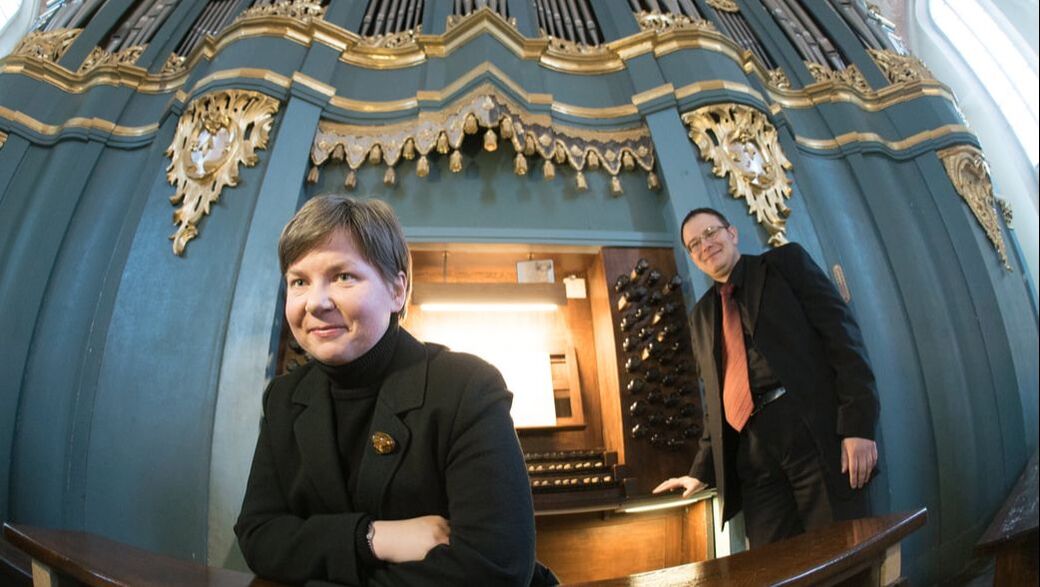 Photo by Edgaras Kurauskas Photo by Edgaras Kurauskas
Authors
Drs. Vidas Pinkevicius and Ausra Motuzaite-Pinkeviciene Organists of Vilnius University , creators of Secrets of Organ Playing. Our Hauptwerk Setup:

Categories
All
Archives
July 2024
|

 RSS Feed