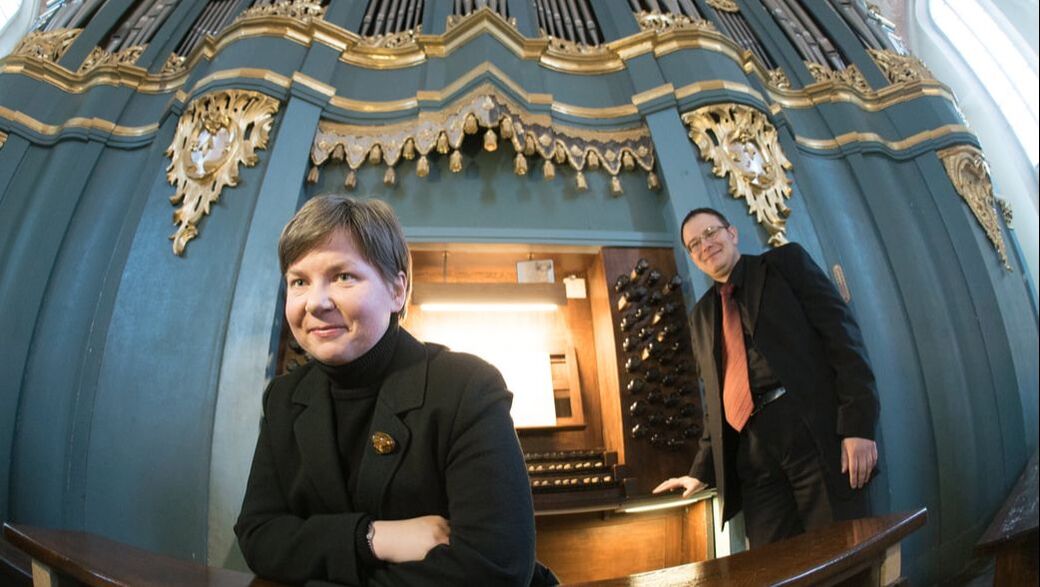
Quite often my organ students ask me how they can learn to play organ without looking down at their fingers. This is a common problem people face in the beginning stages of their organist career. First of all, let me say that it is not always a bad idea to look at the keyboard. If you play pieces from memory this is, of course, only natural. Where else should you look if there is no musical score present? However, if you play from the score, then it is best to look at the music (at least most of the time). Playing from the score develops your ability to sight-read music. However, playing from the score and looking down at your fingers will slow down your progress at least in one specific area: knowing your keyboard and feeling it. This is crucial if you want to be a truly good sight-reader. Without this ability the task to sight-read music in fast tempo will be too hard. In this article, I would like to share with you my personal recommendations how to learn to read music without looking at the keyboard. At this point, you have to understand why the beginners at the organ (or piano) always want to look down. You see, when we first start playing an instrument, we do not know where each note is located on the keyboard. In addition, usually we are slow on reading notes as well. All of this creates a situation, where we naturally want to see what exactly is we are pressing. Just think how you first learned to type on the computer. Unless you were trained professionally, at first, you probably used to type with just two fingers. You did not know (or remember) where each letter or character on the computer keyboard was located. Therefore, you looked at them and at the screen constantly. Now, if you have much more experience with typing, it is sufficient for you just to look at the monitor most of the time. Likewise, in reading music we first want to look down at our fingers. However, to facilitate your advancement, try to resist the temptation to look at your fingers. In other words, force yourself not to look down. Do not be discouraged if you hit the wrong notes; just remind yourself that developing this skill takes time. You see, the fingers have the ability to memorize the distances between the keys. Provided you are practicing regularly and resisting the temptation to look at the keyboard, after a few short months, you will already start feeling the difference in your progress. Developing this skill requires time. The great blind organists like Louis Vierne, Jean Langlais, Helmut Walcha and many others have been able to master such a complex art. If they could achieve that level being blind, we obviously have a chance, too. We just have to have patience and practice regularly. I hope you understand that there is no magical way to learn to sight-read music overnight. The amount of time needed to see the progress varies from person to person but I think that if you spend at least 30 minutes a day for 3 months practicing sight-reading wisely (more on that in Part 2), you will start to see some real changes. In 3 months that will be more than 44 hours of practice. Wouldn’t you think that you would be better at this skill if you had 44 hours of serious practice under your belt? Compare that to driving a car. After 44 hours of practical experience, we would still be at the basic level but certainly not freshmen anymore. I think that in my country they require 30 hours of driving with the instructor before you can take a driving exam. Anyway, you get the idea. Just keep practicing your organ music, stick to it for 3 months, and enter the next level after that. This article continues in Part 2. Here you will find more tips on how to get better at sight-reading without looking at your fingers. By the way, do you want to learn to play the King of Instruments - the pipe organ? If so, download my FREE video guide: "How to Master Any Organ Composition" in which I will show you my EXACT steps, techniques, and methods that I use to practice, learn and master any piece of organ music. CommentsLeave a Reply | Loading
Share This Page
First time visitor?
|