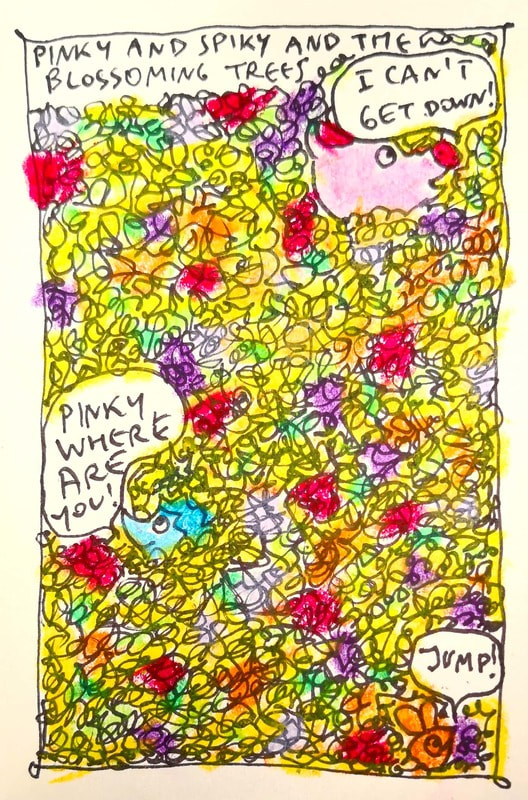
 Today I am going to talk about how can you become creative. This is a common question we all hear right? We all know that creativity is important, that creativity has amazing benefits to our life but the question is how to be more creative and my answer is very simple. You have to practice creativity every day. It’s just like cleaning your teeth or brushing your teeth or practicing any type of activity that you want to improve. So when you want to improve creativity you have to understand that the creative side of your brain is like a muscle. You have to basically exercise this muscle every day a little bit. You don’t have to spend hours and hours doing that but not doing it, it will sort of become weaker.
So I suggest and I practice this, spending some time doing some creative activity, either writing something or playing something or painting or drawing something and then sharing it with the world. It’s really beneficial to get positive feedback. When you share something with the world you suddenly start to realize the impact your art is having, right? Because of this creative activity of sharing. So don’t keep your creativity under the table because it’s quite selfish then. I know a lot of people are afraid of sharing because their art or any type of creativity is not perfect, right? But we have to leave that perfectionism at home and understand that no one can achieve perfection, right? We can strive for that but really I think what’s important is to practice daily sharing or not necessarily daily but you have to do it regularly, right? So talking about how you become creative it’s just a matter of regular, persistent and connected practice, right? Regular means that you set up a time to do it every day or every week, twice a week, how much time you have to devote to that I don’t know. At least fifteen minutes a day. This seems to be a good activity. For example you can create a drawing in fifteen minutes in your small pocket notebook, right? Some kind of picture with pencil or pen. It doesn’t have to be large, right? And in fifteen minutes it’s plenty of time. It’s like a sketch, right? So don’t try to be perfect at first, right? Try to do it and the process itself I think will lead you to perfection later on because it will take years and years to achieve that perfection. So you have to understand one more thing about it. Think about what kind of activity draws you the most. Either you are a visual person or an aural person, right? What excites you the most? What kind of activity could you do? Could you do some visual activity or could you do some creative activity with sound. That would be music, right? Or you could write something with works like poetry or creative writing or story telling or some kind of essay, right? That could be done. Other people like to invent something with your hands, right? You don’t have to do it with pictures or words or sound but you could do it with your hands too. This is also creative. So I think if you feel the urge to become a little bit more creative every day this is a good thing. You just have to try something today for fifteen minutes. And I can challenge you, right? Today after you’re done watching this video why don’t you create something in fifteen minutes, right? And then share it with the world, wherever you are, wherever your future fans are, right? On which platform you’re using. It could be anywhere. So you could create a piece of music, right? That would be wonderful. Of course in fifteen minutes you will not be able to create any advanced musical piece but you could improvise, right? Record yourself or live stream it and that would be perfectly valid way of creative activity, right? You could draw a sketch as I mentioned before, you could write a poem in fifteen minutes, right? You could build something in fifteen minutes, maybe not entire thing but maybe a fragment of it, right? If you have an idea of building something you could imagine what would be the first step and do the first step today, right? And tomorrow you will take the second step, right? So that’s a good way of thinking of I think. Try to do this before you end this day, before you go to bed, that would be wonderful and share it with the world because when you create miracles happen.
Comments
Vidas: Hi guys, this is Vidas.
Ausra: And Ausra. V: Let’s start episode 249 of Ask Vidas and Ausra podcast. This question was sent by Sarah. She writes: Hi Vidas, My dream for my organ playing: To be confident with articulation, pedals, and registration as I accompany hymns; am I supporting congregational singing? I wish to be an excellent church organist. Three things holding me back: Here, I don't have anything holding me back. I just need to continue to practice, listen, and learn. I have just accepted a position as accompanist at an Anglican church. My background is in...you guessed it: piano and voice. I have had a few organ lessons and have played organ using pieces written for manuals only. I discovered you and am very grateful you are here. I need to put in the time at the organ. This is all doable. I am blessed with a supportive pastor and a beautiful small pipe organ for practice. Thank you for what you are doing. My plan is to work through my basics books and then enroll in your program. Kind regards, Sarah V: So it seems that Sarah is on the right track. A: True, seems like she’s very well organized. She knows what she wants. She has nice surroundings, she has organ, nice pastor support so I think she’s on a good track. V: Of course because her major is voice and piano I think she needs to work on pedal playing more. A: True and on articulation of course because it’s different on the piano and the organ. V: And registration because it’s new. A: True. V: But she knows that already. A: That’s very nice. V: There are not too many people who know what they need, right? Many people know what they want not too many people need to know what they need. Do you think there is a difference between needs and wants? A: Sure, sure. V: What do you need Ausra? A: Many things. V: And what do you want? A: (laughs) Also, many things. V: Same things or different? A: Well probably different. V: Different, yah. And a lot of times when people let’s say come to us with some form of question they write that they want to be such and such organist, to develop these skills and sometimes they don’t realize that they need in addition to that to happen something else too. Right? A: True. V: Because Sarah wishes to be an excellent church organist. That’s her dream in organ playing. And to be that organist she needs to be good with articulation, pedals, and registration in hymn playing because she is a church organist, right? A: True. V: Is there anything else Ausra, that she doesn’t mention here that she needs. A: I think also playing repertoire. V: Ah, you are reading my mind. A: It’s important too because you know any church service does not exist only with hymns because you have to play something at the beginning and at the end and maybe one piece in the middle or maybe two pieces in the middle depending on the service. V: But if you go to any church in Vilnius and count those organists who play the repertoire for prelude and postlude or communion or offering do you think there are five people who do this? A: Probably less than five. V: Right so what are others playing then? A: Well some are doing some kind of hymns. V: Hymn playing, yah. A: True. V: They are singing introductory hymn, opening hymn as a prelude which is not the same, right? And since in Lithuania people in clergy don’t notice, don’t know how to make quality church music. They are satisfied probably, they can’t complain. A: True. But I think that even if you have an opening hymn you still have to have a prelude before it. V: Like introduction. A: Yes. V: So you think Sarah needs to learn how to introduce the hymns then. A: True. Because I think it would be very nice to play some sort of improvising sort of prelude in the same key and the same similar style as the opening hymn. But maybe that would be too much for a beginner, for starters. V: What if she played the first stanza of the hymn without singing, would that be a prelude? A: Sure, why not. You could do that. V: With different registration. A: Yes, yes. V: But of course when you do this often enough and with different types of hymns, little by little this becomes boring to you. A: True. V: So at first Sarah might be satisfied with playing just the hymns but I know that in less than three months she will feel that she needs something else too. To learn to introduce the hymns properly and to create short hymn preludes. A: Well yes and actually you can find even to buy some hymn introductions by other composers that might be suited well for the organist but I think it’s easier to create something on your own. V: Would you buy those collections Ausra, yourself, today? A: If I would be like twenty years ago then yes, I would buy but not now. V: You would introduce yourself. A: True. V: So, do you think Sarah needs to practice hymns and introductions for twenty years before she learns this skill. A: I don’t think so. If I would know so much twenty years ago as I do now I would never do it. V: Uh-huh. So it will come naturally to her if she practices and maybe some creative ways to introduce the hymn. A: Maybe it’s good to study some of examples written by other composers what they have done and maybe she would find some ideas that she could use on her own. V: Don’t you think she could take a look at Orgelbuchlein by Bach. A: Yes, but it might be too complicated. The Orgelbuchlein is quite a source but… V: What specifically is too complex there? A: Well you know thick texture. V: But then she could take a principle like one technique and try to use it in ten or twenty hymns in a row and they she will learn this specific technique with twenty hymns on the spot. That would be very handy skill to have, right? A: Yes. V: OK guys, if you are in Sarah’s situation where you need to transfer your piano skills and singing skills to the organ to accompany hymns and you wish to learn the pedal playing and registration and articulation and you need to learn creative ways to introduce the hymns don’t be afraid to play just in two voices. A: That’s true. V: Soprano and the bass from the hymnal. And soprano could play the normal hymn line, the chorale melody, and the bass, what could the bass do then? Passages then? A: Yes, that’s right. V: What else? Arpeggios? A: Yes. There are many ways to approach it. You can do passages, you can do arpeggios, you could do alberti bass. V: Um-hmm. It would sound like Krebs a little bit. So take a look at what Johann Ludwig Krebs did in his Clavier Übung Part I. A: I think it would be easier for starters to look at Krebs Clavierubung and not probably Bachs Orgelbüchlein. V: Yah, that’s right. They’re more systematic. Thank you guys, this was Vidas. A: And Ausra. V: Please send us more of your questions, we love helping you grow. And remember when you practice… A: Miracles happen. Vidas: Hi guys, this is Vidas.
Ausra: And Ausra. V: Let’s start episode 248 of Ask Vidas and Ausra podcast. This question was sent by Jeremy, and Jeremy is on our team of people who transcribe our podcast conversations. So one day, he wrote that he received word that he passed the CAGO examination from the American Guild of Organists. And I asked him what the requirements were, and he writes: I found out about three years ago that I need some type of long term goal to work towards in my life. The easiest thing was to become certificate in something. It began with my Masonic organization, which I received a Masonic Instructor in the state of Iowa. I have been playing the organ for church for about ten years now and two years ago, I decided to take it more seriously by seeking out a teacher. Dr. Christiansen got me involved in the local AGO chapter, and encouraged me to work towards the Service Playing Certification and continued my education to get the Colleague certification. We now have a blood pact! If I take the Associate exam next year, he will take the Fellow exam. That being said, the certification program up to this point has been very practical for me as a church musician--standard repertoire that I have used quite a bit in the service, hymn playing, transposing passages of music, sight reading, harmonization, and improvisation. All of these things I have used at some point in the last year. The most work for me came in the improvisation and transposition portions of the exam. I was introduced to this in the past, but it always remained theoretical and not practical. I have now incorporated these into my daily practice sessions. Your courses have helped out a lot with them, but I still have miles to go! 3 pieces of repertoire: Bach In dir ist freude; Parry Chorale prelude on Omnium Christe Redemptor, and Alain Variations on a theme of Clement Janequin. 2 anthems: Britton's Jubilate Deo and Dupre's Ave Maria. Improvising an 8ish bar piece modulating between two keys. Sight reading a short three staff piece. Harmonizing a folk tune. Short prelude and hymn playing on two hymns. Transposing a hymn into two keys. A half step up and a step down. The improvisation and transposition were the most difficult part. I am reviewing your transposition course and your prelude in Baroque style course. Also, the complaints for the most part were about tempi. Too slow. V: So, let’s congratulate Jeremy about this great achievement. Right Ausra? A: True. It takes courage, you know, to do something like this. V: We have a Colleague, his name is Paulus, and he also wants to take the AGO Service Playing Certificate test. And he needs to practice; he needs to focus his efforts during the year, learn a lot of repertoire, and I know that it’s a challenge for him, too. A: Yes, it seems like he’s postponing it all the time. V: Yes, I haven’t heard about his decision lately to take this test. Maybe we should ask him. But Jeremy took the AGO colleague certification exam and passed, actually. So, that’s a big achievement. And next year, maybe if he has this motivation with Dr. Christianson to take the Associate exam, then that would also be a wonderful step—a big step forward. A: True. I think it’s wonderful that America has this program, and that you can get a certificate without entering to the University or a college. V: Plus, he has this “blood pact,” as he writes, with Dr. Christianson. And, when you have a mentor like this who is also involved in taking an exam, maybe, at the Fellow level, they both motivate each other, right? A: True. V: And that’s probably invaluable to have a partner in crime, so to speak. A: I think that way it’s easier to achieve something than to do it alone, by yourself. V: Yes, that’s why we figured out we need to have those improvisation competitions for people to advance together—to learn to improvise together, too, on Steemit. And also, Jeremy writes that improvisation and transposition were the most difficult part. Why do you think this was the case, Ausra? A: Well, because these are the hardest requirements, to transpose and to improvise. V: And why do you people struggle with this? Why can’t people, let’s say, transpose as easily as they can sight read? A: Well… V: It’s a stupid question, I know. A: That’s an interesting question. I guess it depends on how hard the piece is itself. Sometimes it might be harder to sight read, and sometimes it might be harder to transpose. But transposition—I think it’s something inside us that prevents us, because we sort of look at that assignment as a hard one, but it’s not that hard. Transposition is not that hard. You just need to do it regularly. Maybe take some exercises in the C clefs, that would help you to transpose easier. And of course, the skill of transposition will help you to improvise, too. V: Would you think that improvisation would help to transpose, too. A: Yes, I think these two assignments are related somehow. V: Because, when you improvise, you need to transpose the theme a lot of times. A: True. V: And when you transpose, you don’t need to improvise, but you need to read the music and to move it to either another either clef or key or position on the staff. So, this skill, of course, would develop with improvisation, moving the melody around. And that’s why it helps with improvisation. A: True. And you know, with transposing, you need to know that there are three ways to transpose, and each time, you need to select which way is more comfortable in a given situation. V: For example… A: As Jeremy wrote, that he needs to, for example, transpose a half step. Usually, that’s the easiest way to transpose, when you only need to transpose a half step, because then, you just change, in your mind, the key signatures. Let’s say you need to transpose from D major to D flat major. You just change in your mind 2 sharps with 5 flats. V: And 2 pus 5 is 7. So the sum of those two accidentals, when you do this half step, is always 7. A: And most of the time you can do that. Of course, you will say that, “Ok, if I have G major and I have to transpose a half step higher, how would I do it?” You can still do it. In that case you will have to imagine, for the key signature, 6 sharps and 1 double sharp, because it would be the key of G# major. And it still works. I think some of the piano composers such as Chopin used this key occasionally in their compositions. V: Yeah, you’re right. And would would be the last way to transpose? A: Well, the second way... V: The second way. A: ...would be to change the clef. I don’t know how well you are acquainted with the C clefs, but basically using those 5 C clefs, you can transpose pieces in any way. V: And F clefs. You need F clefs, too. A: F clefs, too. V: So, on the first line, we have Soprano clef. On the second line, we have Mezzo Soprano clef. On the third line, we have Alto clef. What else? A: Then Tenor clef on the fourth line, and then above, you have the Baritone clef. V: Aha, and what kind of C are we talking about? A: C clef always marks the C of the middle octave. So, if you have the soprano clef, it means you have the C note on the lowest line of the staff. V: And there are three F clefs, right? A: Yes. The one that we know so well, V: Bass clef. A: Bass clef. V: Which is F on the fourth line. A: True. V: Then F on the middle line, which is called Baritone clef. Then the one on the fifth line, it’s called Basso Profundo clef, which is the lowest. A: Yes V: But all three clefs indicate the tenor F, either on the third line, fourth line, or the fifth line. A: And there is also the old French treble clef, which is located on the first line. V: So this is G clef then, on the first line. A: Yes, is the G clef. So, basically two G clefs, then three F clefs then five C clefs. V: Oh, so there are 10 clefs, right? You only need to know 10 clefs. A: I know. V: And, if you know 10 clefs, you know everything. A: And, it seems hard at the beginning, but if you work with those clefs, the transposing will become very easy at the end of it. And, of course, you can always transpose on a given interval. And you use this system when you need to transpose probably to change by a major third, or a fourth… V: Whatever interval you want. A: Whatever interval you want. V: Not more than a perfect fourth or a tritone, because a perfect fifth is an inversion of the fourth. A: True. V: Excellent! Guys, please try it out at home. It’s not dangerous; you will not hurt yourself, unless you do it too much, and then what happens Ausra? A: I don’t know, you will get sick, probably. V: <laughing> I see, ok. This was Vidas, A: and Ausra. V: And remember; when you practice, A: Miracles happen. AVA247: The improvement I’m feeling may not be apparent, but I have pushed through several things7/7/2018 Vidas: Hi guys, this is Vidas.
Ausra: And Ausra. V: Let’s start episode 247, of #AskVidasAndAusra Podcast. This question was sent by Ron. He wrote: Hi Vidas and Ausra, Thank you for the nice comments on the post. The improvement I’m feeling may not be apparent, but I have pushed through several things in my contest attempts. I’m starting to learn and mentally catalogue groups of note fingerings. Speed is still a problem, but I know that comes with time. Keeping to the correct notes is becoming second nature, and I’m starting to get a kind of grip on forms I can re-use. The recent lessons you posted, like the 9 day Bach style improv is one of those things, and helps to make sense out of a sort of chaos—when you first start out you think you have to do everything, when in fact.. it seems that just to get one or two things down well is an actual accomplishment. I’m also learning how to record the entries better, so’s not to make people have to listen with difficulty, while not making my early attempts too long, either (in hopes I don’t drive people away!) I do hope the others continue to send in contest recordings. This is too good of an idea, and I know that there are a lot more people out there far more advanced than I who could really add to this and make it a great teaching tool, where we learn from others. You two put in a lot of hard, careful, and considerate work. Cheers, Ron V: So, Ron, Ausra, writes about our series of organ playing improvisation contest. And he participated in several weeks in a row. A: Yes, I remember his performance. V: Do you think that he made progress each week? A: Sure! I found it remarkable how much he improved actually, even the first week. How carefully he responded to our comments and changed his performance. V: Mmm-hmm. We thought that people are traveling and having vacations during the summer so we kind of postponed the next entries until the fall comes, right? A: True. V: But it’s a great opportunity for people to learn together, improvise on the same theme together, and upload those entries and listen to those and receive support too. So during the summer when we don’t have improvisation contests, what would your first recommendation to Ron be? A: Just keep working. Keep improvising. Because it’s bad to have too long breaks of anything that you do. V: Why? A: Well, because you might need to start from the beginning. V: And you lose motivation too. A: True. V: When you don’t practice one day, you just yourself notice that, right? When you skip practice for two days, your friends and family notice. And when you skip practice for three days, everybody.,, A: Everybody will notice. V: Mmm-hmm. So that’s why I’m improvising too, regardless whether I continue to create those improvisations contests or not. Every day I try to sit down on the organ bench and play something interesting. Maybe on those four notes. Maybe based on a hymn tune or choral melody. It doesn’t matter which one you choose. But I found really motivating is to record myself and actually live-stream it when people on Facebook can join in and listen to my playing. Then this act of live-streaming prevents me from stopping in the middle of unfinished improvisation. I have to finish because I know that people are listening. And it doesn’t matter if it’s good or bad but you have finish what you started. A: But it’s good that you can handle the pressure. Not everybody could do it probably. V: I know what you mean, but,,, A: Do you feel nervous? V: No. It’s so relaxing. I kind of, if I have only four notes to worry about, just four notes, C, D, E and F, let’s say. Then I know that I can handle this texture well, and the only think I’m worrying about when improvising like that, is to keep things interesting all the time. So I kind of, try to listen how my listeners are hearing at the same time, sort of from the side, and not to be too immersed in improvisation so that I won’t be able to get out of it in time. A: Yes, and it’s amazing how much you can achieve actually, when working with four notes. I listen to Ron’s recordings and to Mindaugas’ recordings and to your improvisations, and it’s quite remarkable. V: Mmm-hmm. Yes, and especially if you have an organ with a decent acoustical environment. Then those four notes become like four colors, and they work together very well. Any type of color, any type of notes, group of four notes will work well if combined together. It doesn’t matter which ones you choose, it’s just a matter of using them often enough. And then they sort of blend. A: True. V: So, that’s what I’m doing. I’m also trying, I think today I’m going to improvise based on the Genevan Psalter. I recorded those improvisations maybe six months ago or more. But then got distracted from that practice so I think I’m going to come back to those delightful Genevan Psalter tones and keep improvising too. That’s very interesting, especially with the manuals. A: Yes, that’s a good source for hymns. V: And if you don’t have Genevan Psalter, of course, your hymn book is ideal way too. A: True. V: So, guys, let’s keep this day creative, okay? Because when you just play from the score, you are developing one sort of ability. It’s very good, it’s very handy. It’s actually indispensable, right? We need to sight read and play from the sheet music. But, also, if you only play from the score, you are missing something very, very important, something that you have to let out of yourself. And for a second, if you haven’t done this before, for a second, forget that you don’t know how to do this. Forget your fears. Forget your insecurities. It doesn’t matter, right? But, can you trust me when I say that you need to let it out, and of course there plenty of people who are doing this and you would say, ‘Oh, I am not good at this. I’m not Bach, and I’m not a virtuoso performer and improviser’. But it doesn’t matter at all because your improvisations will be unique and they will be yours, and that’s all that matters. Would you agree, Ausra? A: Yes, I agree with that. V: Okay guys. Thank you for sending these questions and for taking action on our advice. And remember, when you practice... A: Miracles happen! 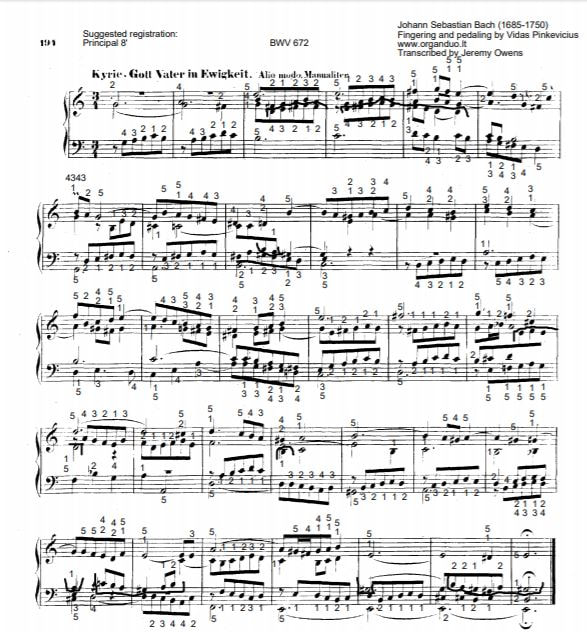 Would you like to learn Kyrie, Gott Vater in Ewigkeit, BWV 672 by J.S. Bach by J.S. Bach from the Clavierubung III? I've created this score with the hope that it will help our students who love early music to practice efficiently and recreate articulate legato style automatically, almost without thinking. Thanks to Jeremy Owens for meticulous transcription of fingering from the slow motion video. Basic level. PDF score. 1 page. 50% discount is valid until July 13. Check it out here This score is free for Total Organist students. Bellow is my practice video in slow motion: Vidas: Hi guys, this is Vidas.
Ausra: And Ausra. V: Let’s start episode 246 of Ask Vidas and Ausra podcast. This question was sent by Michael. He writes: Hi Vidas, I had private lessons with Michael Schneider in the 70s and 80s for 13 years - I am very satisfied with my playing technique and don’t have serious difficulties with the literature. I had a 30 years break - settling in my job and having a family with 2 kids. In 2010 I discovered the Hauptwerk software and bought a three manual console and several sample sets. I took up practicing again and brushed up most of my repertoire. A few pieces are still open: JSB Toccata in F, P&F in E flat and in E minor, Dupré op. 7 - but this is only a question of time, not of difficulties. At present I am studying Carillon de Westminster - it is almost finished. My challenge is to keep all these pieces warm, so that I can play them without too much preparation time. If you are interested in my performances, go to contrebombarde.com and search for bartfloete, my musical nickname. All the best for you and Ausra and thanks again. Best regards Michael V: So, Michael can play quite a difficult repertoire, Ausra, right? A: Actually very difficult. All the pieces that he named are the top difficulty level. V: Dupré Opus 7, those Three Preludes and Fugues in G minor I believe, A: It’s B major, then F minor, then finally G minor. V: G minor. So difficult to play, especially G minor, I think. A: Yes, and I played B major. It’s challenging, too! Fugue, especially. And we have heard some not very successful performances of these three pieces by quite famous American organists, so, that’s quite a challenge. V: Yes, and Toccata in F major by Bach—it could be a very long and tedious piece to play, if you are not careful, if you are not playing musically. A: And those cadences in the Toccata section, I think are the hardest thing in that piece. V: And of course, E flat major Prelude and Fugue, that’s probably a pinnacle of Bach’s writing, in general, for organ. So, you would probably enjoy, tremendously well, just practicing this piece, not only performing it. A: True, and then, he mentions the Prelude and Fugue in E minor, and I believe he means, probably, “The Wedge,” V: “The Wedge,” yeah. A: Yeah, which is, I think, one of the hardest pieces for organ that Bach wrote. V: Even harder than E flat major Prelude. A: I would say so, yes. V: Because of the fugue, probably. A: True. V: Running passages and virtuoso texture. A: True, and it’s also long, as is the E flat major. V: So, his challenge is to keep all these pieces warm, and be able to play them without too much preparation time. That’s very simple, right, Ausra, because, A: Yeah… he has to play them. V: Play them all the time, and let’s say he has a repertoire of about one hour, right? Toccata and Fugue in F major, that’s 15 minutes, E flat major, another 15 minutes, A: Well, perhaps 17 V: A little more, then E minor, so 3/4 of an hour more, probably, and Dupré Opus 7, so that’s more than an hour, I think. A: Oh, it’s much more than an hour. V: Mhm, because Dupré 3 Preludes and Fugues is more than a half an hour already. A: Well, I would say probably more, because that F minor, the middle one is in a slower tempo. V: And Carillon of Westminster, by Vierne, so that would conclude his hour of Bach and Vierne, and Dupré, in addition, a half an hour set… A: Well, that’s like two recitals, I would say... V: Almost two recitals. A: Almost two recitals, yes. V: One and a half, at least. So if he has to keep these pieces warm, he has to play them, not necessarily every day all things, but to have a plan to play them regularly. A: Well, let’s say you choose two pieces for each day that you will work up on and repeat on, and the next day you will do another two pieces and just keep going like that, and keep rotating. V: Yes, Bach F major, E flat major, and then E minor—three. Dupré, three more, that’s six, and seven, Vierne. So, basically yes, in three days, he can do brush up. A: Yes, and you know, it doesn’t matter, there is no magic trick that you learn pieces and you will be able to play them after ten years without practicing them. No, you need to keep practicing and to keep refreshing them. Of course, it always depends on how well you learned them for the first time. For example, did you play them with the same fingering all the time? Because this makes things easier for you to repeat and to keep it in good shape. V: Let’s suggest to Michael to memorize. Would that be helpful in the long run? A: Yes and no. Don’t you think it’s harder to keep things in memory than to read it from a score? V: Yes, he doesn’t have to perform from memory, he just has to learn it inside out. And then, when it comes time to perform from the score, it would be easier. A: Yes, true, but you can do that if you have a lot of time. So, it depends on your schedule. And, for example, for some people, when you learn to play something from memory, it’s very hard to go back and to play it from the score. You need to keep that in mind, too. Not for everybody, but for some, yes. V: I see. Interesting. What else could Michael do? What would you do in Michael’s shoes if you had plenty of time and would like to learn those pieces and keep them warm in your repertoire, in addition to practicing them regularly, maybe twice a week. A: Well, what helps me, actually, is to play my repertoire in a slow tempo. This sort of keeps everything well under my fingers and then I can play pieces for a very long time without ruining them. V: If you play them in the concert tempo, you can get carried away and don’t notice details and ruin the performance. A: True. Yes, because things might get muddy when you practice all the time in a fast tempo. Of course, people think, “Oh, if I play it fast, then I can play more pieces,” and that’s what we do, but I don’t think that’s a good way to do it. V: You have to think long term. What would today’s practice mean for you three months later? A: And I think it especially applies for practicing Bach’s works, because they are such polyphonically complex pieces, and you can miss many important details while practicing in the fast tempo all the time. V: And one last thing. Obviously, if you are so good with those pieces, like Michael is, probably, then it would be wonderful to go out and play in public. Don’t you think? A: Of course, and I think that’s what he does. He has his page on YouTube. V: But that’s in public… he records himself and publishes, but I mean in live performance, maybe in a church setting, maybe in a concert settings, even. Go out in his area, make friends with local organists, and arrange recitals! A: Yes, and another suggestion for him would be that since all the pieces that he mentions, he played them a long time ago, and now he is repeating them. So maybe it’s time to learn something new that he hadn’t played before. V: Ah, I see. Yes, if you only repeat your repertoire from the past, you are not really advancing. Right? A: Well, you are advancing, but you are not expanding your repertoire. V: You are advancing, but not expanding your musical horizons. So that is great final advice, Ausra. A: And he studied with Mike Schneider, as he mentions in his letter, and sometimes we think that we will not be able to learn new pieces without a mentor or a teacher. V: Which is not true… A: Which is not true. Because, if you have already learned so much hard repertoire, I’m sure you can do something on your own, too. V: And teach others, if you like. Thank you guys, this was Vidas, A: And Ausra, V: Please send us more of your questions. We love helping you grow. And remember, when you practice, A: Miracles happen. 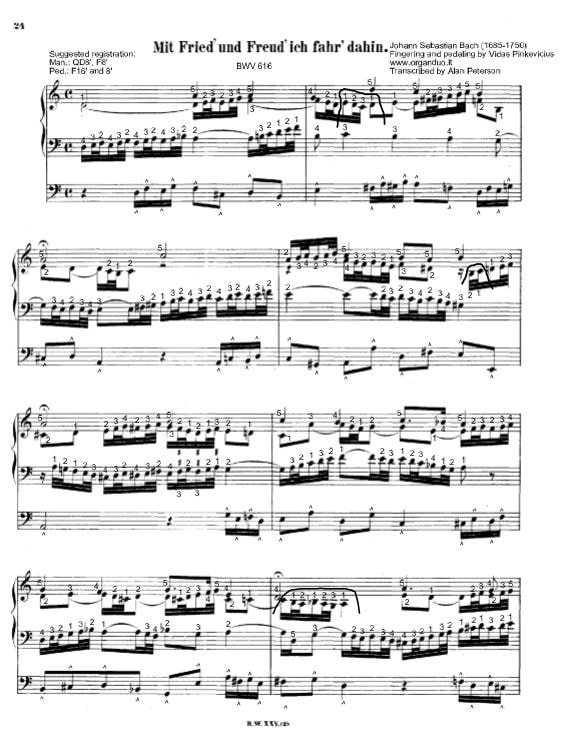 Would you like to learn Mit Fried' und Freud' ich fahr dahin, BWV 616 by J.S. Bach from the Orgelbüchlein? I've created this score with the hope that it will help our students who love early music to practice efficiently and recreate articulate legato style automatically, almost without thinking. Thanks to Alan Peterson for meticulous transcription of fingering and pedaling from the slow motion video. Basic level. PDF score. 2 pages. 50% discount is valid until July 11. Check it out here This score is free for Total Organist students. Bellow is my practice video in slow motion: Vidas: Hi guys, this is Vidas.
Ausra: And Ausra. V: Let’s start episode 245, of #AskVidasAndAusra Podcast. This question was sent by William. And he writes: Do you have any advice for organists who have never played hymn melody in feet or in tenor range? I have been trying all week to do this on hymn amazing grace. I am having hard time. Is it a waste to learn this process? I am trying to begin to improvise and so much I read say to do this and then practice in different keys. It is really hard for me. Is this a God given talent or something that I can learn by practice? Someone told me today if cannot do it it is you can not learn. Another I read to transpose everything to C Major and then you can eventually play by ear instead of thinking about intervals. Do you have as part of your course a step by set way to learn to improvise? I just want so bad to learn improvisation. Is ear training the basic problem? Thanks. William V: Where to start, Ausra? A: Well, that’s a very broad question actually. William brought up many problems that many organists encounter. V: So let’s unpack this a little bit from the beginning. He wants to play hymn melody in the tenor range with his feet, on the hymn, ‘Amazing Grace’, right? A: Yes. V: And he’s having a hard time. Obviously this is not a simple solution, right? Because most of the time people are playing bass line in the pedals. A: True. V: Especially in hymn playing. But then if you want to play a melody with your feet, but a little bit higher, not in the bass range, you have to get use to it, right? How long would it take, I think, in your opinion, Ausra, with everyday practice for William? A: I think it depends on individual abilities so it’s very hard to prognose, how fast he would advance, but definitely he could do it, if he would work regularly on it. V: Is it a waste of time or no? A: No. It’s not a waste of time, but in terms of starting to improvise on the organ, if you don’t have particularly pedal advanced, pedal technique, I don’t think it’s a good solution to start to improvise from things what William is doing, like playing the melody in the pedal, of ‘Amazing Grace’. It’s not such an easy tune to play in the pedals. V: No, not easy. A: So, and if he’s just a beginner improviser, I don’t think that this is the right way or easiest way or the right way to start to improvise. Because, let’s say, for starters, I would definitely improvise something on manuals only, and if he wants to include pedals, he needs to support harmony, at first. V: Mmm-hmm. A: But not to play a solo part. What do you think about it? V: Well there are many approaches to start. Some of the easiest ways to get used to the pedal board and to keyboards, I think, it’s good to choose just four pitches. Any random pitches that you like. It could be adjacent like C, D, E, F, or really random pitches like D, F#, B and G#. It doesn’t matter which four you choose but if you use them explicitly in you improvisation they will sound nice. It’s like one mode, one color in paintings. A: Yes, so improvisation on these four pitch base melodies could work well, nice for many things. For Offering, for example, for Communion at church service. But what if you need to improvise on a particular hymn for example, ‘Amazing Grace’. What would you suggest for a beginner? V: Then, if you really badly want to play the hymn melody with the pedals, then do it just like a normal organ composition. Play it voice by voice. Pedal solo would be ‘Amazing Grace’ melody, with you feet alone, without any accompaniment first, right? And then, even you can play the melody in three parts; in soprano, in tenor and in the pedal. It would be steps one, two and three, without accompaniment, without any additional voices. Just one voice texture, solo melody. Once you get used to this, yes, you could improvise maybe transpose first, not improvise, transpose it to other keys, to really get the hang of it. And then, add the second voice. Like if you play with the soprano add the bass. If you play with the bass, add soprano. What do you think? A: Yes, I think that’s an excellent suggestion. Do you think, is it necessary in your improvisation since it’s improvisation, not a hymn accompaniment, would you necessarily use the entire melody, or could you just extract some specific motive or some motives from the hymn tune? V: Obviously you would choose just fragments of the hymns that would be even more creative, I think. A: Do you think that people would still recognize the tune that you are improvising on? V: If you use it often, in various voices. I wouldn’t recognize it. I don’t know about people. I’m not an ordinary listener, you know. But it’s not important as much as they understand it or recognize it. It’s important that they enjoy it, right? A: True. V: …for people. So, I have this course, Hymn Playing Improvisation Level One, or Organ Hymn Improvisation Level One, where I improvise a second voice in addition to the choral melody, in the right hand or in the left hand. And then I switch. And I first do it note by note. Basically, for one note of the melody, you supply one note of the accompaniment. And then the second step would be, two notes against one. And then three notes against one, like triplets. And four notes against one like sixteenth notes. And gradually it becomes faster and faster and you can really create an entire cycle of variations on any hymn tune based on this course. A: Very interesting. Now what about the second half of the question? As I understand, William is wondering either you need to know theory well enough or you can play by ear, if I understood it correctly. What do you think about it? How much improvisation needs to be based on the theoretical knowledge? V: It’s really hard to say for me because all my life I was involved in theory in one way or another. A: But do you think it helps or it slows you down? V: Theory? A: Yes, learning theory. V: I would say it helps. It helps a lot. Like when I improvise, I always think about key signatures, about modes, and that wouldn’t be possible if I didn’t know the theory behind those modes. I would probably play by ear but then I would create some unnecessary dissonances and basically wouldn’t understand what I am playing. And would only play nicely by accident, you know. I could not repeat it. I could not even teach it to somebody else. A: And I know that you have perfect pitch. Does it help for you to improvise? Is it necessary to have perfect pitch to be able to improvise? V: No, because you still are looking at the fingers and manuals and pedals when you’re improvising. You seeing what you playing. I think it’s okay, but, if I didn’t have this perfect pitch, who knows. Hypothetically maybe it would slow me down. A: But it’s possible to learn to improvise, what to you think? Without having perfect pitch? V: Obviously yes. You just have to think about what exactly you would like to play with your mind, you know, theoretically. Your mind goes first and then fingers follow, not the other way around. Although, there are some improvisers who would disagree. You could close your eyes and play whatever comes out of your fingers. A: Interesting. V: What do you think? A: Well, hard to say. I think that improvisation is sort of a combination of all these things; your ear, your theoretically knowledge, your technical skills. Of all those things. And of course your personal taste. V: If you think too much then it might become too predictable and too boring, you know. You have to leave some space for surprises. A: Don’t you think that sometimes, improviser who improvise in historical, sort of limit the imagination, or not? V: It’s a complicated question because what they do usually, they adjust to the instruments. The reason probably why they do it in historical styles is because they love historical instruments. And to play a modern imaginative improvisation on a historical instrument, it’s much, much more difficult than just to copy somebody else’s style from the past. And these people of course, fall in love with early music, and want to recreate them, sort of imagine them in the real life. Imagine what Sverlink would do today, you know. Imagine what Krebs would do today or Couperin or Bach. So I think instruments dictate the style for them. And when they switch instruments they could switch styles too. So it’s really a fascinating subject. You should really try yourself, even if you have a modern instrument, it doesn’t matter. Just play something interesting for starters on four notes. Or on ‘Amazing Grace’ hymn tune. Thank you guys. This was Vidas. A: And Ausra. V: Please send us more of questions. We love helping you grow. And remember, when you practice,,, A: Miracles happen! 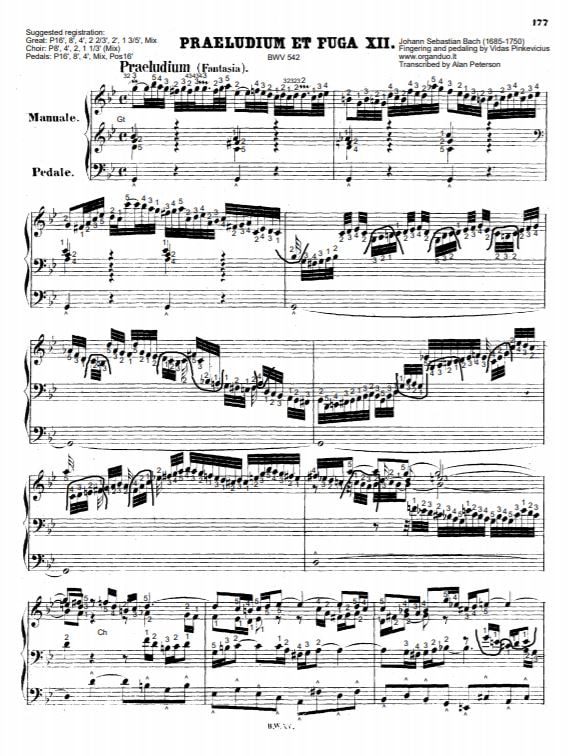 Would you like to master the legendary Fantasia and Fugue in G Minor, BWV 542 by J.S. Bach? I have created this score with the hope that it will help my students who love early music to recreate articulate legato style automatically, almost without thinking. Thanks to Alan Peterson for his meticulous transcription of fingering and pedaling from the slow motion videos. Advanced level. PDF score. 10 pages. 50% discount is valid until July 9. Check it out here This score is free for Total Organist students. Vidas: Hi guys, this is Vidas.
Ausra: And Ausra. V: Let’s start Episode 244, of #AskVidasAndAusra Podcast. This question was sent by John. And he wrote: Dear Vidas, I improvise at every service. I often improvise before the start of Solemn Mass (generally an improvised prelude on the first hymn) and always at the Offertory - during the censing of the altar. The only times I do not improvise at the Offertory are during the seasons of Advent and Lent. On Palm Sunday, I improvise on Stations of the Cross at the evening service. [On Maundy Thursday, the organ is silent after the solemn procession until the Gloria at the Easter Vigil.] Best wishes, John V: So, Ausra, this seems to be a comment about when to improvise during a service, right? A: Yes, yes. V: Or when to play the organ. Because, yes, you can play repertoire, you don’t have to improvise. A: True, true. V: But you can. So John improvises quite often, right? At every service. Why do you think on seasons on Advent and Lent, it’s not really appropriate to improvise for the offertory? A: Well, because in general, Catholic Church does not allow or does not recommend to use pure instrumental music during mass, at Advent and at Lent. And of course during the Holy Week, starting from Maundy Thursday, the organ is shut down until the Easter Sunday, or Easter Vigil. V: I think that this tradition is still alive in some places, even in Lithuania, in smaller churches. But it’s not really, I think, required to keep silent, and not to play anything instrumental. A: Well, you can play instrumental but it can be only accompaniment of the human voice. So usually during Advent and Lent in Catholic Churches you sing more, than at other times. V: Do you think that it would be a problem if one would improvise during that time? A: I think it might be a problem in some churches with some conservative congregation and priests. V: Mmm-hmm. So then, of course, communicate better, if you want to do that during Lent and Advent in a conversation congregation. A: And I remember those times while working inside Catholic Churches, and I remember that Advent and Lent was, and especially Lent, because it’s longer than Advent, was a real challenge for organists because in Lithuania often an organist has to sing himself. So he’s sort of like double man, both organist and cantor. And all these seven weeks before Easter when you have to play and sing yourself at the same time, is just, you know, exhausting. V: Yes, and today, if anybody asks me to play for the service in church, I would generally improvise. And I would only sing Sanctus part and Agnes Dei part because they have to be sung. Sometimes Kyria too. A: And Psalm of course, yes. V: Psalm, Alleluia too, yes. But not Introit and Offertory and Communion hymns. I would improvise during that time. And people in our congregation at St. Johns Church, they start to appreciate it. And at the last time when I played it, it was on June 24, when the feast of St. John the Baptist was. I was invited to play there and improvised all the time. And at the end I played the fiery Sortie or a postlude you know. And people started applauding like crazy afterwards. A: So it means that there is need for organ music. V: Right. Because at that church we only work as university organist, not church organist, and we generally don’t play at services, unless they ask us in advance, in addition to other things. So they have they have their own ensembles maybe, guitars and synthesizers, but they don’t use pipe organ too often. A: Yes, interesting. V: So that’s of course the case with many Catholic Churches. A: True, but you know, I find it’s sort of peculiar because like this for example; law of Advent and Lent, not having instrumental music, is sort of very puritan like, yes? V: Mmm-hmm. A: But on the other hand, you have so many Catholic Churches have, you know, pop music sounding all the time during mass. And guitars playing and people almost dancing near the altar. And I think it’s sort of a big controversy, in my opinion. V: Yeah, liturgically speaking, it’s nonsense. A: I know. I know. Because if you want to be conservative in everything, then you have to be conservative and consistent about everything. So I don’t know how this sort of strict rules apply to modern pop music. V: They don’t think about that relationship, about this dichotomy too often, I think. They play and sing what is pleasing to their ears, right? Especially for the youth. They think that if they play a lot of pop music, then more youth would come to the church. That’s their argument. And if you would play traditional hymns, let’s say, and accompany those hymns with pipe organs and play organ music in addition to that, of course people will leave the church. A: Yes. Gregorian chant might kill you. I’m just joking, but… V: But then, don’t you attract the wrong kind of people to the church? A: That’s right. If the music is the only thing that attracts you, then it’s probably not your place in that church. V: On the other hand, we would probably go to the church which has high quality musical tradition, right? A: True, true. That’s a hard thing to find in Lithuania, in Catholic Church. V: Yes. But when we travel, for example to other countries, it’a always a pleasure to go to a church where is a high standard of music. A: But you know, in America in Catholic Churches, in some of that we attended, the music was very bad, actually. V: In protestant churches, it’s much better tradition. A: True. True. That’s true. Anglicans and you know, Lutherans, Presbyterians, Methodists. V: Right. So I think for everyone is different, you know, their tastes, and everything. Those young people also deserve to have their own music in church somewhere. But not necessarily in the main service, you know. Maybe you have to have youth service, someplace in the morning or in the evening. That could be a solution, don’t you think? A: Yes, it could be. V: And leave the main service, the main mass for the choir and organ. That’s for catholics. A: That’s right. V: For other denominations it’s also different. So guys, don’t be afraid to improvise at the service. Of course, don’t go crazy on Advent and Lent, at least at first, when you,,, A: Unless you want that you would get kicked out of the church and lose your position. V: Right, but if you are improvising just let’s say once during the service, during the postlude, let’s say, or a prelude, when just people are gathering or leaving, they are not really paying attention actually, to the music. Then they are talking and communicating with each other and greeting and chatting, then you are free to do what you want. That’s a big relief, don’t you think, Ausra? A: Yes. That’s a good way to learn to improvise publicly. V: Without too much stress. A: True. True.. V: Okay, guys. This was Vidas. A: And Ausra. V: Please send us more of questions. We love helping you grow. And remember, when you practice,,, A: Miracles happen! |
 DON'T MISS A THING! FREE UPDATES BY EMAIL.
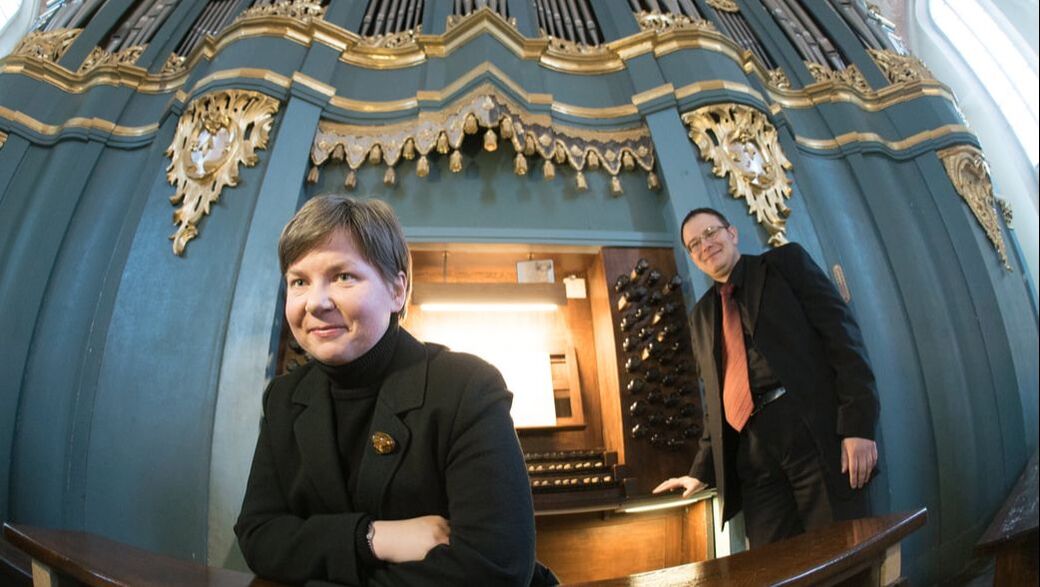 Photo by Edgaras Kurauskas Photo by Edgaras Kurauskas
Authors
Drs. Vidas Pinkevicius and Ausra Motuzaite-Pinkeviciene Organists of Vilnius University , creators of Secrets of Organ Playing. Our Hauptwerk Setup:

Categories
All
Archives
May 2024
|

 RSS Feed