|
Vidas: Hi guys, this is Vidas.
Ausra: And Ausra. V: Let’s start Episode 196 of Ask Vidas and Ausra podcast. This question was sent by Howard: Vidas and Ausra: I have recently begun working on chorales and variations and partitas by Pachelbel and I am very interested in the style he used to create these works. I have also found similar styles composed by Walther and Krebs. What other composers use this style and are there any contemporary composers that use this style? V: Ausra do you love partitas and chorale variations by Pachelbel? A: Yes I like them they are easy and pretty pieces. V: They are very suitable not only for concerts but for liturgy too. A: Yes, that’s right. I think Pachelbel is one of the most composers for liturgy. V: Yes, I remember you have played plenty of Pachelbel works. A: Yes, because I had that volume of his music. V: Published by Dover, right? A: Yes, yes, and I used a lot because you know I needed new music each week to play at church. V: I used this collection too. I loved not only his variations but also his chorale settings. Four part settings. They were like expanded versions of chorale harmonizations. A: Yes. V: With short interludes it seemed to me. What is the basis of the style. I think people should get a better feeling how those pieces are constructed. Probably continuo feeling, basso continuo. A: Yes, but I think you know the main thing is the subject, the theme and if it’s you know free composition then composer you know just composes the theme and variates it. But if it’s chorale based work then you know the theme is chorale based melody which you know composer harmonizes first and then you know creates different settings based on that theme. V: Let’s talk a little bit about the structure of those variations. Variations could be done just for manuals only or it could be done with pedals like passacaglia or chaconne. A: Yes. V: And we have those famous two chaconnes by Pachelbel in D Minor and F Minor. A: Yes. And you know why it’s not so hard you know to learn partitas or variations as separate pieces because the harmonic chords they are the same all the time although the figuration is different in each variation. V: Usually they start slower and they speed up variation with smaller note values toward the end. A: Yes, so for example you would take like traditional variation, you could expect that you know that theme will be exposed to you, presented to you by quarter-notes, let’s say yes, and maybe some half-notes in the cadences. Then in the first variation you will get like eighth notes and then later you will have sixteenth notes, maybe some triplets, and you know you could even achieve thirty-second notes. V: To make the whole process more interesting somewhere in the middle Pachelbel might change the mode to the minor and add chromaticisms. A: Yes, that’s true. And do you know if he uses parallel minor or just you know same name key but minor key. Like C Major versus C Minor. V: Yeah, same name key. Otherwise these variations stay in the same key. And that’s what’s magical about those variations because you always can recognize the theme and always have the same color throughout the cycle and your listeners would appreciate everything very well. They would understand how the piece is constructed so well. And you know Johann Sebastian Bach when he was young and tried to study foreign composer works he a lot of times chose Pachelbel’s chorales and expanded them. A: Yes, I think Pachelbel was one of his main influences in life. He’s very important actually, composer. V: Because Pachelbel was the teacher of his brother who was the first teacher of Johann Sebastian too. A: Yes. And you know as in our question there mentioned other composers. For example, Krebs, yes? V: Um-hmm. And Walther. A: So basically you know Walther was basically almost contemporary of Pachelbel, maybe just a little bit younger but you know… V: Krebs was also not too far removed from Bach because he was a student. A: So basically this style of variation settings of partitas was very common in baroque time and not only in Germany. J. S. Bach composed partitas as well. V: But he also lived in Germany. A: Yes. V: But in various parts of Germany. Bohm lived in Luneborg and that’s not Germany. And Walther lived in central Germany and Krebs also in central Germany. And Johann Sebastian Bach wrote partitas I think fairly early in his life influenced by those composers previously mentioned. So... A: And I think if we are talking about influence we need to mention Dieterich Buxtehude as well. Because he composed partitas as well and he influenced Bach as well. V: Well exactly. And those partitas are not too far removed from variation cycles like they call Verses by maybe Sweelinck, Scheidt and their contemporaries too. They are more polyphonically created of course than Pachelbel but they also have the same structure. The themes go throughout sometimes have more imitations. But they are very beautiful to play. A: And if you like variations and partitas you definitely have to see french noels too because these I know typical french type of music that are you know based on Christmas Carols and are also composed in variation styles. Such composers are Daquin for example or … V: Balbastre. A: Dandrieu. V: Exactly. A: They all composed variations. V: Even more romantic composer like Guilmant wrote cycles of noels too. A: Yes, that’s a French tradition. V: Um-hmm. So talking about more modern times I think Hugo Distler wrote some variations too. But then that style might be more contemporary. The language of musical composition might be more contemporary. A: You know if you really like that Pachelbel style you have to improvise yourself. This will be sort of you know already modern composition but in style. Because I think that Pachelbel’s partitas and variations are wonderful models for improvisation. V: In the old style you mean. A: Yes. V: A lot of improvisors who love early music they started with his style, not with Bach’s style, not with Buxtehude, not with Sweelinck… A: Yes, because his style is not a complicated. V: But nevertheless very beautiful. A: That’s true. V: So where to start if a person loves to improvise. Maybe pick a hymn tune from your hymnal and do what Pachelbel did. Maybe analyze what he did in his partitas. See how many variations move in eighth notes, how many in triplets, where does he change the mode and chromaticism. How does he transfer to sixteenth note values, maybe even sextuplets too at the end. Um-hmm. And then do the same on your chorale tune, on your hymn. A: Yes. And you know if your talking back to liturgy I think it’s excellent for those places in the liturgy where you don’t know how much music you will need in advance because you can you know end up in any of those variations. V: You mean you can stop, right? A: Yes. V: Thanks guys, we hope this was useful to you. Pachelbel is an amazing source to explore and experience with your musical adventures and we hope they will lead you to more musical discoveries, right Ausra? A: Yes, we hope so. V: And send us more of your questions. These are wonderful situations. We would love to help you grow. And remember when you practice… A: Miracles happen. Vidas: Hi guys, this is Vidas.
Ausra: And Ausra. V: Let’s start Episode 195 of #AskVidasAndAusra podcast. This question was sent by Brendan. He writes: My sight reading has improved by taking the course. Slowly but surely. I continue to play very slowly though. Around crotchet 50 - 60, depending upon what's going on in the music. I need to slow well down for some of the passages, particularly where there are semiquaver sections, or triplets against quavers for example. My biggest challenge is that I'd developed a really bad habit when I was younger and not studying music properly - I look down from the music desk to see where my fingers are, and where the note is I'm trying to hit. I sometimes play much slower just to allow my fingers to find the note without me trying to look to see where it is. That continues to be quite a challenge! But I am improving, and I am grateful for the material. Best wishes, Brendan So, Brendan is taking our organ sightreading mastercourse. A: Excellent. V: And he seems to enjoy it. Maybe we should clarify the British nomenclature, right--terms. A: Yes, yes. V: “Crotchet” means, probably, quarter note. A: Quarter note, yes. V: And then “quaver” is probably...probably 8th note. A: That’s what I’m guessing, from...yes. V: And then “semiquaver” is probably 16th notes. A: Yes. V: Excellent. So now we’re on the same page. This course is devised in such a way so that you are playing the entire Art of the Fugue by Bach, plus some additional materials for legato playing suitable for Romantic and modern music and after that. But for a long time, like maybe 40-41 weeks in a row, you’re studying Baroque style, right? And playing voice by voice, and then 2-part combinations, 3-part combinations, 4-part combinations, taken from Contrapuncti by Bach. And of course, I had to do something else with this course, in order to help people be familiar with other keys. So I transposed some of those Contrapuncti and fugues in many other minor keys, in the order of ascending number of accidentals. Do you think that’s a helpful device? A: Yes, I think so, because it’s not good to play everything in one key only. V: Mhm. Although, this collection is written in d minor. A: Yes, yes. I know that. But still, if you will play only everything in d minor, then you will be good only for d minor, really. V: Mhm. A: Because the other keys require a little bit different fingering. V: So then...Brendan seems to be frustrated with his habit, when he has to look down to see the fingers. Is is a bad habit, or…? A: Well, actually, it’s sort of a strange one. I have never heard about such a habit before. But you know, I could draw a parallel: he’s with playing organ like I am with computers. Because I sort of never look at the screen when I’m typing things, and only looking at the keyboard. V: That’s good for your eyes! A: Yes, it’s good for my eyes; but you know, sometimes, when you finally look at the screen, you see some mistakes, and then you have to correct them. V: And that’s not how professional typists do, right? A: I know. V: They always stare at the screen, and they touch/feel the keyboard, and use all 5 of their fingers. A: That’s true. V: How many fingers do you use, Ausra? When you pla--not when you play, when you type? A: Well, six. V: What do you mean, six? A: Three in one hand, and three in another one! V: Oh, I thought six in each hand! A: Hahahaha, no, I don’t have 12 fingers! V: Wow, that would be a very fast way of typing! Sometimes people have 6 fingers, right? A: Yes. V: Like Hannibal Lecter, remember? from Silence of the Lambs! Excellent. So now, Ausra, is it similar when you play the organ, do you have to look down at your fingers, or not? Or do you only look at the score? A: Actually, I only look at the score. Sometimes I have to look at the pedal...sometimes. V: How many fingers do you use when you play the organ? ...All of them? A: All of them, yes! V: Excellent, good for you. Because not everybody is so advanced as you. Sometimes people use 2 fingers in each hand. I’ve seen my 2nd grader do that. A: Heheh. So he’s good with paired fingering, probably? V: He uses like 1 and 2, maybe, in each hand; and no matter how hard I emphasize that, “You need to use all fingerings!” and “Please use my written-down fingerings for that piece!” he never listens, never looks at the numbers. So he plays with weird positions in his hand. But what can I do? A: So he uses only 2 fingers in each hand? He plays sort of like a piglet! V: We could say that, yes! A: But don’t tell him this. V: No, he wouldn’t understand. At that age they’re very sensitive. A: I know. V: So basically...basically, we need to use all the fingers; and is it really bad, to look down from time to time? A: I don’t think it’s very bad. But how can you find in your score, the particular spot you are playing? Is it difficult? V: What do you mean? A: Don’t you get lost, when you look down at the keyboard and then look back at the score? V: It should be more difficult this way, yes. And one of the reasons we suggest people just look at the score is to get more fluent with your playing, right? Because your focus will not be interrupted. A: Sure. And what if you are playing from memory? Is it good to look at the keyboard then? V: Well, it’s the same when you improvise, right? When you’re not using your score. I have to look at my fingers, right, because where else should I look? A: Yes, you could just look in front of you. V: Empty music rack? A: That’s true, yes. V: And what would i see then? A: I don’t know. Put some pictures there--some nice photographs. V: A picture of you, maybe. A: If that would help you, then why not. V: A picture of you playing the organ. Or typing on the keyboard with 6 fingers. A: Funny... V: But I do the same when I improvise, right? I look at my fingers, and I sometimes look at my feet, too. I don’t feel troubled looking down from time to time. When I’m using a familiar organ like at St. John’s Church, I can feel the keyboard and the pedalboard quite well. But still, if it’s a large leap I’m making, I may look down from time to time. Should I feel embarrassed? A: I don’t think so. V: So Brendan--should he feel embarrassed, looking down from time to time? A: I don’t think so. I think it’s just perfectly normal. Some of us just have better motor skills, some not so good. That’s normal. V: But if he could reduce the number of times he has to look down, then he would probably become more fluent with his playing A: Yes. And maybe try to look--if you are looking at the keys--at the same spots each time, while you’re playing the piece, and see if the spots are the same each time. It means that maybe you need to practice those particular spots more, in the piece. V: Ah, that’s a good solution. Look for trouble, right? A: Yes. V: Isolate trouble, and make that trouble spot smaller each time--maybe not only isolate both hands, but maybe play each hand separately. A: That’s true. And maybe you need to correct your fingering in those spots, or make some accents, or change something else. Or maybe articulate more in those spots. Because if those spots are the same each time, it means that something is technically not right. Maybe move your hand to a little bit different position; maybe use your wrist. A: Sure. V: Right? Sometimes it’s good, especially on mechanical-action organs. So, experiment, guys, if you are in Brendan’s shoes. And that will lead you eventually to success! A: Yes. V: Okay, guys! Thank you so much for your questions. Please send us more of your goals and the challenges that you are facing. We would love to help you grow. And remember, when you practice… A: Miracles happen. Vidas: Hi guys, this is Vidas.
Ausra: And Ausra. V: Let’s start Episode 194, of #AskVidasAndAusra Podcast. This question was sent by Terry and writes: I just retired as a physician (December) but I would like to be a substitute organist in a couple of years. I have advanced intermediate or so piano skills and love Bach. I have been self teaching myself organ for the past three months and I am blessed to have an Allen organ in my basement (purchased from local church no longer using) and your tips on organ practice are great. I just joined your group. I can practice 2-3 or more hours most days so my only barrier is daily commitment. So far so good. I am already practicing the Widor Toccata, and of course the pedals are the biggest challenge, but it is SO much fun. I am looking for a teacher (scarce in Petoskey, Mi) but you are (thankfully) it for now. Blessings, Terry V: So, um, Terry is playing Widor Toccata, and also he hopes to be a substitute organist in a couple of years, right? So... A: Yes. A: And that’s a great goal. V: Yes, it is. I think, you know, it’s a great solution when you are retired to take part time job as an organist in charge, because playing organ, you know, sort of your makes your aging slower because of coordination and all that music sight-reading and I think it’s a great solution. V: Plus you need a hobby right? Whether you are in early days or middle age, or if you are a retired person, you need an activity which you could enjoy and do regardless of any goals, regardless of actual results. You would enjoy the process itself. Don’t you think, Ausra? A: Yes, it’s true. But it’s also very nice you know, to have a goal. V: Like he wants to become a substitute organist, right? A: Yes. V: So that’s, that’s a result; he wants to have that result in a couple of years. So basically in order to do that he has to, maybe, you know, get familiar with quite, quite a few of organ pieces, playable for church. A: Yes, that’s true. Widor’s toccata is great, but you know, because organists that, you know, play services, we have to know a little bit about liturgy and to select repertoire appropriate for liturgy. So of course to know the hymns very well, because if you know the congregation better he will be a substitute organist to sing and definitely I think he definitely will sing. So he will have to accompany hymns as well as to do his solo pieces. And because he said that the pedals is biggest challenge, and I assume it will be for everybody since you know he has a good piano background. V: Right. A: So I would suggest for him maybe you know to focus more on pedal technique. V: Right. Play pedal scales and arpeggios maybe? A: Yes. And of course the other thing would be you know, coordination. How you coordinate you know, between your feet and your hand. V: I see. So when you say coordination, meaning playing separate melodies for right hand, left hand or right hand and pedals, left hand and pedals, right? A: Yes. Yes. V: Uh huh. Why is it so important in church? A: Well, because you know, in church, especially if you are accompanying congregational singing you must play with pedals. V: And your left hand has to play something different than the pedals. A: Sure. V: Mmm, mmm. A: Sure. V: Usually tenor line. A: Yes and usually for those people who are right-handed, left hand and pedals give most of the trouble. If you are left-handed then just the opposite, right hand and pedals. Meaning that sometimes when you are beginning at the organ, beginning organist is hard for you to coordinate what your left hand and feet are doing. For example you know, if your pedal line goes up, you want to play up with your left hand; you want to double everything that you are playing with your left hand with your pedal too. V: I see. Do you remember those days when you were an organist at the Holy Cross church? A: Yes, I remember that. V: That was in early days of your career, right? A: Sure. V: Were you comfortable in playing pedals hymns with pedals? A: No, it was hard for me. But I... V: Did you sight read them or practice at home? A: Well I practice them at home, of course. V: I see. So... A: Not at home because I didn’t have the organ at that time. V: Mmm, hmm. A: But I practice at the music academy of music or in our church. V: Mmm, hmm. Each hymn like a separate organ piece? A: Yes. That’s true and remember those times we had also sing ourselves, to lead congregational singing. V: Right. In most of the Catholic churches in Lithuania, and I suspect in Poland too, they have a tradition that organist himself or herself has to sing. A: I know and you know, organist even goes downstairs and sings the psalm, or sings the psalm from the organ bench with the microphone. So it’s sort of, most organist in Lithuania are sort of organists slash,,, V: Cantors. A: Cantors. Yes. So it’s really challenging. Sometimes it’s even more important that you know, organist could sing well. V: And the same person has to sometimes direct the choir too. A: Yes. V: With, with one hand or one foot, or... A: (Laughs) not with one foot probably, but you know, with one hand or with your head. V: Right. Do you think that a lot of organists can direct with their ears, moving ear muscles? A: (Laughs). I don’t think so. V: That would be a nice skill to have, though. A: Yes. You could try to develop it. V: I imagine, I could imagine what would be, the basic,,, A: And you would put it on the Youtube, I bet you would get rich overnight. V: Overnight? A: Yes. V: Oh, sensation. Excellent. Maybe I will devote, my, my summer for this project. A: Good. V: Good. A: Good. V: Would you like me to teach you? A: No, (laughs) thank you! V: (Laughs). A: I’m not the rabbit and I have such a long ears. I cannot move them. V: Maybe we could consult a neighbors rabbit, how he does, right? A: Yes. That’s a great idea. V: Okay guys. I hope you, you are getting fun in this, this discussion. We’re now going to go to our neighbors and interview our guest rabbit, how he directs choir with his ears. And maybe we could tell you later how it went. Okay? A: Sure, yes. V: Alright, but you don’t forget to practice, because when you practice… A: Miracles happen! Vidas: Hi guys, this is Vidas.
Ausra: And Ausra. V: Let’s start Episode 193 of Ask Vidas and Ausra podcast. This question was sent by Jasper and he wrote: Thanks for the recordings of the BWV 669, 670 and 671 choral preludes. I purchased your 671 fingered score a couple of months ago and have had much enjoyment playing through it (very slowly). I am treating it more as an exercise in multiple parts as I cannot see myself playing it at listenable tempo. Incidentally, one thing I had to do was to white out all your fingering with correction fluid and print it back in freehand to a font size that my poor eyesight could cope with. One question I have: how do you recommend practicing to bring out the individual parts? Just playing it through to get the fingering and notes correct must sound awful unless the parts can be articulated. To deal with this problem I assume two methods: one to play each part separately – although this is not easy with so many parts together on the printed score. The other seems to be to play everything but to concentrate on just one part at a time and ensure that at least that one ‘sings’. Jasper V: So Ausra, first of all Jasper played Kyrie, Christe, and Kyrie from Clavierubung Part III by Bach, and he seemed to enjoy the recordings and he recently played the last Kyrie right? The five part setting and that’s a very thick texture. A: Yes, it is but it’s very beautiful too. V: He had to adjust my fingering a little bit to enlarge it right, because his eyesight is poor and he had to have a bigger font. So his question is about listening to individual parts, right? That’s a tricky question. A: Yes it is. V: Do you remember the time when you last played this piece. Did you have to do something special or articulation came more naturally for you? A: Well it came quite natural although this chorale is not that easy to do because it is very chromatic and as you said earlier it’s a thick texture. But I had to practice each single line of this particular chorale. Usually I practice individual lines when I’m working on fugues. V: Um, you know if you have a trouble to articulate thick texture it means just that this piece is too difficult to you. A: Could be. Could be. V: I would go back to the like three part texture or at least four part texture. You know because five part texture is something that has to come very naturally. When I played it for myself a few weeks ago yes I slowed down the tempo quite a bit, made it very very slowly and that saved me of course a lot of time. But I also didn’t practice each part separately. I listened to each part separately, yes, but I didn’t have to do all those separate parts because I prepared my homework you know for many years before. A: Yes. Another thing that might help I think singing each line would help too. V: He didn’t say Jasper about singing but he says to concentrate on just one part. He sort of concentrated, focused on one part at a time. And you suggesting basically to sing it, right? A: Yes. V: That would probably help him a lot. I remember another trick I think my first organ teacher suggested to me. She was in Eduardas Balsys at the Art School, Elena Paradies I think her name was. She said you could play with silent keyboard, you know, one part and louder with the others, you know. The part you need to concentrate on you could first play louder that the others and then do the opposite, make it much softer that the others. A: But I don’t think it would work for this chorale because you play all voices on one manual so how would you put it into a different manual? V: Most of the time though, you could do two voices in each hand, most of time, not always. So then at least two parts would be softer and two parts would be louder. But it’s not perfect solution obviously. You suggested better I think right? To sing. A: Yes and of course articulation. Doesn’t matter how many voices you play you must articulate each of it. V: Well let’s assume that Jasper is so motivated to play this piece that he can do all those individual lines first, right? It will be more than sixteen combinations, maybe twenty something. Over twenty or even thirty. I haven’t counted all the individual solo parts, then two voice combinations, three part combinations, four part combinations, and only then, you know, five part texture. Maybe he can do that but not everybody is so focused, right? A: Yes. V: But then you see he has to sing any part. Soprano, second soprano, alto, tenor, the bass in his range. A: Yes, that’s true but I also mean that you must play all other voices you know, while you are singing one. V: Ah, you are not suggesting that you omit that voice which is being sung. A: No, no, no, no. Because I think it’s very important to practice in this kind of thick texture that you will get used to it and you could control your touch Ordinary Tuch. V: If this was a training exercise you would omit. A: Sure, but not in this case. V: You would omit the part you are singing. A: Because look, if you will omit one voice that you are singing for example you might ruin your fingering and it’s important to play with the same fingering all the time because you know, fasten up your progress. V: Um-hmm. What if he uses you know, our scores with printed out fingering and pedaling and can then play let’s say one soprano and another to sing with correct fingering? A: Well yes and no because still the position of the hand will be different while playing one voice. V: Mmm. Your right, your right. A: So I would say you know, practice all voices together. Maybe not all voices together but right hand, left hand, right hand and pedal, left hand and pedal, and then both hands together and then everything together. That’s what I would do. In slow tempo and sing each line. V: And if it’s really really difficult or too difficult like huge mountain, like Everest in front of you then I think you should do a few easier pieces. A: Yes and you know if you like this particular collection which I personally do I would suggest that you don’t start with large chorales. You could perfectly do those little ones. V: and duets. A: And duets, yes. And you know those little chorales are just wonderful pieces. Excellent examples of you know baroque writing and baroque composition and know these three kyries. I remember playing them in a concert actually those little ones in Lincoln. So, I think they are wonderful. Vater Unser is wonderful example of you know chorales, the short ones. V: Um-hmm. Did you have fingering written out for those pieces or not? A: Well maybe just a few spots you know for those. V: Um-hmm. A: But you know if you are a beginner organist I would suggest you write down fingering for those pieces as well. V: We haven’t prepared such scores yet for you but in the future we hopefully will so stay tuned for that if you are you know, eager to play with our fingerings which produce natural articulate legato almost without thinking. OK thanks guys this was Vidas. A: And Ausra. V: Please send us more of your questions. It’s a really fascinating discussion we are having here with Ausra. We love helping you grow. And remember when you practice… A: Miracles happen. Vidas: Hi guys, this is Vidas.
Ausra: And Ausra. V: Let’s start Episode 192 of #AskVidasAndAusra podcast. And today’s question was sent by Robert. And he wrote a response to my question about what are his organ dreams, and the challenges that he’s facing in his organ journey. So, he writes: 1. I'd like to perform, occasionally, in public and perform concert-level pieces. 2. Major holdback is a lack of adequate practice organs, and someone to actively listen to my practice. Hmm, interesting. So, that’s a very natural dream, right? To be able to play in public? A: Mhm. yes. V: Concert-level pieces. For that, of course, he has to develop a large repertoire. What else? A: Yes...and you know, for his first performance, he could sort of mix pieces. Not necessarily play all the hard stuff, or long stuff. V: Exactly. And not necessarily even a full-hour recital. You could play 30 minutes. A: Yes, and it always depends on what audience you’re playing to, too. Because not everybody appreciates long-lasting and difficult music. From the audience, I mean. V: Mhm. A: That sometimes, people enjoy hearing lighter music. V: You know what I would do if I were a beginning organist, but would love to eventually play in public: I would probably go to find friends in local churches, and then ask for occasional performance opportunities in the liturgical setting. What I mean is, I would play a postlude or a prelude or communion piece, or even an offertory, once in a while--maybe once a month. One piece or two pieces--it doesn’t have to be long, right? 2-3 minutes. So basically 2-3 pages of music--that would be enough, and enough to keep me motivated, at first. A: Yes, that’s true; but later on, you would have to keep going with concert repertoire and more complicated pieces. And what I would also suggest, maybe you can find somebody who will help you to perform together--with you, I mean another instrument or you know, a soloist. That way you could do, let’s say, half a concert of your solo music, and half a concert with your soloist. V: Exactly. Even if this concert itself would be short. A: I know. And that way, usually when you accompany, it’s easier. V: Yes, maybe without pedals. A: True. V: But he writes that he can’t find adequate practice organs, right? In his area. So maybe he could go to one of the churches, and ask for permission to practice there occasionally, maybe in exchange of playing some services. It’s a volunteer work, right? A: Yes. But I remember in my study years in Lithuania, of course I did not have enough time on the organ as I wanted or as I needed; so what I did was I practiced my organ pieces on the piano, too. V: Of course, we don’t know if Robert has any type of keyboard at home. A: But I think it’s easier to get, let’s say, piano, than organ. Don’t you think so? V: Generally speaking, yes. Or maybe a keyboard, an electric keyboard. A: So that way, you could save some time, and do some work on that kind of keyboard. V: What some of our Unda Maris studio students do: they print out our paper pedals and paper manuals, and play at home on the table and on the floor. And not all of them do that, because you cannot hear the sound. But people who are persistent, and have a big vision--they would rather do this instead of skipping practice. A: Yes, that’s true. So, you know, you can find various, most unexpected solutions to your problems! V: And it’s just temporary--I don’t think you would play all the time on paper, or an electronic keyboard. Maybe it’s just for a month or two, until you get a better solution. A: And I think, you know--if you would do some part, or the largest part, of your practice at home, in any way, or at least be able to play notes smoothly (not making too many mistakes), then you will not feel embarrassed when somebody would be listening to your practice. And this was a problem, too, for Robert, as I understood from his question. V: Umm, I’m not sure I’m following you. That he would love that someone would actively listen to his practice, right? Like a coach? Or not…? Or do you understand that somebody is listening, and he is embarrassed? A: That’s how I understood this part of the question. Maybe I… V: Ah, could be both, actually. Could be both scenarios. A: Yes. V: If someone is listening to his practice, it means that he has an instrument on which to practice. That’s good, right? A: I know. But you know, if you don’t have somebody who would listen to your practice and would advise you what to do or what not to do, and how to play, you could record yourself. V: Absolutely. A: And listen to your playing. And you know...you will hear some things that you will probably not like; and then you will change them, and improve them. V: You know, the funny thing about recording yourself is that before you do that, you think, “Oh, you play so well sometimes, you are proud of your achievements because you spend so much time on the organ bench.” And...sometimes you cannot really hear what’s happening until you record yourself. And don’t even listen to yourself right away, but after a few days--after you forget that feeling of that practice. And then you sort of listen to that recording as a stranger, and then you can be more objective. A: Yes, that’s true. And also, some people who are very modest might have a very bad opinion about their performing, about their performance. And this might change, also, after listening to their recordings, that, you know, they listen and, “Oh, I’m playing actually quite well!” V: So it depends on how you judge yourself. A: Yes, and what your character is. V: If you’re a perfectionist or not. A: That’s true. But either way it would be useful, for yourself to record your playing. V: Are you a perfectionist, or not? A: I will not dignify this question with an answer! V: We know the answer, though! And...was it difficult for you to let go of the feeling that you might not be perfectly prepared for the public release of your recording? A: Yes. V: You have to let go of your imaginary mistakes. A: Yes, that’s true. V: Sometimes those mistakes don’t’ kill you, you know. A: Yes. Sometimes they do. V: Hahaha! What do you mean? A: I’m just making fun! V: I see. Yeah. Sometimes, people, if you put a recording on YouTube, you can receive some nasty comments. And I don’t recommend replying to those comments at all. If you don’t like negative feedback, ignore those comments. And you can even mute comments, and let them vent anywhere else, on their own channel. A: But you know, from my experience, I think that people who give other people negative comments, they actually cannot play well themselves. V: Absolutely. And in my experience, whenever I listen to YouTube videos, sometimes I encounter not-so-well-performed pieces, right? But I never, ever have complained about that performance level, and never said, “Oh, you should not play the organ,” or “Just keep it to yourself, I’m embarrassed,” and things like that. Never. You know? Because I know what it takes to play well. A: Yes, that’s true. V: Or what it takes to play badly, right? A: I know. V: So it takes thousands of hours. And if that person was brave enough to put that recording out there, and feel vulnerable, that’s better. It says a lot of you. A: Yes. V: So Ausra, let’s encourage people to publicize their own performances on the internet. Okay? A: Okay. V: So, encourage! A: Don’t be afraid to put your recordings on the internet! V: Exactly. You actually will feel stronger about yourself, once you are doing this for, let’s say, a month or two. You kind of feel resilient to feedback and negative comments. A: Yeah, so just lose the comments! V: Exactly. Thank you guys, this was Vidas. A: And Ausra. V: We hope this was useful to you, right Ausra? A: I hope so. V: Please send us more of your questions; we love helping you grow. And remember, when you practice… A: Miracles happen. Vidas: Hi guys, this is Vidas.
Ausra: And Ausra. V: Let’s start Episode 191, of #AskVidasAndAusra Podcast. This question was sent by Eddy; And he wrote quite a lengthy commentary, about dry acoustics and organ performance, and he asks us to give, you know, our opinion, so we decided to answer this question and discuss this idea about acoustics and organ performance on the podcast, right, Ausra? A: Yes V: So let me read it first. He writes: Dry acoustics (little, if any reverberation with full audience capacity) pose challenging interpretational problems to the performer. Most of the great organ works were composed for highly reverberant rooms such as cathedrals ranging from 3 to even 10 seconds and more. In these rooms the music is allowed to 'breathe' naturally leaving mesmerizing and long-lasting memories/impact; it is also technical-wise much easier to perform in these buildings. However, when performing in dry acoustics like most churches and even some Cathedrals in South Africa, the organist is confronted with major problems in getting across the music of the composer in a convincing, natural and coherent manner. Some 'rescue' methods to resort to may include: ♪ Shortening rests considerably at phrase-ends in order to counteract 'dead' / 'dry' breathing gabs and preventing the music to fall apart; ♪ Lengthening note values at the end of phrases to prevent the same as above; ♪ Changing / altering the music text not only to achieve a better overall musical realization (for instance, to achieve a better legato when needed), but also to ease very difficult passages technically that would otherwise be almost impossible to execute convincingly and which would be far easier to perform in live-acoustics allowing to move the hands/fingers and feet over the keyboards and pedals with more ease) (needless to say the original notation and intentions of the composer must at all times be respected with the highest integrity by the performer); ♪ Phrasing voice parts unevenly at the end of phrases, in other words, not cutting voices at the end of phrases simultaneously as required by the composer's score, but taking-off voices parts /hands/feet after another resulting in a much more natural and coherence way without dry/sec gaps in the sound and musical flow. I do not have the time here to illustrate the observations above with examples from the organ literature (I might have more time later...?); in any case, these suggestions are much easier to demonstrate than to explain in writing ... V: So, what do you think, Ausra, about Eddy’s ideas? A: Well, yes we have very interesting and it might be useful, you know, for some organists, but you know, I would have to disagree that playing in live acoustics, or big acoustics is easier. V: It depends on who is playing, right? A: I know. It depends on the complete room, on the complete organ, and what you are playing actually. V: And if Eddy is really experienced in playing at large cathedrals let’s say, with reverberant rooms, then it comes really natural to him. A: True, but, but you know, you need to play well in either room. Either with acoustics or without acoustics. Because if you will do something technically incorrect, you know, everybody will hear it, in either way, in any circumstance. It doesn’t mean you know, that that if you are playing in a reverberant room, and you will play something incorrectly, nobody will hear it; everybody will hear it, and it will sound even worse. V: Why? A: Because the acoustics you know, will expand it. V: Amplify it? A: Yes, amplify it. V: Let’s say you hit the wrong note,,, A: I know. V: And it will last for three or ten seconds. A: I know, it will last much longer so everybody will be able to hear it. V: And remember. Uh huh, you’re right, here. But probably what do he wrote about large acoustics, is remember we had a short like small studio organ at the Academy of Music in Vilnius, in 316 Auditorium, Neo- Baroque style with fourteen stops I believe, two manuals. And it’s really tricky to play this organ because it’s really no reverberation and everything you play is so on the face, on the notes. A: Well, I believe it had twelve stops. V: Twelve? A: If i remember correctly, and a couple of.. V: You know what I had in my imagination is a couple of reeds. A: It doesn’t have reeds, though. V: Yeah. A: Well, yes, i remember that time, you know, playing that room; it was very tricky. Very hard, actually. V: Mmm, hmm. So that’s what probably Eddy is referring to. A: Because you felt like you know, playing on, on the ice. V: Very slippery. A: Yes. V: Maybe the keys are not pure wooden keys but you know, plastic keys. A: Yes. V: Mmm, hmm. Exactly, so shortening rests in drier acoustics. A: And you know, I think this question just explains you know, one thing, that you need to adjust each time when you play on different instrument in the different room. And that either dry acoustic or live acoustic has it’s, it’s way to approach the instrument and to approach the music. V: It’s kind of similar, that you have to approach you music every time, freshly, with with fresh pair of ears. It’s like unfamiliar environment, and also unfamiliar piece. You have to prepare, pretend you are playing ahead in this piece, you know for the first time. A: And of course if you are playing in a dry room, you probably have to play faster. You probably will have to articulate less, talking about Baroque fugue, for example. And of course, it will be different you know, you cannot maybe play, do as much rubato as you would do in the large acoustics. V: And at the end of the phrases would be shorter. A: But you know, when of course it would be also, you know positive things in playing in the dry acoustics; you will not have to worry about things will get you know, messy. V: Mmm, hmm. A: And, I would say that the dry acoustic is especially, not especially good, but easier to play with other musicians. For example to play duets, not necessarily organ duets, but like chamber music. V: You’re right. A: To play with soloists like other voice, you know, especially like flute or violin. V: Because every part will be audible. A: Sure. And it would be easier to communicate while not having live acoustics. V: Mmm, hmm. For beginners, do you think large acoustics pose larger problems, or dry acoustics? A: I think that large acoustics, because we are not used to it. Because many, you know, come to organ after practicing piano for some years, and it’s more like playing piano that way, you know, when you play dry acoustics. And large acoustics is so different. So I think it challenges more the young performer. V: You’re right, Ausra. Because, because not too many people start out in large cathedrals, their organ journey. A: I know. I know let’s say two seconds reverberation is not the same as ten seconds of reverberation. V: Have you played ten seconds? Remember? A: Yes, I had it. And you? V: We both played, actually, in Detroit. A: Yes. V: I think it was like more of ten seconds. A: Yes, and it was very nice. What did you play? V: I played, i believe suite by Durufle, yeah. Maybe not entire suite but a couple of movements. A: I think two movements. And I played Liszt’s Prelude and Fugue on BACH. V: Do you remember any feelings, any experience? A: Well, actually, I think it went quite well, and I remember it was a nice experience. I enjoyed it actually, a lot. V: And we can tell you stories about maybe twelve seconds reverberation, after our trip to London, St. Paul’s Cathedral this summer. A: Yes, but you know, there are sometimes things that you are thinking you will go and you will find reverberation and after you know, going to that particular organ you will realize that there is no reverberation or almost no reverberation, even if you play historical organ. As for example we did in September, last September in Poland. V: Uh, huh. The old Hildebrand organ from 1717, I believe. In the village of Paslek. A: Yes. V: Mmm, mmm. So you have to adjust, and that’s the beauty of it, right? A: I know. You never know, so just be ready to face challenges. V: Exactly! You are continuing the old tradition that comes back from, from the time of Estampie and Robertsbridge Codex, and even earlier that was not written out. So maybe from the time hydraulis too, Ctesibios, engineer from Alexandria who created the first hydraulic organ, started out this tradition and we’re diligently carrying it into the next millennium or even further. A: Yes. But what about, about you know, if you could choose, would you choose reverberant room, or no acoustics? V: I would choose reverberant room. A: Yes. It’s much nicer. I think it gives sort of liveliness to the organ. V: Exactly. A: And sort of you know, increase the mystery. V: Mmm, hmm. If you’re listener, I would always imagine I’m underneath a swimming pool, you know, submerged maybe twenty feet, and listening to the music of the water and fish and, you know, and things like that. It’s really fun. Of course I didn’t include in my calculations the water pressure, but, but who cares? A: That’s right. V: What about you, when you are listening to reverberant room music, and sitting in the middle of the dome, let’s say. What do you feel? A: I feel, well, actually, I enjoy it a lot. And I feel sorry for churches that has no acoustics, and I think, you know, ‘what could you do, in order to, to make it better?’ V: Oh, alright! You could eliminate all the cushions. A: Yes, and all the carpets (laughs). And you know, maybe just, you know, destroy some windows, and make solid walls. V: Majority of churches won’t do that right? A: I know. V: But some, a little bit of minority will. A: I wish that you know, architects, especially nowadays would think more about acoustics than building you know, their houses and, and churches especially. V: I think you are asking too much from architects because sometimes they even don’t plan the room for the organ. A: I know, and it’s just too bad. V: Good, guys. Um, thank you guys for listening. We hope this was useful to you. Ed, this question was really thought provoking. And please send us more questions like that. We love helping you grow. This was Vidas. A: And Ausra. V: And remember, when you practice… A: Miracles happen! Vidas: Hi guys, this is Vidas.
Ausra: And Ausra. V: Let’s start Episode 190 of #AskVidasAndAusra podcast. This question was sent by Neil. He writes: Hello Vidas, I’m trying to learn this fabulous piece but finding the ornamentation a challenge. Can you advise on correct fingering and ornamentation? I enclose the link to the collection of Purcell pieces via IMSLP website and the voluntary is on page 64. http://imslp.org/wiki/Harpsichord_Music_and_Organ_Music_(Purcell%2C_Henry) V: And he encloses the link to the collection of Henry Purcell pieces on Petrucci Music Library website and he playing the voluntary that is on page 64. So were looking at the page 64 right now and it appears it has a lot of various ornaments, graces as they are called. So what should Neil do for starters? A: Well you know if I had been in a situation like he is and would have a piece where I could not understand some of the ornamentation I would look at the beginning of that collection because it gives all of the rules for graces. V: Not only for graces right? They also explain its a big preface right? With notes, with dedication to the royal highness the princess of Denmark, right? That Purcell did and also the scale or the gamut, right? The pictures from original score, examples of time or lengths of notes, again you mentioned rules for graces and then fingerings, right? He writes fingering too. So there is also a lot to be learned from preface like this and from introduction. A: I know it’s amazing you know how how how many details Purcell gives for his performance. V: Exactly. We could discuss a little bit the types of graces, right? A: Yes. V: The first grace is marked with two lines above the note, note stem, right? Horizontally or a little bit diagonally. It’s called a “shake” and if the note is written on the note B like in example then it should be performed C-B-C-B-C-B-C-B in thirty-seconds. A: So from the upper note so it’s like trill. V: Yes, upper note trill. Like french trill, like Bach trill too. A: Sure. V: And then another type of grace is marked like a normal mordent, like a curly line, right? And actually it has to be played from the note below. If it’s on the note B then it has to be played A-B-A-B. A: And that’s different from Bach’s, from french you know ornamentation but probably similar to italian. V: French has this type of ornamentation but A: But we mark differently. V: Then there is a shake with two diagonal lines above the note stem but also like a slash, backslash sign from the computer that we have. And it’s like played with repeated C and then C-B-C-B again. This first C is long like eighth note long and the rest of them are thirty-seconds. A: Yes. V: Um-hmm. Then there is a shake probably but with one diagonal line above B. So that is played from below A-B. A is sixteenth note and B is dotted eighth note. A: So this is some sort of appoggiatura version. V: Exactly. But english have their own version of everything. A: Yes. V: Um-hmm. Backfall they call it. And the previous one was a forefall. And now B note with an opposite appoggiatura, right? Opposite diagonal line like a falling so you have to play it like C-B. Not A-B but from above. A: Yes. So all those you know tiny differences that are very important for performing such music. V: Hey look. There is another one like a turn. Turn and it is played from the main note. Not upper note. If it’s written on the note B so you have to play it A: From B. V: B-C-B-A-B in thirty-second notes. Um-hmm. Right? And then there is mark like a shake with two diagonal lines but also like a parenthesis, like a slur actually, like a slur from above the note. And they have to be played C-B-C-B-A#-B in thirty-second notes. It’s strange, right Ausra? A: Very strange. V: What else? O you have sometimes two interval. B and D so then it’s like passing notes B-C-D. French they have Tierce culée exact sign too. If you have a chord and a slur before those notes it means you have to play arpeggio. Right? A: Yes. V: But it’s not a very simple arpeggio. It’s very intricate. What do you understand here Ausra? A: Huh. I just. What I understand from this marking is that you have to hold the lower note all the time while arpeggiating the upper note. V: Um-hmm. So then you would need to start with the lower note then skip one note and then play the third note, fourth note and lastly the second note of the chord in order to play this arpeggio. Um-hmm. And then they indicate how various clefs are notated. Bass clef. A: Tenor clef. V: Treble clef and of course they have how many lines, 1-2-3, six lines in the staff. Good luck Neil. I think you will love it. Then of course we could discuss a little bit about the fingering. Because Neil was asking about the fingering too. You see at the end of this example Purcell writes a scale up and down, both hands. So what do you see here? A: Well that he uses position fingering and lots of good fingering too. V: And the strong finger is three in the right hand obviously. So you play 3-4-3-4-3-4-3-4 in ascending line with the right hand and 3-2-3-2-3-2 in descending. And in the left hand what do you do? A: It’s interesting because he uses also a strong finger in the left hand, the three as well. Can you see that? V: Left hand. A: Yes. V: It doesn’t make sense for me the left hand. A: I know it looks sort of V: weird. I’m talking ascending 1-2-3-4-3-4-3-4-3-4. A: I know it’s like all written backwards, I don’t know. V: It’s like the right hand actually. A: I know. V: It’s all mixed up. Maybe he meant downwards this fingering. Wouldn’t you love to see Purcell’s hand? A: (laughs) V: How many fingers did he have? A: Maybe he played like this you know. V: Yes, backwards. A: I know. V: I think you could play 3-2-3-2-3-2 with the left hand ascending and then descending 2-3-2-3-2-3. That would be easier right? A: Yes. V: So, guys always consult the preface if there is one. A: I know but this preface and that fingering of the left hand you can you know damage your left hand. V: And then always consult your mind. A: That’s true. V: That sometimes has a better explanation. A: You have to sort things out always for yourself. V: Um-hmm. Excellent. That’s a fun collection actually. A lot of beautiful suites, variations, and voluntaries that Purcell wrote. A: Yes, it might be very handy for church musician when you need you know short episodes for your service. V: And some of them are hymn related, right? A: True, yes. V: We found one Old 100th hymn. But obviously they are more virginal type of music like harpsichord. A: That’s true but let’s say if you have for example service in a chapel as we for example had at Grace Lutheran Church on Saturday. V: Without the pedals. A: Yes, without the pedals it’s a perfect collection. V: Exactly. Doesn’t hurt to play it. The more variety the better actually. Wonderful. Thank you guys, this was Vidas. A: And Ausra. V: Please send us more of your questions. We love helping you grow. And remember when you practice… A: Miracles happen. Vidas: Hi guys, this is Vidas.
Ausra: And Ausra. V: Let’s start Episode 189 of #AskVidasAndAusra podcast. This question was sent by Stephen. He writes: Good morning Vidas, I'm finding your #AskVidasAndAusra podcasts very helpful and have a two-part question I'd like to submit: Many years ago, very early in my experience as a church organist, when I was playing one Sunday morning during the Advent season, a young nun standing in the front row who taught music in the nearby elementary school unexpectedly turned around during the opening hymn and began waving her hands to direct the congregation at a tempo much faster than it should be taken. The organ, of course, must lead, but she evidently felt the tempo should be faster, which wasn't the case at all, the organ wasn't dragging and neither was the congregation. She seemed not to know that the congregation is never conducted during a worship service because it distracts the worshipers from their devotions. She was literally hauling the congregation by the scruff of the neck from line to line of the hymn with her arm waving without giving them any time to take a breath. The fact that tempo of hymns needs to be nuanced in the service, never rushed, that singers need a split of a second between phrases to breathe, none of that seemed to register or even matter to her. When she failed to return my phone calls (why, I never found out) I took the matter to the priest, who told me it was up to me to work things out with sister ... he also added that HOW I WENT ABOUT DOING THAT WAS ALSO UP TO ME. He washed his hands of it when I felt he should have weighed in on it, since his organist was encountering unnecessary interference and he was in a position to do something about it. The next time I found myself playing was for midnight Mass on Christmas Eve. The opening hymn was Adeste Fidelis in the key of Ab Major, two stanzas. Sister took her place again in the front pew and, right on time, she turned around during the opening stanza and started waving her hands at a tempo that had some people out of breath and the rest of them two beats or more ahead of the organ. My thought was, this can't get any more messed up than it already is ... or can it ... maybe it's time for a demonstration. Remembering what the priest had told me, the way I handled it was, I abruptly dropped the key of the hymn to F Major by transposition -- an unrelated key 3 half steps below -- for the second stanza without a modulating interlude to get the congregation there -- something an organist should never ever, repeat never, do. When this happened everyone stopped singing, of course, because their sense of tonal center had evaporated into thin air. Sister was in shock and began waving her arms frantically to get the people to catch up, to no avail. It was a Silent Night for them right through the whole second stanza. Shame, shame on me for showing sister just how bad things can get messed up when everybody's trying to do their own thing. I figured I was dead meat. Somehow I made it to my car. Sister never showed up at any organ Mass I played after that, for the next two years, and it just wasn't the same without her. Things went fine. So, while this seemed to solve the problem at the time, I can't really recommend this kind of solution, it's too disrupting to the conduct of the service not to mention jarring to the nerves, and I figured there must be a better way to deal with things like this, better communication on the part of the organist maybe. My question I guess has two parts: 1) how to get the pastor more involved in what happens musically when there's an obvious problem with the hymn singing that begs to be solved, and 2) how to deal with well meaning but interfering micro-managers who won't let the organist do his/her job. Fighting fire with more fire like this carries its own dangers (it can get you bottled up and choking to death if you're not careful), and any suggestions from your own experience on how to better handle situations like this would be much appreciated, I'm sure, not just by me, but by every church organist out there. Many thanks for your wonderful web site, podcasts, instructional materials, kind generosity, encouragement, and your precious friendship. Steven Wow, that’s quite a story, right Ausra? A: Yes, I...you know, I just laughed out loud, it was so funny! But I can just guess how poor Stephen felt at that moment--it must have not been fun for him at that time. V: I just hope that Stephen has posted this long comment as a blog post on his own blog, called organbench.com. Because it’s a really valuable experience… A: Yes, it’s a fascinating story, and many organists will appreciate it. V: Mhm. A: And you know, the one thing that I could suggest in Stephen’s case--what you could do is maybe not transpose the next stanza to a different key, but to play organ as loudly as possible. Maybe that way… V: To overpower! A: Yes, to overpower any attempts to change your tempo, that actually you must dictate. V: That’s a wise solution, right? Although, I kind of liked Stephen’s, too... A: I know! But, you know...Hahaha! If the priest cared more, you might lose your position as organist in that church, after such an incident! So… V: Mhm. A: And what Stephen asked about is how to involve your priest in the music. To the music part of the worship. That’s the sort of problem has two parts of it. On the one hand, it’s bad if your priest doesn’t show much interest in the musical part of the service; but on the other hand, it’s good, because it frees your hands, and you can do whatever you want to do. And I’m not saying you have to experiment and play whatever… V: Although you could! A: Well, I… V: I would play whatever! A: I would not suggest to do that, but...it means you can be your own owner of what you are making. V: Master. A: Master, yes. V: Mhm. A: And you can make things your way--you know, to play what you want, and what you like. And another thing--how I would suggest you would overcome people like that nun: I would probably do rehearsals with the congregation before the service, let’s say. Some of the people come to church quite early before the service... V: Mhm. A: And you know, if you don’t have something special going on (like sometimes there are months in the Catholic Church where you have, for example Rosary, spoken before the service, or something else going on), you could just do short rehearsals, like 10min rehearsals with the congregation. Let’s say, you could say that, “Today we will sing [hymn numbers, that, that, and that].” V: Mhm. A: “And now, we will just try to sing 1 stanza of each of them.” And you could go downstairs from the organ pew, and go in front of the congregation and sing with them. V: That’s only on Sundays, though? A: Yes, yes. That’s on Sundays. V: Then, more people come. A: Yes. V: I see. What I suspect, that your solution to play with much power, with mixtures, even reeds sometimes, and overpower let’s say, a heckler, right? Like a troll! She was like a troll, trolling Stephen’s service, right?! A: I know, and I think this might be a problem because she was also an elementary school teacher, as I understood. V: Ahaha, I see! A: She...she...well, don’t get offended, but I think, you know...And he did not write how old she was, but if let’s say she was already in her mid-age, or you know, later on. Teaching… V: Changes you. A: Teaching, yes--it changes you, yes. And with years, you just become sort of...you know, that teacher thing becomes like a diagnosis for you. V: What do you mean? A: Well, imagine that you have to day after day teach kids, like elementary school kids. V: Mhm? A: And you have to...rule them--make them to… V: Behave! A: Behave--to make silence in your classroom, and order, and everything work...I think she just sort of lost the sense of reality. V: Where she was. A: Yes. And I think with her congregation, she also acted like they were all her students, her elementary school graders. V: Mhm. A: And I think that’s sort of funny, but on the other hand, sad...But if you would go downstairs in front of your congregation, and take responsibility for hymn singing… V: Mhm... A: And teach them, and lead them, conduct them before the service, you would show that you are the leader for music in this church, and no other person. V: Although, the situation sounds very unfortunate, right? We could all draw a valuable lesson here, right? Like, I’m quoting or paraphrasing-- A: Mary from Pride and Prejudice, right? V: Exactly. The lesson would be to, first of all--from the position of the elementary school teacher, or nun right, who interfered with Stephen’s playing--would be to get involved in many other areas of interests in life, not only teaching--not only one side. In case of yourself, not only organ, right? You should have a lot of passions and interests, that your personality would develop more roundly. That would be a great thing to do, if you can, if you have time. And another thing to do, from the position of Stephen, the organist, could be to--without any anger, actually, not taking it personally (this was not a personal attack at all), without taking this to the next level of anger--you could simply...The first thing you could do is play much louder, and with much more power. And your congregation would have no choice but to follow you. I think so. A: Yes, especially, you know, as he wrote that he played Adeste Fideles. That’s a joyful, loud hymn. V: Exactly. A: So you have to play it very loud. V: And if you want, you could do congregational rehearsals, too. A: Sure. V: Before the service. For people--they will appreciate that gesture. A: And that way, if you will rehearse with your congregation, you might listen to them, how they are singing; and you might choose some of the leaders between them, that can really lead the congregation’s singing. Then you will be playing from upstairs. V: You mean that the organist could assign some people to work? A: Yes, yes. That’s true. V: Or, as some people do, they transfer their choir members to the pews… A: Yes? V: In various locations of the church, among the congregation members. And they’re not dressed in robes. They’re just like civilians! A: Yes…Choir members are not civilians?! V: In this case, not! And then, nobody will know that they have special powers, right? They look like everybody else. But they sing more powerfully, this way. A: That’s true. V: Excellent question, and story, too. You know, people should express themselves like Stephen did in this question, too, with so much humor and so much poetry, too. We loved discussing this, so please send us more of your questions. It’s really fun. This was Vidas! A: And Ausra. V: And remember, when you practice… A: Miracles happen.  Would you like to master Prelude and Fugue in C Minor, BWV 546 by J.S. Bach?
I have created this score with the hope that it will help my students who love early music to recreate articulate legato style automatically, almost without thinking. Thanks to Alan Peterson for his meticulous transcription of fingering and pedaling from the slow motion videos. Advanced level. PDF score. 10 pages. 50% discount is valid until April 10. Check it out here This score is free for Total Organist students.  Would you like to master Fantasia and Fugue in C Minor, BWV 531 by J.S. Bach?
I have created this score with the hope that it will help my students who love early music to recreate articulate legato style automatically, almost without thinking. Thanks to Jeremy Owens for his meticulous transcription of fingering and pedaling from the slow motion videos. Advanced level. PDF score. 7 pages. 50% discount is valid until April 10. Check it out here This score is free for Total Organist students. |
 DON'T MISS A THING! FREE UPDATES BY EMAIL.
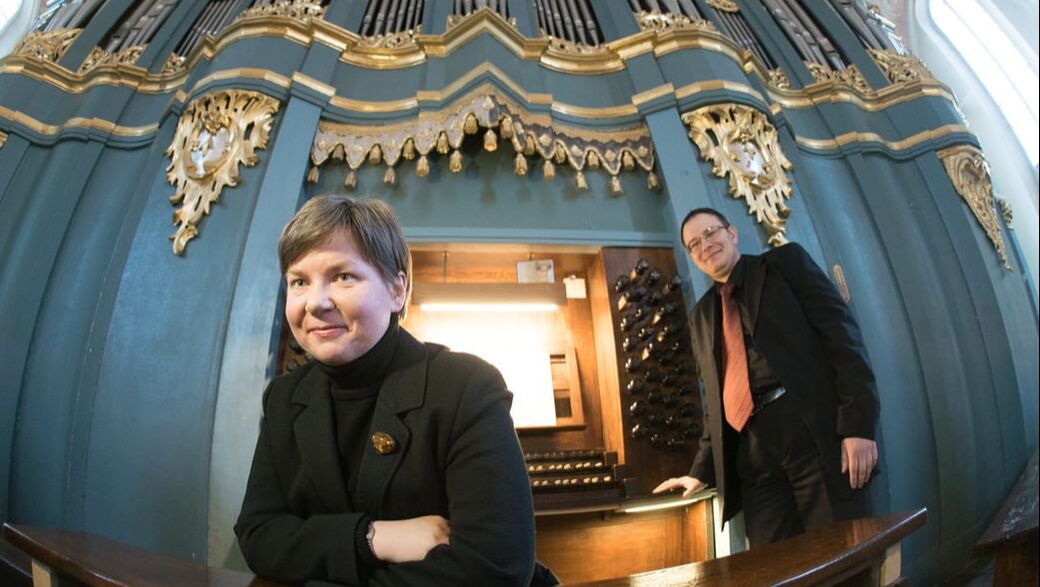 Photo by Edgaras Kurauskas Authors
Drs. Vidas Pinkevicius and Ausra Motuzaite-Pinkeviciene Organists of Vilnius University , creators of Secrets of Organ Playing. 
Our Hauptwerk Setup:
Don't have an organ at home? No problem - print out our paper organ manuals and pedals and start practicing today!
Categories
All
Archives
August 2026
|

 RSS Feed