|
Many organists would really want to start improvising but are afraid to even try. It's because of these (and other) myths that surround the (seemingly) mysterious art and craft of improvisation.
1. Melodies have to be memorized. No, you only have to memorize the questions and answer them. Answers can be simple repeats with different endings or more developed commentaries (just like in speeches). 2. Rhythms must be very elaborate. No, you only have to use the rhythms which fit the meter you have chosen. Pay attention - the moment you feel the rhythms beginning to be boring, add some faster notes in one voice. This will add more interest. 3. You have to be fluent in all 3, 4, and 5 note chords and their inversions, modulations, many different keys and modes. It's nice if you are, but if you only know one 3 note chord and can transpose it in a few keys, it's a good start. 4. It's very difficult to change dynamics with swell pedal. Since you are the one who is creating the music, in places where you need swell pedal changes, you can play with your left foot only or even without any pedal part. 5. It's very difficult to change registration by hand. You can make the stop changes as complex or as simple as you want. You can set the registration in advance and change only manuals for the entire piece, you can play with one hand and change the stops with the other, or you can make a full stop to facilitate registration changes. It's entirely up to you. 6. Texture has to be very elaborate to keep listener's interest. No, some of the nicest improvisations can be done using a simple one part texture. If you are worried about the polyphonic texture, remember that the easiest way to do dialogues and imitations between the voices is when one part is moving and another is stationary. Just like in a conversation between two or more people. 7. Form has to be very advanced with lots of new ideas to be musically interesting. No, the more complex form you have chosen, the more challenges you will face. But the form could be very simple - idea A, idea B, and recapitulation of idea A (with or without some changes). Simple is good in this case. It's important to recognize these myths for what they are - simply untrue common believes and excuses to not even try. By demystifying them, you can set aside your fear and begin your improvisational adventures. The growth begins the moment you sit down on the organ bench.
Comments
Recent research suggests that if we mix up some letters in words, we can still read them, as long as the first and the last letters are in proper place (you can test it yourself on that site with the sentences of your choice). Based on this information, Vadim asks about the relationship between how we read words and how we read music.
His concern is if we see patterns (which we do) and this makes it easier to read music, what if the music is constructed out of unfamiliar or meaningless strings of notes. He finds it hard to imagine what kind of level of focus we should have in order to read the words and the music without patterns - literally. He has a good analogy with a spy who would need to remember multi-digit or multi-letter code. That's a great question and very accurate description of what happens when we read music or words. That's exactly right - what is valid in the language, is very often valid in the musical language as well. We really do see patterns - arpeggios, cadences, familiar chord progressions, even our fingers remember their position on the keyboard. This means that if all things being equal, an organist who is better at music theory, not only is able to understand musical composition better and on a deeper level but also he or she can sight-read better too. But if the music is hardly predictable or seemingly meaningless, you will not see patterns so easily. Just like in the code which needs to be deciphered. Do you like deciphering musical language? Last Saturday, December 13 I had an opportunity to play about 19 minutes while people were gathering before the annual concert of Lucia Day, organized by the Swedish Embassy at the Vilnius University St. John's church. The result was a fantasia on the themes of these Christmas carols: "Silent Night", "O Holy Night", "Santa Lucia", and "Adeste fideles". Today I'd like to share with you the video of this improvisation in which you can see my hands and manuals from up close - this will make it possible for you to follow what and how I'm improvising.
By the way, since Christmas is just around the corner, tomorrow evening at the same church I'm going to improvise on the Story of the Nativity - a 10 part cycle with such stories as the Annunciation, the Shepherds, Jesus in the Manger, the Angels, the Three Wise Men etc. It will be a thrilling experience with elements of Gregorian chant - the hymn "A solis ortus cardine" connecting all the scenes into one coherent and colorful musical adventure. Let's imagine you know major and minor scales, simple diatonic intervals, major and minor triads, the dominant seventh chord and other basic concepts of music theory. Some of my readers could even play them in various keys and build them from various pitches. But what about the more difficult scales, intervals, and chords that you can find in more advanced music? Here they are:
1. Blue scale. It consists of the notes of the major scale but with additional pitches as well - lowered 3rd, raised 4th (or lowered 5th) and lowered 7th scale degrees. 2. Altered scale. In major, the ascending altered scale has additional raised 2nd and 4th scale degree and the descending scale - lowered 6th and 2nd scale degrees. In minor, the ascending altered scale consists of additional raised 4th and 7th scale degrees and the descending scale - lowered 4th and 2nd scale degrees. 3. Altered intervals. These are the augmented, double augmented, diminished, and double diminished intervals that consist of at least one raised or lowered scale degrees of the altered major or minor scale. In major: lowered 2nd, raised 2nd and raised 4th, and lowered 6th scale degrees. In minor: lowered 2nd, lowered 4th, raised 4th, and raised 7th scale degrees. Altered intervals are very useful in building altered chords. 4. Diminished triads. They consist of two juxtaposed minor thirds. Between the outer notes they have diminished 5th. In natural major, they are built from the 7th scale degree and in the harmonic major (with lowered 6th) - from the 2nd scale degree. In natural minor they are built from the 2nd scale degree and in harmonic minor (with raised 7th) - from the raised 7th scale degree. 5. Seventh chord of the 7th scale degree. In natural major it consist of three juxtaposed thirds (minor 3rd, minor 3rd, and major 3rd). Between the outer notes there is an interval of the minor 7th. Between the three lower notes - diminished triad. In harmonic major and harmonic minor all thirds are minor and the 7th is diminished. 6. Seventh chord of the 2nd scale degree. In natural major, it consist of minor 3rd, major 3rd, and minor 3rd. Between the outer notes there is an interval of the minor 7th. Between the three lower notes there is a minor triad. In natural minor and harmonic major the structure of the chord is the same as in No. 5. More about seventh chords - in my new Seventh Chord Training. 7. Dominant ninth chord. This is the most commonly found five note chord. In natural major, it is built from the 5th scale degree and has 4 consecutive thirds - major third, minor third, minor third, and major third. In other words, it is a Dominant seventh chord plus a major 3rd. The interval between the outer notes is major ninth (major 2nd plus an octave). In harmonic minor, the top third is minor and the ninth is minor. In four part harmony this chord is used incomplete - without the fifth (the middle note). If you want to advance in your understanding of music, you can take advantage of the above terms and put them into your bag of tricks while writing and playing them in different keys and from different pitches. No matter if your goals are only to discover them in the pieces that you play or to use them in your own improvisations and compositions, I have no doubt you will find them extremely useful. A few days ago I shared with you my short list of 7 different species of seventh chords (chords with 4 notes). After this post I received some requests from my readers to dig deeper and with more details into these advanced and colorful chords.
After some thinking of how to arrange the training materials on this topic so that my readers would understand and learn it better, I decided to create a video course about these chords. Here it is: Seventh Chord Training. If you want to master these advanced chords, check it out. As it's usual with my programs, there are 2 weeks of bonus trainings included in the price. NOTE: Members of Total Organist Premium and Premium Plus Memberships can take this course without any additional charge. It is no secret that today organ music is not very popular among many people. Even classical music lovers prefer to listen to the piano, violin, symphonic, choral, and vocal music, rather than the organ. The reason is that a considerable part of people's minds is heavily rooted in certain myths about organ and its music. Here I would like to bust some of those myths.
1. Organ music is always sad and serious. As with any other instrument, so the organ repertoire has the works of the most varied moods and characters. Incidentally, even the sad pieces have the delicate balance between minor and major tonalities which create those moods. Organists usually try to maintain this balance in recitals. Listen to The Gigue Fugue of J.S. Bach. There is no doubt that this fugue is really extremely fun piece both to play and to listen to. Pay attention to reaction of the audience. 2. Organ music can only be sacred. Perhaps today it seems strange, but the organ's origins were of secular nature in Ancient Greece. Only in the medieval times the Church adopted this pagan instrument in its liturgy. However, even later organ music, a large part of organ music is secular, like this Finale from the Symphony No. 1 by Louis Vierne. 3. Sacred organ music is always sad. Although the music, like the liturgy of the church often has a serious mood, it would be wrong to assume that it is necessarily sad. Even the works written in minor keys often express other feelings and characters. Very often it depends on the text. For example, it can be pieces of solemn and even dramatic character. In fact, choral prelude In Dir ist Freude by Bach is probably one of the most joyful of his choral preludes. 4. Organ music is always difficult to understand. Such very advanced music exists, there is no doubt about it. But this is only one side of the vast organ repertoire spanning 7 centuries. A number of works written in the 20th and 21st century are like that. However, even this kind of music can be properly understood and appreciated if the listener found out a bit more about the composer, his style, the structure of the piece and so on. In this case, the saying "appetite arises with eating" fits perfectly well. I think that you can befriend advanced music gradually. 5. Organ music is not suitable for young people to listen to. It probably depends on the particular piece of organ music. For example, the piece "Penguins Playtime" by the English composer Nigel Ogden sounds like an excerpt from the movie. Here you will surely find a lot of influence of pop music, which is liked by a lot of young people. On the other hand, not all of young people like pop music either, some of them are heavily into classical and art music. 6. Organ music is played only at funerals. This impression may occur to some people due to the fact that these people associate the church only with funerals (apparently they come to the church only on this occasion). While at the funeral organ music is indeed very prominent, none of the above examples are designed for this occasion. It's not clear to me why organ is not necessarily associated with joyful and sweet weddings because that's surely another side of the instrument that general public is aware of (perhaps because nowadays a lot of other instruments can play at weddings - not so much during funerals). Proper understanding of these myths will clarify some people's reaction to the organ. Hopefully you will be able to explain in some way what organ music is all about. Perhaps then some people will no longer find it scary, sad, boring, or depressing. Most of all, organ music is the food for your brain (besides your soul). And this is a good thing, isn't it? If you play natural and harmonic major and minor scales, you can build the following species of seventh chords based on the 3 consecutive triads. These seventh chords are systematized according to what kind of seventh is between the two outer notes (major - 5.5 steps, minor - 5 steps, diminished - 4.5 steps) and what kind of triad is produced out of the 3 lower notes (major - M3-m3, minor - m3-M3, diminished - m3-m3, augmented - M3-M3). Below is the list of 7 species of seventh chords you may find worth spending the time with.
1. Minor Major Seventh Chord (C-E-G-Bb): Structure: Minor 7th between the outer notes and major triad. Function: Dominant seventh chord (natural major and harmonic minor). 2. Minor Minor Seventh Chord (C-Eb-G-Bb): Structure: Minor 7th between the outer notes and minor triad. Function: Seventh chord of the 2nd and the 6th scale degrees (natural major), Tonic seventh chord and Subdominant seventh chord (natural minor). 3. Minor Diminished Seventh Chord (C-Eb-Gb-Bb): Structure: Minor 7th between the outer notes and diminished triad. Function: Seventh chord of the 7th scale degree (natural major), seventh chord of the 2nd scale degree (natural minor and harmonic major). 4. Diminished Seventh Chord (C-Eb-Gb-B double flat): Structure: Diminished 7th between the outer notes and diminished triad. Function: Seventh chord of the 7th scale degree (harmonic major and harmonic minor). 5. Major Major Seventh Chord (C-E-G-B): Structure: Major 7th between the outer notes and major triad. Function: Tonic seventh chord and Subdominant seventh chord (natural major), seventh chord of the 3rd scale degree and seventh chord of the 6th scale degree (natural minor). 6. Major Minor Seventh Chord (C-Eb-G-B): Structure: Major 7th between the outer notes and minor triad. Function: Subdominant seventh chord (harmonic major), Tonic seventh chord (harmonic minor). 7. Major Augmented Seventh Chord (C-E-G#-B): Structure: Major 7th between the outer notes and augmented triad. Function: Seventh chord of the 6th scale degree (harmonic major), seventh chord of the 3rd scale degree (harmonic minor). Study these 7 species of seventh chords and try to play and/or write them in any key and from any note you want. By doing so they will become your own and you will start to notice them in real music that you play. Moreover, you will be able to use them in your own improvisations and/or compositions. For most people who try to learn to play the organ, pedal playing present some common difficulties, like coordinating hands and feet, playing fast notes etc. But sometimes there are highly specific situations that you don't see in every person or on every organ. In fact, I'm quite sure some people might never experience them altogether. Below is the list of 7 uncommon problems in organ pedal playing.
1. Delayed sound. I have played a few organs which have a curious feature - when you depress the pedals, the sound appears a moment later, even later than those on the manuals. This is due to the fact that either the pedal action is different or the tallest pipes need more time to speak. Solution: Depress the pedals and release them a moment earlier than the manual parts. 2. Distances in different style pedalboards. It's easy to miss the notes on the pedals when you are used to one style of pedalboard (radial, flat etc.) and you suddenly have to play an instrument with a different pedalboard. Solution: Play as many different instruments as possible. This experience will help you adjust to the new pedalboard much faster. 3. Bench in historical organs too high. In this situation, you can barely touch the pedals (especially for shorter people). Solution: Play with your toes only and take a slower tempo. 4. Bench in historical organs too low. When the bench is too low and you can't change it's position, pedal playing requires a lot more muscle work. Solution: Add additional wooden blocks or hymnals under either side of the bench. 5. Pedalboard too deep. When the organ has several manuals, sometimes reaching for the top manual and playing on the pedals is very uncomfortable - pedals seem too far away. And you can't move the bench closer because you will touch the lowest manual. Solution: Don't play the most difficult parts of your piece on the top manual. If you do - slide forward to the edge of the bench. 6. Short octave in pedalboard. Some Baroque organs have an incomplete octave in the bass lacking the lowest accidentals. This layout makes it very easy to play the wrong notes by accident. Solution: Find out the layout of the bottom octave ahead of time and pretend you have the same situation on your organ. Mark those notes on the score and practice them in advance. 7. Additional subsemitones in pedalboard. Similarly to the problem No. 6, some historical organs have additional keys for D#/Eb and/or G#/Ab (even in the pedals). This situation makes it quite strange to play chromatic music. Solution: Same as No. 6. Think about the above unusual problems and if you have the privilege to play such organs, you might avoid those pitfalls, if you prepare in advance in your mind. When you sit down to improvise on the organ bench and continue to play for 10 minutes while recording yourself, you can later listen to this recording and decide what was worth remembering and what could be improved. If you want to create an improvisation that would be worth writing down, it's good to know ahead of time these 7 things which don't contribute to the success of your improvisation.
1. Melodies are without a direction. Always think where the culmination must be (in small details and in a broad general sense). 2. Rhythms are too unified or too contrasting. In either case, your listener will feel bored. Having a clear sense of meter helps. 3. Harmonies that you don't understand. You should be able to name each chord you are playing. 4. Dynamics are too soft or too loud for a long time. Be mindful of your listeners - nobody likes the same dynamic level over extended periods of time. 5. Registration - no balance between the parts. Try to register your piece so that more prominent thematic material would be just a little louder than the rest of the parts. 6. Texture is too similar or too varied. If the piece is very short, unified texture is a good thing but when you play longer than 2 minutes - try to vary the texture (but not too much). 7. Form is not balanced or undecided. The hard part for an improviser is remembering the themes (which is the easiest thing with written composition) and repeating some of them in a balanced way. Don't start to play until you have figured out what the form should be (simple is OK but hectic is not). Consider the above 7 things to avoid which will make each of the musical elements more interesting and artistically pleasing. This in turn will help you create a highly balanced improvisation which you and your listeners will enjoy. Let's pretend you have decided to learn a couple of contrasting pieces by a certain date (say, in 30 days). You have long thought about having a nice goal, almost like a small mission for yourself and since living with the feeling of regret, laziness, excuses, boredom, and aimlessness became too depressing, you have looked at the mirror and said to yourself: "Now or never". So you are all pumped up with excitement and ready for change. These two pieces would add a nice excitement into your day - you will watch your skills grow every day and by a certain date you will be ready to play them in public. Here are a few mistakes to avoid when you are planning and goal-setting your organ practice: 1. Starting with too much excitement. When we are jumping from joy about the prospect of succeeding in some exciting goal, it's very easy to lose ground. Temptations come every day, every hour, every minute. Our inner dragons are waiting for us around the corner. Actually it's nothing special. Start silently. Practice just today. If tomorrow comes, you will have another chance. 2. Having too much to learn every day. Have you planned to learn one page a day? Maybe you can do it once or twice, but believe me, in three days your mission will become unbearable (unless you are professional at this) because you will have to repeat previously mastered material. Bite only what you can eat. If you learn one line a day, then you have a chance to do it long-term. 3. Giving in to the idea "it's not the first time I decided to achieve something and failed." Of course, we all have had our failed New Year's resolutions and other epic failures, some public, some private. But it's not a failure, if you learn from it. F = Feedback. Although you are not some Super Man, but you are not a loser either. This time it's worth your effort. 4. Thinking about the end result all the time. Looking too far ahead without doing the work for today is pointless. All that matters is today. Remember, you are like this train going from place A to place B. If you are on the right track, you will reach your destination. But you have to keep moving. 5. Scolding yourself for not being able to keep up with your plan. There will be some days when you miss a practice session or two. This happens and it's OK. Not that you must chicken out of your mission. You see, your inner dragons want you to stop. So every slip you make along the way will be held against you (in your mind). You can adjust your plan as long as you keep going. Make sure you pay attention to these common mistakes. You don't want to be disappointed and go back to where you started without actually achieving anything. But find your inner strength, believe the power of today, and you will successfully master these pieces and will be ready for another challenge. Result is not the goal. Process is the goal. 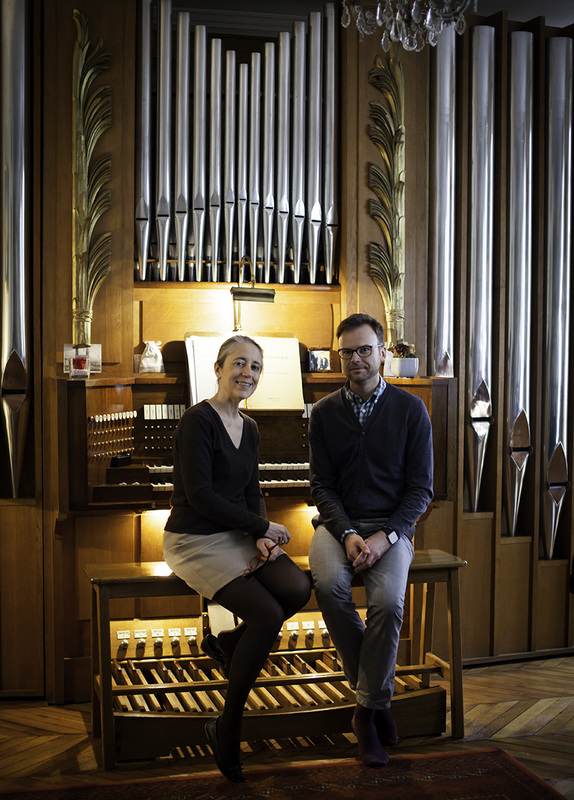 Paulius Grigonis: Moments when the dreams come true... With Professor Sophie-Véronique Cauchefer-Choplin. |
 DON'T MISS A THING! FREE UPDATES BY EMAIL.
 Photo by Edgaras Kurauskas Photo by Edgaras Kurauskas
Authors
Drs. Vidas Pinkevicius and Ausra Motuzaite-Pinkeviciene Organists of Vilnius University , creators of Secrets of Organ Playing. Our Hauptwerk Setup:

Categories
All
Archives
April 2024
|

 RSS Feed