SOP Podcast #99 - Gerd Hennecke and Markus Kumpf: Passion, Teachers and Practice on Different Organs6/18/2017
organists from Bavaria in Germany, Gerd Hennecke and Markus Kumpf.
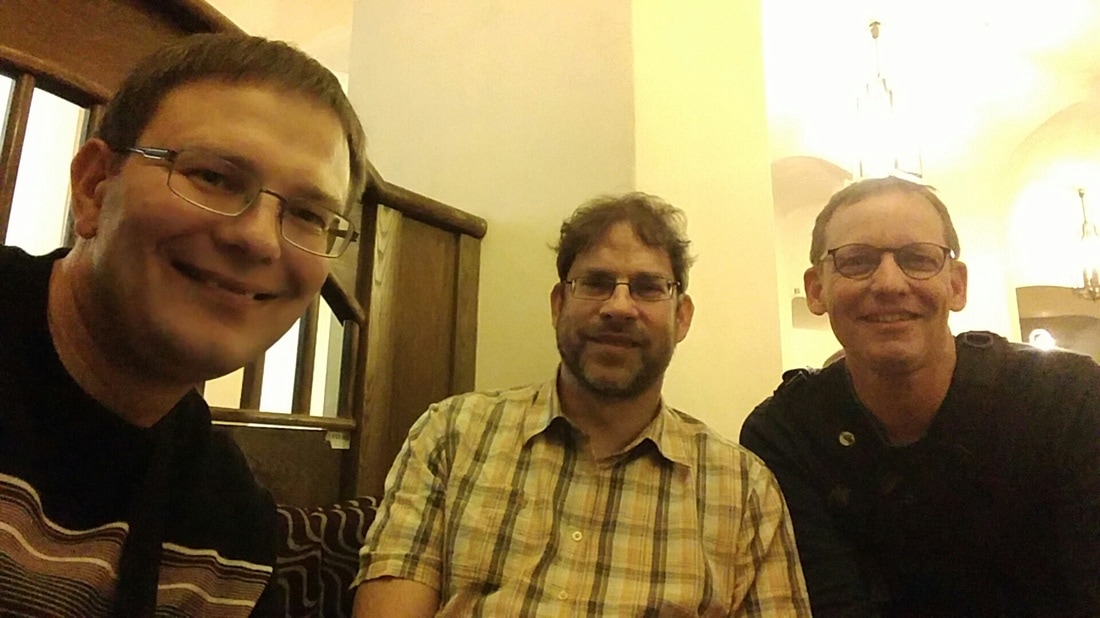
We met at Vilnius University St. John's church last week where a few days before Gerd played a concert of organ, vocal and oboe music together with soprano Gunta Gelgote and oboist Juste Gelgotaite. Gerd kindly agreed to share his organ journey with our podcast listeners and even brought a friend Markus who was returning to Vilnius from another town, Nida, a UNESCO protected national treasure on the Curonian Spit in the Western part of Lithuania. Both Gerd and Markus also played a joint recital this week in Vilkyskiai, a small town with the German organ about 250 kilometers west from Vilnius. Gerd Hennecke was born in Schwabach, Germany, in 1970. After the completion of a degree in Sacred Music in Bayreuth, he undertook further studies of organ music with Domkantor Professor Hartmut Rohmeyer in Lübeck. Since 1995 he worked as professional church musician in Augsburg and Wolfsburg. His current employment as organist and choirmaster with the Protestant „Church of Christ“ in Sulzbach-Rosenberg started in February, 2001. His work with several choirs and instrumental ensembles is widely acknowledged. In 2017, he was awarded the title of „Church Music Director“ (Kirchenmusikdirektor). In 2001, Gerd founded the „Sulzbacher Kantorei“ choir, which over the years has performed numerous oratories and a-capella concerts, showing a repertoire ranging from the Renaissance up to the Modern Era. Furthermore, he is also working as organ expert and campanologist. Before his concert here in Vilnius I asked him a few questions and Gerd gladly shared his responses. Vidas: Which type of music programs do you prefer? Gerd: I appreciate all the different musical works featured in my concerts. However, each organ is a unique product, stilistically and musically, and thus, the main task of an organist is to find the appropriate works for the organ in question. I was very fortunate to play the organ at the St. John Church intensively in 2016. Both, the Church's interior and the organ itself favor grand scale compositions, which is why I have chosen masterpieces by Johann Sebastian Bach and Alexandre Guilmant. Moreover, the organ of St John's supports a variety of tonal colors with the main stops, which provides a perfect accompaniment for the oboe – every color and tuning of the oboe can be matched by an equivalent of the organ. Vidas: What's the greatest difficulty at playing the organ for you? Gerd: As every organ presents us with a unique „personality“, the most difficult thing is to adapt yourself to the instrument as quickly as possible. The organ in Vilnius has 64 stops, which are allocated to three manuals plus pedal. All stops can be combined with each other in a multitude of ways. Only if you are acquainted with a lot of different organs, you will be able to determine the suitable timbre for each composition. This is where my work as an organ expert comes into play. I am used to work with a multitude of organs on a daily basis. For exampe, I even had the chance to play some very interesting instruments in Lutheran churches in Lithuania: Vilnius, Kaunas, and Vilkyškiai. Vidas: What are your plans for future organ explorations? Gerd: It's a delight to witness the progress of organbuilding in Lithuania during the last three decades. The organ of St. John's in Vilnius is a significant example. Built by Rimantas Gucas, who was a visionary and idealist at the same time, it is the synthesis of Western organbuilding with Lithuanian influences. Even today, we can listen to the sound of pipes built by the great baroque organ builder Casparini. Gucas was able to create a masterpiece, in which the musical languages of France, Germany, and the Baltics are being combined to form a superb tonal entity. So in today's conversation, Gerd, Markus and I talk about their organist careers, the importance of having passion, good teachers and access to many different organs. Enjoy and share your comments below. And don't forget to help spread the word about the SOP Podcast by sharing it with your organist friends. Thanks for caring. You can reach Gerd andMarkus by email. |
DON'T MISS A THING! FREE UPDATES BY EMAIL.
AuthorVidas Pinkevicius' conversations with internationally renown experts from the organ world - concert and church organists, improvisers, educators, composers, organ builders, musicologists and other people who help shape the future of our profession. Archives
November 2017
|

 RSS Feed