|
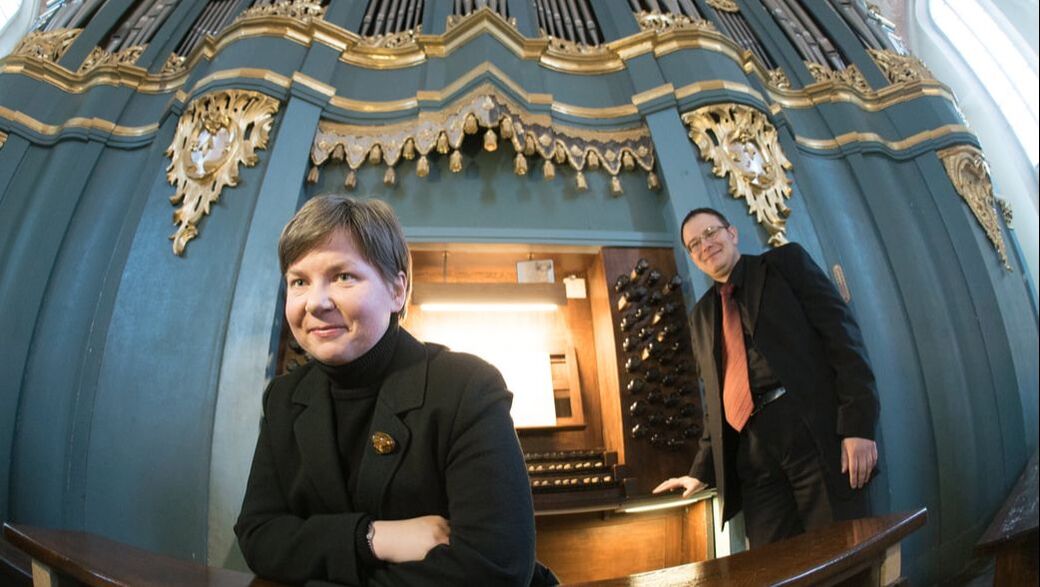
Vidas: Hi guys, this is Vidas.
Ausra: And Ausra. V: Let’s start episode 291 of Secrets of Organ Playing Podcast. This question was sent by John and he writes: “Lately I've been having trouble with osteoarthritis in my right hand (and to a lesser extent in my left) so my practice has been restricted to work on the pedals. Simple finger-work is basically fine for me, but holding a note(s) while the other fingers move can be quite painful. Being a pianist my pedal playing has always needed attention but it's distressing to have the hands so sore after playing.” V: How long can you play without the pain? “It varies, Vidas, but if the pain gets bad I just give up for the day and let my hands recover. If I start a session with no particular pain I can play for maybe fifteen minutes or so without too much trouble. If the texture is complicated and I'm trying (for example) to hold an inner part while another melody weaves around it that can be troublesome. I think I need to choose repertoire with more care and try to avoid anything that gives me grief. My home practice instrument has a modern keyboard action, so I don't have to deal with tracker action.” V: I think Ausra that John partly answered this question himself. A: Yes and I thought that the best solution for him would be to play trio sonatas. V: Where one hand takes one voice, another hand takes another voice… A: and the pedal has another voice. So that you wouldn’t have to deal with those center voices and to hold them up and to be in pain. If I would be John and I would have problems like this I would first consult a physician because it’s dangerous to practice like this without consulting serious specialist because you might hurt yourself even more. V: Right, sometimes even permanently. A: I know and it’s a serious matter. So if you haven’t done it yet you need to consult your physician. V: Umm-hmm. He might have written about that if he had visited a physician before so maybe it’s pretty important for him to go to the doctor. A: Because I think that some kind of these problems it might be good to exercise but in some cases it might be harmful so you never know what type his problem is unless you consult a serious specialist. V: Umm-hmm. A: But anyway if the piece hurts yourself don’t play it or if it makes your condition worse play another one. V: And play for a shorter amount of time. A: Sure and organ repertoire is so vast that you can choose from so many things that you really don’t have to give yourself such trouble and get that pain. V: Umm-hmm. Maybe work more on the pedal playing because he needs that because since he is a pianist. A: Yes and I myself always struggled with the thick texture because my hands are like cat’s paws and I don’t have strength in them and it’s very hard for me to play big chords. I still cannot avoid playing big chords but I avoid things with big texture where I need to stretch a lot and things like Max Reger. I played it when I had to do it when I was a student but now I’m certainly not making myself to go through that again. V: How is Cesar Franck working for you? A: Well it’s working quite well actually except maybe a couple of pieces. Maybe not so much the beginning of E Major chorale and maybe not Prierre. But with other things I can do pretty fine. V: Because anybody who has seen Franck’s picture and his hands might have noticed that he had enormous span with the palm and his texture very thick and chromatic. Sometimes you make tricks with playing the bass line with the pedals even though it’s written for the hand but in general it’s quite complicated texture. A: Yes it is. And for me for example it’s much easier for me to play playful music, something like Durufle, like Durufle Scherzo or Prelude from Veni Creator Spiritus, the Prelude, Adagio and Variations than let’s say Reger. V: Right. Reger has its own problems most of the time although he wrote trios too. A: Yes, and I played them and I did fine and they didn’t cause trouble for my hands so trio texture is wonderful for me. V: Umm-hmm. And if we go back to John then obviously trio texture would teach him a lot about coordination, right? Remember Johann Sebastian Bach created those trio sonatas for his own son, Wilhem Friedemann. A: Yes, his older son. V: And he was quite a virtuoso. A: True. And let’s see if one hand hurts more then you can practice another hand with the pedal. V: Exactly. And if you wanted to get started easier you can use our score with fingering and pedaling for E Flat Major Trio Sonata which is number one. So guys this is basically our advice for John or for anybody who might suffer wrist pain, hand pain, finger pain sometimes, right? A: Yes and also another suggestion would be keep your hands warm. V: You mean not only warm up before practice but keep gloves. A: Yes I know things like what you put on your wrists. V: It is dense. A: It is dense, yes. Like made from natural wool. It might help to reduce pain. V: That works of course. Heated environment. Keep yourself warm for people who can tolerate. A: Of course, consult your physician before doing any of these things that we have suggested. V: The first thing you have to do is set an appointment with the doctor. A: Sure. V: And then if he or she lets you play then play wisely. Stop before you are feeling the pain, not after it’s too late. But rest while you still feel comfortable even though you might have practiced for as little as 5 minutes. A: And maybe your doctor will suggest you to take some medication too to reduce the pain. V: Yes, well avoiding pain is sometimes tricky especially in later part of life. You don’t always know what to do. For some people exercising more is a good solution but for others not so good. Or exercising certain muscle groups might be problematic. Maybe John can find some kind of exercise routine which is helpful for his own condition but that could only real doctors tell. A: Sure. V: Thanks guys for sending these questions. You see we’re not always qualified to answer them but we could give you some pointers what to do next, where to find some real medical help. And please continue sending your challenges and dreams, what you want to accomplish in organ playing in the next 3 months or 6 months and what is stopping you, right? The challenges, right? And we will try to sort it out and get you unstuck. This was Vidas. A: And Ausra. V: And remember when you practice… A: Miracles happen.
This blog/podcast is supported by Total Organist - the most comprehensive organ training program online. It has hundreds of courses, coaching and practice materials for every area of organ playing, thousands of instructional videos and PDF's. You will NOT find more value anywhere else online...
Total Organist helps you to master any piece, perfect your technique, develop your sight-reading skills, and improvise or compose your own music and much much more... Sign up and begin your training today. And of course, you will get the 1st month free too. You can cancel anytime. Join 80+ other Total Organist students here
V: Let’s start episode 268, of Secrets of Organ Playing Podcast. This question was sent by Lorelei. And she’s our Total Organ student. She writes:
Dear Vidas, I think it might not be a bad idea considering my case, to do a podcast or an article on how to keep the back and neck pain free and hopefully injury free while practicing piano and organ etc. I must say I have in the last 5 weeks a very keen interest in the subject. Thank you for your well wishes and again, thank you for your wonderful contribution to the music world. Lorelei V: So Ausra, have you ever had a back or neck pain? A: Of course. I think every body who plays [an] instrument has experienced this. V: Why do you think organ is so, organist sometimes get this kind of pain, or more often than on other instruments? A: Well I think that everybody who does the sitting, jobs, gets this pain. I think this pain is also often, in those people, who for example work with a computer all day long. Because I think in general, back doesn‘t like this sitting position, and especially when you play organ because you cannot place your feet on the ground. V: Mmm-hmm. A: You have to keep them on the pedalboard. V: And they‘re playing, and you have to find the balance and it‘s a very delicate thing. A: So, the spine suffers from it. V: Remember at musical academy, we had this friend Vitalijus, who had back problems many times. A: Yes, I remember that. V: So, one thing that was recommended to him was probably some kind of yoga stretches. Don‘t you think that‘s helpful? A: I think you need to be careful with yoga and stretching. You really need to know what you are doing because you may hurt yourself even more. I think in general, maybe not so much stretching is important, although it is important, as it’s important to strengthen your back muscles. V: Oh, so that‘s where Pilates might come in. A: Yes. V: Mmm-hmm. A: I think Pilates might help. V: Tell us more. A: Well, what? (Laughs). I‘m not a Pilates instructor, but i know I,,, V: Is there one particular exercise from that program that you attend which helps to support your back muscles? A: Yes, actually it‘s a very simple one. You just have to lay down,,, V: On the stomach? A: Yes, on the stomach, and then you have to take your hand and leg, opposite side. V: Mmm-hmmm. A: And to,,, V: Slowly raise them. A: Slowly raise them, and then to put them down, and then to do that with the other side of your body. V: So then when you raise your right hand, you at the same time raise the left leg. A: That’s right. V: And then you slowly lower them down, and you raise the left hand, while raising the right leg. A: Yes. So, it should be always on opposite hand and opposite leg. V: Mmm-hmm. A: Or I should say arm, because you have to raise entire arm. V: Mmm-hmm. A: So basically this is a classical exercise for stretching your back. V: They also have this, Superman, remember, pose,,, A: Yes. Where you,,, A: Yes. Although Superman is harder sort of exercise. If you are just beginner then you better start with the first one. V: Or a swimming exercise: You lie on the stomach, you probably raise a little bit your front, and with the hands extended, you do some kind of swimming motion, right? And the same with the legs too, at the same time. A: So there all kinds of exercises you need to know, to try some of them. And of course, another thing; if you are experience the pain, you need to break between your practicing. V: Mmm-hmmm. A: You could not sit and play for a few hours in a row, without exercising and taking breaks. V: Mmm-hmm. Taking breaks usually works for me every twenty-five minutes of the thirty minutes. I get also tired and I need to talk a walk, get a glass of water, stretch. I do this Salutation of the Sun, collection of exercise. It takes only a couple of minutes, but then my entire body is stretched and warmed up and ready to do some work in many positions. Not only in sitting but I could do some strenuous strength training afterwards. A: Another thing that would might help would be swimming. Swimming is also very good for back. V: Mmm-mmm. A: And in general for your muscles. So, you need to try some of these exercises, swimming. And never think you need to check if you are sitting right on the organ. Maybe your position is incorrect. V: Right. A: Maybe you are sitting to low, or too high. V: If you are sitting too high then I think it’s easier than too low, for your back. A: Well, it could be either way. Because also if you are sitting to high as you try to reach the pedalboard, you might injure your back too. V: Hmmm. Right. So the classical sitting position on the organ bench is when you place the bench in parallel to the pedalboard, yes? And when you sit, your feet have to touch the pedals, but only gently, without depressing them. And the bench should be positioned in relation to the manuals so that your toes should almost touch the sharp keys, right? A: That’s right. V: Naturally, while you relax your feet. Then you know you are sitting correctly and efficiently. Some people move the left side of the bench further from the keyboards. Is that healthy? A: I don’t think so. I don’t thinks so. Because in that case you need to twist your back a little bit and I don’t think it’s good. Also I found sometimes you have to practice your hands on a different manual. And for example, if you practice for a long time, and let’s say your left hand is always above the right hand; let’s say you have a three manual organ and you practice the right hand on the first manual and left hand on the third manual. I had experience like this. And if you practice for an hour or two in such a position, you back is sort of twisted. It also might hurt your muscles. V: Right. So change the position of your hands frequently. Right hand goes on the upper manual, and then left hand goes on the other manual, and vice versa. Switch them up, maybe with each repetition of the piece, right? One repetition could be this way and the second repetition could be that way. A: Yes, and this is especially useful when you practice for example, such piece as trio sonata. V: Mmm-hmmm. A: And it’s also, if you practice on one instrument and when you will go to perform on another one, it will be easier for you to get used to the new instrument. Because you never know for sure how you will register it when you will be finally arriving on the organ,,, V: Exactly. A: On which you will perform. V: I remember the time when I was a student and it was really difficult to adjust on the situation when my right hand was supposed to be on the top manual, and then I had to switch to the lower manual, because my professor suggested also this way. Now I understand I had to practice constantly, changing the manuals. A: Yes, if your back problems, or neck problems will increase or will not release you from the pain, I think it’s better if you will consult your physician. Because it might a serious condition, really serious. V: Mmm-hmm. Our advice is very basic and general. Of course, it is applicable for people who don’t have a back pain but want to prevent back and neck pains in the future, right? But if you have something really serious and specific for your situation, obviously you need to check with your physician. Thank you guys. This is interesting discussion. We hope this was helpful to you. Please send us more of your questions. We love helping you grow. And remember, when you practice,,, A: Miracles happen!
This blog/podcast is supported by Total Organist - the most comprehensive organ training program online. It has hundreds of courses, coaching and practice materials for every area of organ playing, thousands of instructional videos and PDF's. You will NOT find more value anywhere else online...
Total Organist helps you to master any piece, perfect your technique, develop your sight-reading skills, and improvise or compose your own music and much much more... Sign up and begin your training today. And of course, you will get the 1st month free too. You can cancel anytime. Check it out here Here's what one of our students is saying: I am learning greatly from the sharing of other organists on their experiences with composers, some of whom are new for me. I find inspiration from them, too. Total Organist is a community builder. (Ruth) Would you like to receive the same or even better results that Ruth is getting? If so, join 80+ other Total Organist students here. |
DON'T MISS A THING! FREE UPDATES BY EMAIL.Thank you!You have successfully joined our subscriber list. Photo by Edgaras Kurauskas
Authors
Drs. Vidas Pinkevicius and Ausra Motuzaite-Pinkeviciene Organists of Vilnius University , creators of Secrets of Organ Playing. Our Hauptwerk Setup:
Don't have an organ at home? No problem - print out our paper organ manuals and pedals and start practicing today!
Categories
All
Archives
November 2025
|

RSS Feed