|
Maintaining accuracy in organ playing is very important for organists. If you play a public organ recital or a simple church service, you have to be able to play without mistakes. Achieving this level is not easy because you have to know how to practice systematically and in the most efficient way. In addition, your performance has to be very focused and your mind has to stay in the current measure. Below you will find my most important tips on how to achieve accuracy in organ playing.
When you practice your organ piece, try to choose a slow practice tempo. The simple rule is this: play at the tempo in which you can avoid making mistakes. This usually means practicing at a half speed or 50% slower than the concert tempo. The next thing you have to do is to subdivide your piece into manageable fragments of about four measures and practice them repeatedly over and over again. Also remember not to play the entire four-part texture right from the beginning because in most cases it will be too difficult for you. What you can do instead is to play separate parts of that fragment. When this becomes easy, master it with two-voice and three-voice combinations and only then attempt to play the entire four-part texture. Always remember to aim for at least three correct repetitions in a row of each particular step. In order to achieve and maintain accuracy in your public performance your mind also has to be focused. What this means is that you have to think about your current measure you are playing. Don't think about episodes or fragments that you have already played - they are gone already. Don't think about the future episodes - they have not yet come. Just stay in the current measure or in the current moment. This will help you to stay focused and pay attention to details on a deeper level. Also this will help you to reduce the stress and the level of anxiety. You will not fear your audience and you will not fear any difficult episodes or fragments that are coming up if you perform in such focused manner. Apply my tips in your practice and public performance and this will help you to maintain accuracy whenever you play an organ recital, a church service or just for your friends or family. Advice for Organists: Finding a Technically Manageable and Musically Worthwhile Repertoire7/20/2013 When you first start playing the organ, you will discover right away that majority of organ repertoire is too difficult for the beginner organist. In other words, the pieces might be really well constructed but you will not be able to learn them if you are just starting out. On the other hand, some pieces are easy to manage and learn but they are simply not musically interesting enough and not artistically pleasing. So you have to find a balance between these two sides of the organ repertoire - technical requirements and artistic quality.
The best way to go about finding such a composition which is technically still accessible to a relative beginner and musically interesting enough to keep you interested for a long time is to choose a piece by classical organ composers. By classical composers, I mean that these are masters whose works have stood the test of time. So anything you will find written by a major organ composer will be worth playing and worth practicing for a long period of time and you will not feel bored. On the other hand, even in these classical pieces you will find a high number of places which will be technically too challenging. So what you have to look for in these pieces are texture, rhythms, and key signatures. The texture has to be simple enough and rhythms have to be not complicated and the keys should be easy to understand and to play. Let's consider each of these three points in turn. The simplicity of the texture means that it's best to choose the piece which has only a few voices. Try not to choose four and five or even six voice compositions if you are a relative beginner. The most number of voices for you will be three - one for the right hand, one for the left hand, and one for the pedals. The next thing to consider is the simplicity of the rhythms. In other words, the note values have to be not complicated and you should not see any syncopations and smaller note values such as sixteenths and thirty-seconds. The smallest note value has to be an eighth note or an eighth note triplet. Lastly, the keys have to be simple and easy to play for you. If you are a beginner, try to avoid pieces which have more than one accidental next to the treble and the bass clef. Consider my tips in your practice and apply them when you choose the piece to play. If you choose wisely, you will be able to learn and master it very effectively. Any organist who wants to master this instrument aims for efficient practice. What this means is that you simply have to be able to practice in a manner which would allow you to master as much organ repertoire as possible in as little a time as possible. Achieving this level is not easy but here are a few simple rules to consider.
First, your repertoire should be within your technical reach. This means that if the organ piece is too difficult for you at the moment then you will face a higher probability of frustration. Consequently, you might even quit practicing altogether so the piece has to be not too difficult. The second thing to consider is how you practice. Your practice has to be repetitive, slow, persistent and regular. Let's consider each term in detail. Your practice has to be repetitive in a way that you should practice your fragments or episodes over and over again. This will help you to make your playing very fluent and consequently you will avoid making mistakes. Also you will correct any mistakes you make along the way because you will be repeating your fragment many times. Second, your practice has to be slow. Even though the concert speed of your piece is fast, try to pick a very slow practice tempo. In other words, your practice tempo has to be so slow that you would avoid making mistakes. This usually means that you should be playing about 50% slower than the concert tempo is. Third, your practice has to be persistent. This means that whenever you feel that you are making a mistake you have to go back to the beginning of the fragment and correct it at least three times in a row (usually more, because three times is just a minimum number of repetitions). Finally, your practice has to be regular. It's no good if you just practice once or twice a week and skip two or three or more days without even touching an organ. The best way to practice efficiently is to practice regularly and this is one of the most common mistakes I see beginner organists make. They practice sporadically once or twice a week while in reality they should be practicing every single day even for as little as 30 minutes. You don't need to practice for many hours a day but only 30 minutes might be enough so try not to skip your practice time. Apply these tips in your practice and with time you should be able to practice efficiently on your instrument and learn pieces very fast and easily. Do you have a dream of becoming a competent organist who can play difficult compositions with ease and fluency? If so, you have to know how to use existing organ pieces which will help you to incrementally improve your organ playing skills. Below you will find my personal recommendations on how to achieve that.
Let's start with understanding the level of difficulty of an organ piece. You see, even though you like certain pieces by classical organ composers, the difficulty level of these compositions might be very different. So if you practice several compositions which are different in technical demands, then your organ playing skills will develop much slower. Instead, you should find the system of using organ compositions in increasing level of difficulty. This will help you progress in organ playing in the step by step manner. What I recommend you would do is to find organ pieces which are easy in technical demands. For example, the keys should be simple enough, the rhythms should be no more than eighth notes, and the texture should have no more than three voices. If you find that kind of composition, then you should master it and perfect it so that you can be ready for public performance with this piece. But you should not stop here. Find similar compositions and learn them as well. When you feel that learning these pieces are getting easier and easier by the day, you can start looking for compositions which are more advanced. For example, they could have four voices, smaller note values like triplets or sixteenths and so on. Perhaps the keys used in these pieces might have larger number of accidentals. Remember it is best to do it in a step by step manner. Increase technical demands of your piece just a little which means the requirements should not become more difficult in all these areas at once but only change one technical limitation at a time. For example, choose a piece which has the same number of keys but smaller note values. Or it could be the piece with the same note values but with a different number of voices and so on. Apply my tips in your practice and try to find these pieces. Mastering them will help you incrementally increase your organ playing skills. Many organists who like playing the organ spend a lot of time practicing organ pieces every day. However, if they lack proper structure in their practice sessions, then they will lack the direction. This lack of direction will slow down their progress in organ playing. In this article, I would like to share with you my thoughts on the importance of structured practice.
The usual practice session of many organists looks like this: they take an organ piece that the like and play it from the beginning until the end several times and take another piece and do the same. So their time ends and they call it an organ practice. However, it is far from an efficient and effective organ practice because it lacks the proper structure, direction and goal. If you just play your pieces from the beginning until the end, chances are you're not developing the skills that you need. You also are not learning your pieces to the best of your ability. Instead, you should work on mastering each individual piece. Here's what I mean: you should be striving to make it an error-free, fluent, musically interesting, and enjoyable to listen to. This can be accomplished only if you have the proper goal for each and every of your practice sessions. So in each individual practice session you will have to know specifically what you need to master and what kind of steps do you have to take in order to achieve that. One of the best ways to practice your organ music is to work on individual fragments repeatedly. In order to better control your movements and avoid making mistakes, you have to choose a very slow tempo and work on perfecting separate voices or parts. Only then you can go on practicing two-voice combinations and three-voice combinations. It would be a mistake in many cases to attempt to play the entire four-part texture right from the beginning because this kind of texture simply will be too difficult for you at the moment. However, you should structure your practice in such a manner that you take one step after another and little by little you will succeed in reaching your goal of that particular practice session. Remember that one practice session leads to another and so on until you master the entire piece. Think about these tips when you practice organ playing and implement these steps and techniques in your everyday structured practice. This will help you to achieve much higher level than you are currently in. Do you ever find yourself in a situation that you sit on the organ bench and practice your organ music but are not accomplishing anything of importance in organ playing? If this is the case, it is very likely because you don't have any structured goals set for your future. In this article, I will share with you my thoughts about the importance of structured goal setting for organ playing.
If you don't have any important goals set for your organ playing, chances are that you are not advancing very much. Just think about it for a moment. How can you achieve your goal, if you don't know what the goal is? Even more importantly, how can you achieve your goal, if you even don't have one? Your goals can be long-term goals or short-term goals. Long-term goals work best for your future accomplishments and short-term goals work really well for your everyday practice. An example of a long-term goal would be becoming competent church organist or a famous recitalist or developing excellent organ sight-reading skills and so on. All these long-term goals are related to much longer periods of time - most likely many months, sometimes years. Shorter range goals, on the other hand, work really well for supporting your longer range goals. An example of a shorter range goal would be mastering a specific piece of organ music. This could be even shorter and more specific, like mastering a particular section of that piece. Your goal would be small, if it fits into one practice session. They are the things that you want to accomplish in one sitting. Just remember that one practice session leads to another and another. So they can lead to the larger goal you are setting for yourself for the future. A final thing to remember is that your longer range goals should be exciting enough that you will feel some sort of challenge and excitement for yourself when you will reach them. If the goal doesn't excite you enough to strive for it to be persistent and persevere in your daily practice, it probably means that it is too small. So your short-term goals must be very specific. If you do this, they will contribute to your long-term goals. Apply my tips in your goal-setting practice and you will discover how much faster you will progress in organ playing because you will have vision for the future. Imagine that you have written an organ piece of about 24 measures long. This usually is about one page of music. You can now easily expand your piece into a larger composition while following my simple tips.
One of the simplest ways to expand your organ composition is to add a contrasting middle section. By contrasting I mean it should be different in one of the several most important musical elements: thematic material, keys, rhythms, harmony, texture, and registration. So you can choose a different theme for your second section, a different type of rhythm, contrasting keys or different kind of chords. You can also use less or more voices and you can use different stop combinations. Let's call this middle episode section B. Remember your original piece will be named section A. So if you compose section B from scratch, then you will have two contrasting sections or episodes - sections A and B. In order to make your composition complete you can repeat this section A at the end. The first section A then will be called an exposition and B will be called a recapitulation. In order to make the B section more complete you can design it in the same way as you have composed the exposition. In other words, it can also have 24 measures. These 24 measures can be divided into three parts each of eight measures long. If you want your section B to be more interesting, you can change the meter. In addition, you can also make your melodies much more different than in section A. For example, if in section A there were many leaps, then in section B the melody could be composed more in a stepwise manner. Similarly if in exposition your melodic material included more steps than leaps, then in this middle section you can do the opposite. Try to apply my tips in your organ composition and create this section B with recapitulation at the end. This way you will have a nice ternary ABA form. If you want to master organ playing and develop your technique, you must understand the importance of efficient use of practice time. Too often people sit on the organ bench for several hours a day and don't accomplish anything worthwhile. In this article, I would like to share with you some tips which will help you to use your practice time more efficiently.
If you find yourself playing the organ without a new goal in mind, you should stop right away and think what you would like to accomplish today. It is very important thing to do. Without this small goal for today your organ practice will not be effective and efficient. You must have clearly defined goals. For example, this could be just perfecting previously mastered material, learning a new episode of organ music, memorizing one section of your piece and so on. When you have your goal that next step is to take action. Every action on your organ bench will lead you closer to your goal so if your goal for today is to memorize four measures of your organ piece then that's what you have to do. Don't sight-read any organ music; don't play any of your favorite hymns. Instead you should focus on memorizing those four measures. The best way to memorize these four measures is to subdivide them into for separate measures and memorize them individually. When you can play each of the four measures separately, combine them into fragments of two measures and later of three measures and only then attempt to play four measures without stopping from memory. So this kind of practice is very specific and helps you to use your practice time efficiently. If you only have 15 minutes available for your organ practice today, don't despair - you still can achieve some important tasks. For example, you would perfect your previously mastered material that you played the day before. This might mean repeating it at least three times. Aim for correct notes, rhythms, ornaments, fingering, pedaling, articulation, and hand and feet position in each repetition. If you make any mistakes, go back and try to correct them. Apply these tips in your practice and remember that you always have to have clearly defined goals for each practice session. This will prevent you from using your time inefficiently. Sight-reading is a very important skill any organist must develop because it helps you to play an unfamiliar organ music with fluency and ease. Some people believe that this skill is difficult to develop and only geniuses would succeed in playing new pieces fluently. In this article, I will share with you some tips which will help you to understand that systematic approach to sight-reading is possible and it provides wonderful results.
My first recommendation for you is to find an organ collection that you like and start playing it one page a day. However, do not attempt to play the entire for-part texture with hands and feet combined right away. The best way to go about practicing sight-reading is to play solo parts first. This means playing the soprano part separately, the alto part, the tenor and finally the bass part separately in the entire collection. After you do that, go back at the beginning of the collection and start practicing two-voice combinations. Make sure you are covering every single one of them without missing any of these steps. Every step and combination is just a little bit more difficult than the previous one and leads to the next step. The following step would be to practice three-voice combinations from the beginning of the collection. Again, try not to skip any combination of three voices and aim for your playing to be fluent and free of mistakes. This may mean that your practice tempo should be much slower than the concert tempo. This systematic step-by-step approach allows you to progressively advance in sight-reading and be able to play with four parts together later on. By the way, you can make an experiment which will prove to you how effective this system is. Here is what you have to do. Before practicing your sight-reading, try to play all parts together of your first piece right away. You will soon discover how difficult it is and you will make many mistakes. Make a mental note of exactely how many mistakes you have made in one page of music. However, repeat the same exercise after you complete this training and you will discover who much further you have progressed with this systematic step-by-step approach. If you want to become competent in organ sight-reading, try to practice it every day. If you skip one day without practice, only you will notice it. If you spend two days without practice, your teacher will notice it and if you skip three days without practice, then everybody else will notice it. If you are a church organist and your duties include regular playing of hymns on the organ, you have to develop good hymn playing skills. There is a systematic procedure you can follow if you want to become competent in hymn playing. If you want to find out my tips please read on.
The best way to go about perfecting your hymn playing skills is to find a hymnal you could use at home for your own practice every day. Depending on your level of proficiency on the organ you might want to make things easier or more difficult for yourself. What I mean is that if you are good in sight-reading four-part harmony and chords, then you could play four parts right away. Do this in a slow tempo for several months in a row and you will be quite competent in playing the hymns in four parts fluently. However, for people who have weak sight-reading skills, I recommend practicing in separate voices first. For example, when you open your hymnal, play just the soprano part of that hymn. Then take another hymn and also play the soprano part. Do this for a number of hymns. After you sight-read the soprano line of about 100 hymns, you can go back to the beginning and start practicing the alto line. Later take the tenor line and the bass line in the same manner. When this becomes easy, start playing two voices at a time and later three voices. There are many combinations of two-part playing and three-part playing so make sure you cover all of them in your hymn-playing. After the last combination you can go back and start practicing these hymns while playing the entire four-part texture. This way you can become quite competent in hymn playing regardless of your current technical limitation. This type of systematic approach to hymn-playing is very simple yet very powerful. However, it is not easy to follow through because it takes many days of consistent and regular practice. If you apply my tips and aim for at least three correct repetitions in a row of each particular hymn, you will discover some tremendous changes in your sight-reading of the hymns and you will be able to play them with fluency and ease. |
 DON'T MISS A THING! FREE UPDATES BY EMAIL.
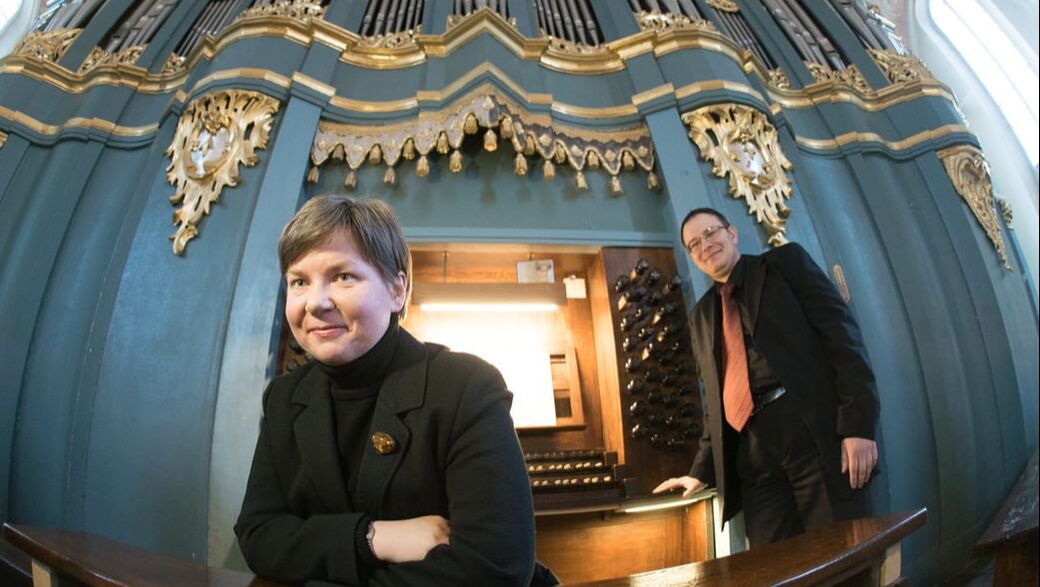 Photo by Edgaras Kurauskas Authors
Drs. Vidas Pinkevicius and Ausra Motuzaite-Pinkeviciene Organists of Vilnius University , creators of Secrets of Organ Playing. 
Our Hauptwerk Setup:
Don't have an organ at home? No problem - print out our paper organ manuals and pedals and start practicing today!
Categories
All
Archives
August 2026
|

 RSS Feed