|
A beautiful Passion chorale O Sacred Head, Now Wounded has wonderful harmonies. In this video, I will first play this hymn once through and then analyse each chord, key and modulation. Then I will come back and play it one last time with a different registration. Hope you will enjoy Begard sample set sounds by Piotr Grabowski and my Hauptwerk setup.
Thanks so much for your support! You get early access and I get to keep going.
Vidas: Hello and welcome to Secrets of Organ Playing Podcast!
Ausra: This is a show dedicated to helping you become a better organist. V: We’re your hosts Vidas Pinkevicius... A: ...and Ausra Motuzaite-Pinkeviciene. V: We have over 25 years of experience of playing the organ A: ...and we’ve been teaching thousands of organists online from 89 countries since 2011. V: So now let’s jump in and get started with the podcast for today. A: We hope you’ll enjoy it! V: Hi guys! This is Vidas. A: And Ausra. Vidas: Let’s start episode 638 of Secrets of Organ Playing Podcast. This question was sent by Graham, and he comments on my recording of the practice session of his Idyll. So he writes,: “Wonderful, Vidas! It was written in the summer of 2020 during the first lockdown of the Covid pandemic. I saw a competition advertised for a meditative piece for organ and this composition appeared nearly instantly! I do love Erik Satie's 'Gymnopedies' (I have heard you play No 2 on the organ!) and there is a strong French impressionist influence in this piece. It came together remarkably quickly from an initial improvisation to the finished composition as I was very near the deadline for submitting for the competition. As you know, I am not 'original' in my writing as I recognize everything I create is derivative - a fusion of everything I have ever heard or played. I love the music of Cole Porter and George Gershwin and Irving Berlin . . . so there is a trace of those songsters deep inside the piece as well. It sounds gorgeous on the Salisbury Willis - a sound I never expected to hear. THANK YOU!” Vidas: So Ausra, do you remember me playing this piece? Ausra: Yes, I remember it. Sweet little slow meditative piece. Vidas: Idyll. It’s like a pastoral scene from an antiquity time with lots of nature and maybe some animals. Ausra: I think it really fits the Salisbury organ very well. Vidas: Yeah, I enjoyed playing it. So what Graham writes in response to the style, did you hear Erik Satie’s influence here? Ausra: Yes, a little bit, yes! Vidas: The triple meter is kind of similar to Satie’s Gymnopedies (here is the score of organ arrangement of Gymnopedie No. 1). I don’t know how to pronounce it either. So yeah. I wonder if it’s difficult to create or improvise a piece like this, Ausra! Ausra: I think it depends on everybody’s skills! Vidas: So as a harmony teacher, what do you hear when you listen to this piece? Ausra: Well, as far as I have heard Erik Satie’s Gymnopedies, and I used to play them on piano, at least a few of them, they are strongly influenced by Jewish music, or at least that’s what I thought when I was working on them and when I heard them played. You played them on the organ. And of course in this Grahams piece, Idyll, I don’t hear that Jewish influence. At least not that remarkable. What do you think about that? Vidas: By Jewish you mean special modes, right? Special intervals in the scale… augmented intervals. Right? Ausra: Yes, and of course the minor keys. Vidas: No, probably most similar this with Satie’s work stem from the triple meter in my mind. But other than that, it’s like a major key, idyllic character, slow moving tempo, and in general a very gentle rocking sort of feeling. It’s like a little bit… remember we played this piece by Ad Wammes about the boat. Ausra: Yes, I remember it very well. Vidas: Something about the lake, summertime, breeze… Ausra: Yes there was sort of a like a suite out of like four movements. Vidas: And one of them was probably in triple meter, too. So I imagine lying on the bottom of a small boat in the middle of the lake on a hot summer day, and this boat gently rocks back and forth. I can hear water splashing on it, on the sides of the boat, and maybe some sounds from nature, you know, gentle breeze blowing, also. Sort of idyllic vacation feeling. Do you like this feeling? Ausra: Yes, especially now when it’s really cold outside. I would wish it would be summer and I could be on the lake! Vidas: Do you usually spend your vacations like that on the bottom of the boat? Ausra: Well, actually no, I don’t own the boat, so… Vidas: Yeah, it’s new to me, but I can just imagine how it would look. Looking, obviously, up to the sky, right, when you lie on the bottom of the boat. It’s a good feeling. Could this piece work as a liturgical music, too? Ausra: Of course. You could play it for communion. It wouldn’t hurt, definitely. Vidas: Even though it’s not based on any preexisting chorale melody or hymn tune. But the gentle character fits the liturgy well; especially for communion, maybe offertory, maybe at the beginning, too, for gathering, as a prelude. Right? Ausra: Maybe it’s too soft for a prelude. Vidas: Why too soft? Ausra: You would want something louder in order to quiet people who are walking downstairs. Vidas: Oh, you mean like Brenda? Ausra: Yes. Vidas: Tell us about it! Ausra: I think I already told about it a few times, about that comic strip that I saw when we were back as students at UNL, and there was an old lady in that drawing who actually had a hunting rifle, and she was sort of silencing the crowd for her prelude with a gun! Vidas: Right. That’s probably very symptomatic of the situation before the service in any church. Right? People gather and they talk, they haven’t seen each other for a week, probably, or longer, so any music that is played before the service is not on their radar just yet. Just like, obviously, the postlude after the service. Ausra: Yes, you finish the postlude and there is nobody left in the church. Everybody is having coffee. Vidas: And if you are playing a fugue as a postlude, then voices are enter one by one, and people leave one by one, which is not true. Right? Ausra: I think it’s nice that at least some people stay to listen the postlude and they applaud after that. Vidas: I was just going to say that people do not actually leave one by one, but they tend to leave in droves. Excellent. Shall we wish Graham to keep creating? Ausra: Sure! I think it’s a real gift if you can compose music, so just keep doing that. Vidas: And to make your pieces available, because it’s really hard to get! You have to write an email to the composer and the composer has to write you back with the score. It’s obviously complicated to both the would-be-performer and to the composer. It should be frictionless. I suggested that he could upload it to Sheet Music Plus and he could sell those scores, but Graham wanted for people to have them for free, so why not upload them to IMSLP like Petrucci Music Library? Ausra: Yes, I think that’s a great idea. Vidas: And it would be free, available instantly for anyone. Ausra: That way maybe more organists would get access to it and would perform it more often. Vidas: Yes, for this, we really hope this will happen in 2021. And please send us more of your questions if you have about the composition process, about performance issues that you encounter in the works you play for perhaps, we would like to help you out. And remember, when you practice, Ausra: Miracles happen. V: This podcast is supported by Total Organist - the most comprehensive organ training program online. A: It has hundreds of courses, coaching and practice materials for every area of organ playing, thousands of instructional videos and PDF's. You will NOT find more value anywhere else online... V: Total Organist helps you to master any piece, perfect your technique, develop your sight-reading skills, and improvise or compose your own music and much much more… A: Sign up and begin your training today at organduo.lt and click on Total Organist. And of course, you will get the 1st month free too. You can cancel anytime. V: If you like our organ music, you can also support us on Patreon and BMC and get early access to our videos. A: Find out more at patreon.com/secretsoforganplaying and buymeacoffee.com/organduo  Thank you everyone for participating! You all made us very happy with your entries. We have all selected the following winners. You can congratulate them here. And if you want to participate in the next week's contest, here are the rules.
Vidas: Hello and welcome to Secrets of Organ Playing Podcast!
Ausra: This is a show dedicated to helping you become a better organist. V: We’re your hosts Vidas Pinkevicius... A: ...and Ausra Motuzaite-Pinkeviciene. V: We have over 25 years of experience of playing the organ A: ...and we’ve been teaching thousands of organists online from 89 countries since 2011. V: So now let’s jump in and get started with the podcast for today. A: We hope you’ll enjoy it! V: Hi guys! This is Vidas. A: And Ausra. V: Let’s start episode 643 of Secrets of Organ Playing Podcast. This question was sent by Whitney, and she writes, My challenge is with getting enough courage to play hymns with pedals. I can do it fine when practicing, but I get way too nervous when I’m playing at Mass. V: Hm. That’s a good question, right Ausra? A: Yes, I think all beginners go through this stage when you are scared to add pedals. V: It can be compared with any type of new skill that you are trying to build up, and when you want to play it for yourself, it’s one thing, but when you present for others, it’s completely different. Let’s imagine you want to improvise for yourself, right? Yes, it’s confusing sometimes, but you can feel much safer than playing for others, correct Ausra? A: Sure. Well, you know what I could suggest for Whitney to do - when she practices for herself, let her imagine that she is playing in public. You can do that sometimes. You can trick your mind sometimes. And you might get as nervous during practice as you get in a real performance. And that might help to control that stress level that you get. V: And one way to do that is obviously to record yourself, even with video. Put a cell phone, if you don’t have a tripod, just position maybe further away from you so that your hands and feet would be visible, and play that hymn, right? Several stanzas. And you will soon discover how different you feel when you know that you are being recorded, correct? A: Sure. And also, never skip practicing with the pedal and playing in public with the pedal while accompanying hymns, because I think the pedal is crucial for hymn singing. V: Plus, if you skip playing with pedals, let’s say you’ve been practicing a hymn or a few hymns for a week, and then Sunday comes and you have to present it with the pedals, but you suddenly get stressed out and play only manual parts, then what happens is that you suddenly sacrifice your progress, right? This one day. A: Yes, that’s very true. Because I think that things will get easier the more experience of public performing you will get. V: Another thing that seems strange from Whitney’s question is that I’m not sure she’s practicing hymns correctly. Because she writes “I can do it fine when practicing,” but then she’s getting way too nervous when playing at mass. So I assume she would play the manual part, correct, when playing in the hands, she would need to do soprano/alto in the right hand and tenor and bass in the left hand part, correct Ausra? A: Sure. V: When playing with pedals, the correct way of playing hymns is to omit the bass in the hand and play it instead with the pedals. Don’t double hand and feet. A: But very many beginners actually do that. V: So my question is, if you can do it the right way for yourself, how can you suddenly, suddenly play all four parts in a different arrangement - two parts in the left hand instead of just one part in the left hand, right away in public? A: I think it’s not such a difficult thing, because most of organists come from the background of being more or less pianists. So I think it’s easier to manage two voices suddenly with the left hand than one with the pedal. V: Another explanation is that she is doubling the bass line in the left hand part, and then she just drops the bass in the pedals and plays the hands. A: Yes, that’s also possible. V: That’s more than likely to me. Because I’ve seen it over and over again. And this is incorrect. This will slow down your progress. It actually is counterproductive. A: It is, yes. But you know, some people might add that we have all these various organ stops in the instrument. I mean, 16, 8, 4, 2 and so on and so forth - and that we have that one single note doubled or tripled, or four-tuplet many, many times. V: Quadruplet. A: Quadruplet, yes - four tuplet! (laughs) My English is not so good, but you know what I mean. And people might ask you, then what is the problem if I’m doubling bass in the pedals with my left hand? Because organ already doubles everything everywhere. What could you say for people? V: Obviously, you don’t have to take my word as 100% truth. It’s okay to play with hands only, without the pedals. It’s okay to play two parts, soprano and bass. It’s okay to play the trio texture without one of the inner parts. It’s okay. And as long as you have variety and still play some four part texture as well, yes Ausra? A: Yes. V: You can play five parts if you want, or six, with double pedals. (laughs) You see? There is no one right way to do it. And you can solo out the melody, the chorale line on a different manual, taking the alto and tenor in the left hand part. Or you could even play soprano part in the left hand, but left hand but one octave lower - that would be in the tenor - and switch tenor and soprano in the right hand part. That would be interesting, this position. Various creative ways to play hymns, but more advanced, obviously. So, least advanced way to play hymns convincingly and still build up your pedal technique and independence of hands and feet is by playing four parts, soprano/alto in the right hand, tenor in the left hand, and bass in the pedals. So, final thoughts, Ausra? A: Yes, I agree with you as always. V: Not always you agree with me. A: Okay, okay. But I agree this time. V: Yeah. Do you agree that people should record themselves? A: Yes, it’s very helpful. You know, what would be a correct way to say it? If you want to live in peace right now, then maybe don’t record yourself. Because the recording will trouble you a lot. But if you want to be at peace in the future, then better record yourself today, and your recording will teach you a lot. It will teach you more than a good teacher can do. Because when you listen to yourself from the side, you will suddenly realize what you lack, and what you should do in a different way, and what you are doing right. It will teach you a lot. V: Exactly. It’s like preparing for a competition ahead of time. Preparing for a stressful situation. Do it yourself right now, something more difficult, so that later you will be well prepared and feel easier, okay? Thanks guys. This was Vidas. A: And Ausra. V: Please send us more of your questions. We love helping you grow. And remember, when you practice, A: Miracles happen. V: This podcast is supported by Total Organist - the most comprehensive organ training program online. A: It has hundreds of courses, coaching and practice materials for every area of organ playing, thousands of instructional videos and PDF's. You will NOT find more value anywhere else online... V: Total Organist helps you to master any piece, perfect your technique, develop your sight-reading skills, and improvise or compose your own music and much much more… A: Sign up and begin your training today at organduo.lt and click on Total Organist. And of course, you will get the 1st month free too. You can cancel anytime. V: If you like our organ music, you can also support us on Patreon and BMC and get early access to our videos. A: Find out more at patreon.com/secretsoforganplaying and buymeacoffee.com/organduo Today was an online meeting with our book club friends. In it we celebrated a birthday of one friend. I was asked to improvise a piece based on the Memory from the musical Cats. On this occasion I mixed it with Happy Birthday, Podmoskovnyje vechera and Ilgiausiu metu. Hope you will enjoy the result on the Sauer organ sample set from Chemnitz and my Hauptwerk setup.
Score of Memory from Cats for piano: https://www.sheetmusicplus.com/title/... Thank you for your support! You get early access and I get to keep going. Today I recorded Allemande from Partita I, BWV 825 by J.S. Bach on Ruckers Harpsichord model Pianoteq software. Hope you will enjoy it!
Thank you for your support! You get early access and I get to keep going. Get early access: https://www.buymeacoffee.com/organduo https://www.patreon.com/secretsoforga... Today I had not much time to record between my online classes so I mastered Prelude from Bach's Partita No. 1, WV 825 using Ruckers harpsichord model and Pianoteq software. The sound is quite realistic. Enjoy!
Thank you for your support! You get early access and I get to keep going. Get early access: https://www.buymeacoffee.com/organduo https://www.patreon.com/secretsoforga... The organ that I'm going to demonstrate today stands at St John Cantius church in Cracow, Poland. It was build in 2004 by Jacek Siedlar and has 30 stops over 3 manuals and pedals. The style of this instrument is French Romanticism and this sample set was made by Piotr Grabowski. Hope you will enjoy it!
Thank you for your support! You get early access and I get to keep going. Get early access: https://www.buymeacoffee.com/organduo https://www.patreon.com/secretsoforga...
Vidas: Hello and welcome to Secrets of Organ Playing Podcast!
Ausra: This is a show dedicated to helping you become a better organist. V: We’re your hosts Vidas Pinkevicius... A: ...and Ausra Motuzaite-Pinkeviciene. V: We have over 25 years of experience of playing the organ A: ...and we’ve been teaching thousands of organists online from 89 countries since 2011. V: So now let’s jump in and get started with the podcast for today. A: We hope you’ll enjoy it! V: Hi guys! This is Vidas. A: And Ausra. Vidas: Let’s start episode 636 of Secrets of Organ Playing Podcast. This question was sent by Steven, and he writes: “Hi Vidas. Organ playing is going okay, thank you for asking. These days I am making more time for practice, which is key. I still feel like I am a slow learner, but I know how to pull apart a new piece and start making it work. Pedal work continues to improve, with the biggest aspect I'm noticing is my accuracy. The right foot position (like keeping toes touching the "black" pedals) seems to be super helpful. I have a teacher, and we have lessons every other week for one hour. I typically work up a couple hymns out of the ELW, sometimes an introduction or related piece with those hymns. Then I have several other pieces in various states of progress.” Vidas: So Steven is talking his practice during the pandemic, and I’m very glad that it’s improving. Ausra: Yes, and in general, I thought one day that many musicians will become really virtuoso during this time. Vidas: Why is that? Ausra: Because they stay home and practice all day long! Vidas: Like we do! Ausra: Yes. But of course, I don’t practice every day and all day long. Vidas: Well, right. Ausra: Because I have to teach online. Vidas: When the pandemic hit, obviously a lot of people stayed at home. It doesn’t mean they have more time to practice. Right Ausra? It doesn’t necessarily mean… Ausra: And it does not necessarily mean that they have access to an instrument at home. Vidas: Right. People who relied on church organs now have to figure out a way to play at home. Or people who worked in a physical location before and now have to online during that time, usually that online work takes at least twice as much of time than if you compare it to the physical location work. Is this the case with you, Ausra? Ausra: Well, I save time from the trip to my school and back, and this time I can practice, actually, at home. Vidas: Oh yeah, depending on where you live from your work, commuting could be very time consuming, up to several hours per day. So during that time, if you stay at home and could squeeze in some practice time, that’s even better. Ausra: Yes, and for me, for example, it takes about an hour and a half to go both ways back and forth to school, so, I think it’s a nice practice session. Vidas: But even though you have to work more at school, you kind of are practicing more than before at home. Don’t you think? Ausra: Yes, true. Vidas: How can you manage that when you have so much work to do for online teaching? Ausra: Well, because I have two instruments at home, actually three instruments at home, and I don’t have to go anywhere. I still can find much more time. Vidas: Mmhmm, except, of course, looking at the screen is very exhausting when you have to work online. Ausra: Yes, and you know, the worst thing about this pandemic is that actually when it started, I stopped reading books. I just simply gave up, because looking at the screens takes too much time and too much energy from my eyes, so I stopped reading other books non-related to my work. Vidas: Me too. But we watch Netflix instead. Ausra: Well yes, that’s not a very good habit, perhaps, but you have to do something just not to go crazy. Vidas: Right. So Steven is practicing from Evangelical Lutheran Worship hymnals, and we used to have those in America. Right? The green ones—ELW. Remember those? We have one at home. Ausra: Yes, we have one at home. The old one. Vidas: They have, I think, upgraded, updated since we left The States. Remember, we were going back to Lithuania, and they were getting new hymnals. Ausra: Yes, I remember that. That’s why we could bring the old one with us. Vidas: Right. But I guess the core anthems and chorales and hymns are still the same. The core. Ausra: At least most of them, I guess. Vidas: Right. So, what I would suggest to Steven besides working on hymns, is probably focus more on pieces, also. He spends a lot of time practicing on hymns, but only the last sentence in his answer is about pieces, and we don’t even know what kind of music he plays besides hymns. So basically it’s probably not a big focus for him. Ausra: Well, if he is a church musician it’s natural that you focus more on the hymn playing, although being an active in the Lutheran church, you will surely have to play some solo music as well, for each service. Vidas: At least two pieces per Sunday—a prelude and postlude. Ausra: Yes, and probably maybe even more, especially if you don’t have a choir. Vidas: Right. Now during the quarantine it could be even more, because the organist has to fill in a lot of music himself. Ausra: True. Vidas: So yeah, that’s a good way of looking at things—through organ repertoire. Choose something doable, not necessarily Toccatas and Fugues and standard organ concert repertoire, but maybe shorter pieces—two or three pages. Ausra: Yes, that’s, I think, a good suggestion. Vidas: Alright, so hopefully this will help Steven. Please send us more of your questions; we love helping you grow. And remember, when you practice, Ausra: Miracles happen. V: This podcast is supported by Total Organist - the most comprehensive organ training program online. A: It has hundreds of courses, coaching and practice materials for every area of organ playing, thousands of instructional videos and PDF's. You will NOT find more value anywhere else online... V: Total Organist helps you to master any piece, perfect your technique, develop your sight-reading skills, and improvise or compose your own music and much much more… A: Sign up and begin your training today at organduo.lt and click on Total Organist. And of course, you will get the 1st month free too. You can cancel anytime. V: If you like our organ music, you can also support us on Patreon and BMC and get early access to our videos. A: Find out more at patreon.com/secretsoforganplaying and buymeacoffee.com/organduo  |
 DON'T MISS A THING! FREE UPDATES BY EMAIL.
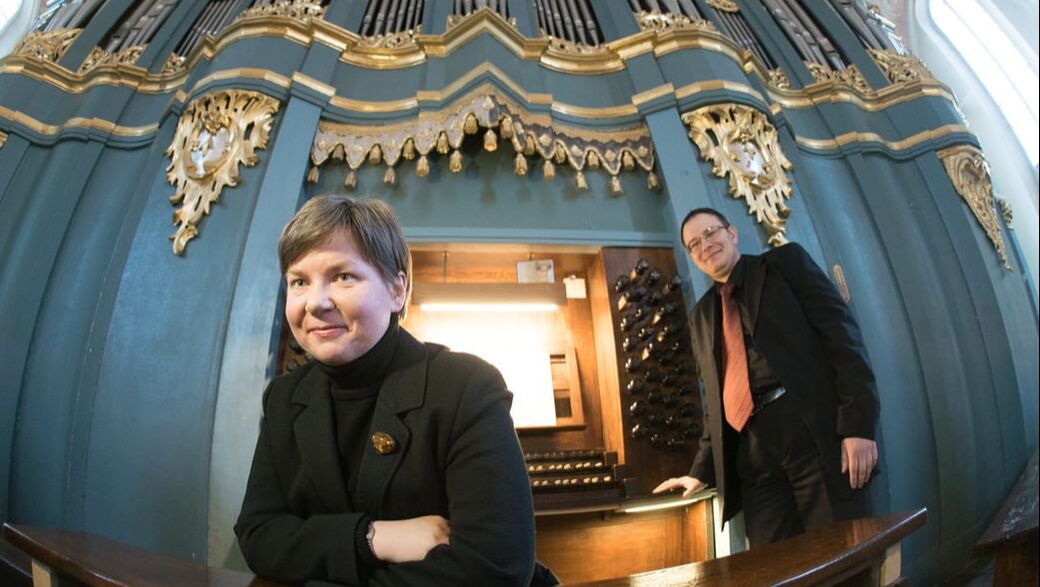 Photo by Edgaras Kurauskas Authors
Drs. Vidas Pinkevicius and Ausra Motuzaite-Pinkeviciene Organists of Vilnius University , creators of Secrets of Organ Playing. 
Our Hauptwerk Setup:
Don't have an organ at home? No problem - print out our paper organ manuals and pedals and start practicing today!
Categories
All
Archives
October 2026
|

 RSS Feed