|
Although there are many technical elements in organ playing, one of the most important and noticeable is articulation. It is precisely articulation which might be the decisive factor about the overall level of the organist. It is such a vital aspect of organ playing because it can help to achieve precision and clarity in your performance. Therefore knowing what kind of articulation to use in any specific organ piece is indispensable skill any organist must strive to achieve. One particular type of articulation, the Ordinary Touch, is commonly used in certain organ music. Today I would like to explain what it is and when you should use it.
Articulate Legato in Early Music If you play music which was composed before 1800s, the general traditional touch is articulated legato. Writers of the Baroque period used a term “Ordinary Touch” to describe such an articulation. As a general rule of thumb you might think of articulated legato as having small distances between the notes. It is not non legato because the spaces between the notes are very delicate which does not make the music sound choppy. Actually, this playing manner is quite vocal and Bach refers to it as “Cantabile”. The authors of the Baroque period called this touch “Ordinary” because it was widely accepted and there was no need to indicate it in the music score. For this very reason you will rarely see any articulation markings in early music. But you should not assume that although the score is clean, you should play everything legato, which some organist still do even nowadays. The habit of playing legato comes from our background of piano playing. Actually, people who have experience with articulated legato touch use it for playing early music even on the piano. This touch has many similarities to the tonguing of wind instruments and bowing of the strings. For example, when a violinist uses up and down strokes of the bow we barely hear the articulation. Nevertheless, we can clearly hear that the notes are not slurred. The same is with articulate legato on the organ. Although there are small distances between the notes, we may not even be aware of them unless we pay attention. The ordinary touch can easily be tested by playing a scale with only one finger but as connected as possible. Then try to copy the same sound with the usual fingering. Emphasize the Meter Although the ordinary touch is very important for early music, you need something more to make the music come alive. You need to emphasize the meter and the strong and week beats of the measure. Because the organ pipes cannot sound louder or softer depending on the level of strength that you are using with your hands, there are three primary ways to make accents in organ playing. First, you can make the strong beat longer which will have the impression of accent on the listener. Second, you can make the weak beat shorter which will have the opposite effect. Finally, you can come in a little late on the strong beat which will make it even more accented. As you can see, not all the notes have the same length in early music. Some notes are longer or shorter than the others depending on the beat of the measure. In syncopation, the weak beat becomes accented. Therefore, make the weak beat longer and the downbeat shorter. If you are interested in articulation and other issues of performance practice, an invaluable resource is "Performing Baroque Music" by Mary Cyr which I highly recommend. By the way, do you want to learn to play the King of Instruments - the pipe organ? If so, download my FREE video guide: "How to Master Any Organ Composition" in which I will show you my EXACT steps, techniques, and methods that I use to practice, learn and master any piece of organ music.
Comments
I have written earlier about the need for a slow practice and the work in fragments, and attention to detail which are all technical things. Although attention to detail is crucial in practicing your organ music, it is not enough to be able to play without mistakes. You need to have a special kind of mentality. Here I am referring to the focused mind which can help you to reach that optimum performance state which in turn will empower you not only to play without the mistakes. Moreover, your performance will have the special power over listeners and you will have their attention fixed on your playing without interruption. In this article, I will explain this mental technique and how to achieve it.
The mentality or the mindset of a world class organist is similar to the state of mind of an athlete or a martial artist. Athletes refer to it as “Being in the Zone”. Martial artists say that “their body should be relaxed but the mind should be on fire”. In other words, they have to have an alert but clear mind. They have to throw all of their thoughts, insecurities, and mental blocks away and simply be in the moment. Various traditions have different techniques which can help you to achieve that state of mind. Some of the most popular are breathing, meditation, or prayer. In organ playing, I find that deep, regular, and slow conscious breathing from the lower abdomen actually helps me to improve my mental focus. When playing a piece of music, I often try to find the natural breathing rhythm. Usually it coincides with the cycle of measures. For example, I may inhale over two or more measures and exhale over the same number of measures and repeat this process over the course of the piece. The breathing should be done through the nose. You can do the same in your piece and you will start to notice some really interesting things over time. If you stay focused on your breathing then your mind gradually calms down, your body relaxes, and you will be able to control your movements much better. In turn, the risk of hitting the wrong note by accident is much lower. If you do play an incorrect note or two during your performance, let it go and force yourself to stay focused and not keep your thoughts on this mistake. Very often if we make a mistake, we think about it for a while when we are playing, we loose focus, and consequently make more mistakes. So no matter what went wrong you have to try to stay focused until the very end. It is interesting how we can make mistakes even in a slow tempo in an easy spot. This is how it may happen. As we are playing, we might be aware how well we play or how easy is this particular episode and again, we may loose our focus. The solution is to keep your focus until the very end. The legendary American organist Marilyn Mason used to say that the recital is not over until you are in the parking lot. Actually, it is so true because if for a moment we relax our focus, we can make a mistake and loose control over the piece. The master French organist Marcel Dupre suggested that we keep our attention fixed on the current measure that we are playing in order to avoid mistakes. This thought is similar to the idea stated earlier of being in the moment. I understand that for most people it will be hard to achieve this level of focus on the organ. However, if you consistently practice slowly, work in fragments, give a great attention to details, and keep your attention on your breathing, eliminating mistakes actually is not too difficult. Simply change your focus from how not to make mistakes to fulfilling the musical needs of the piece, be in the current measure, and your performance level will improve dramatically. By the way, do you want to learn to play the King of Instruments - the pipe organ? If so, download my FREE video guide: "How to Master Any Organ Composition" in which I will show you my EXACT steps, techniques, and methods that I use to practice, learn and master any piece of organ music. Many of my organ students ask me how they can play their organ pieces without mistakes. They ask for an advice about being able to achieve the level of fluency when they could sit down on the organ bench and play flawlessly for a long time any organ composition they want, slow or fast, easy, medium, or difficult. They know it is possible because they have heard top level organists play organ music with such an impeccable technique that it could be taken directly from a CD recording. However, they also know that very few people ever advance this far in organ playing. Performing on this level takes more than mastering a piece of music. It also requires a special attitude and mindset. In this article I would like to give some insight into the techniques which might help you eliminate mistakes in organ playing.
Somebody told me some years ago about the difference between the good performance and a superb performance. When you are listening to a good organist playing some nice organ music, everything seems to sound well. There might be some tiny insignificant errors but in general, you like this performance. However, if you happen to listen to a real world class performer, there is something more in such a playing. It is hard to express this feeling in words but you feel that absolute clarity and sense of precision and perfection in such a performance. If you ever had an opportunity to listen to such playing, you probably know what I mean. I am not talking about many wonderful CD recordings which we all love to listen to, because most of the time they are edited, mastered, and sometimes they may not necessarily reflect the real skill of the organist. I am talking about the live organ concerts, these unforgettable events when you simply marvel at the artistry of the performer. At any rate, the real difference between a good performance and a superb performance is attention to detail. A truly world class organist will know exactly why he or she made some particular decision about some episode in the organ piece. These people never leave anything to chance. At any given moment in a piece they know the exact reasoning about the fingering and pedaling choices, about the rhythmic and melodic accuracy, about the phrasing and articulation, about the registration, or about the formal and harmonic structure of the piece. They simply give such a meticulous attention to any detail that many of us take for granted. So if you seriously want to be able to play without mistakes, I recommend you give some thought about the above mentioned aspects of organ playing. Moreover, once you are sure about your choices in your practice, you should attempt to achieve those things through practice. In other words, it is not enough to know why you are playing this particular spot with this fingering and pedaling, articulation, ornamentation, or registration. You should reconcile all these things through dedicated and relentless practice. Always ask yourself questions like “Does it sound the way I want it?” or “Why am I playing this spot in this particular manner?” Answering to these questions and in turn practicing with attention to detail will enable to progress to such level of organ playing when the task of playing without mistakes will seem insignificant. Instead, you will want to express the composer’s intentions to the best of your ability. And you will have the means to do that. Remember, that professionalism is not necessarily a financial status of a person. You can also think of it as an attitude. You can play like a real professional with absolute precision and clarity a simple 2-part invention or a majestic 5 voice fugue. The complexity level does not matter. What matters is the attention to detail. By the way, do you want to learn to play the King of Instruments - the pipe organ? If so, download my FREE video guide: "How to Master Any Organ Composition" in which I will show you my EXACT steps, techniques, and methods that I use to practice, learn and master any piece of organ music Every organist admires people who can play flawlessly without any mistakes. Such a performance seems like taken directly from a CD recording. While listening to live concerts of top level organists we are wondering how they are able to play without mistakes not one piece but the entire recital. Most people can play with accuracy a slow piece but when it comes to playing in fast tempo, they might hit at least a few wrong notes. This is the opposite with world class artists. There is seemingly no limit of their finger and pedal technique. Achieving that level can take years of dedicated practice but there are certain elements which can help you to progress faster along the road to perfection.
In this article, I would like to give you some advice on how to eliminate mistakes in organ playing. This article is not about the situation when you make mistakes because you do not know the piece well enough and leave some difficult passages not fully mastered. Instead, I am writing about a situation when you think that you have already mastered the piece but during the actual performance accidentally hit the wrong notes here and there. Slow Practice One of the most important techniques which can help you to play without mistakes is a slow practice. If you struggle with accurately playing in a fast tempo, it is crucial to understand that slow practice is a key to success. Even though the piece is fast, you will only be able to reach this tempo through a slow practice. On the contrary, if you usually practice at a concert tempo, the time may come when you will not be able to be in control. In fact, constantly practicing in a fast tempo is actually quite dangerous. You may reach the point of making mistakes habitually and consistently at the same spot. So practice slowly in order to have a full control of your piece. When you are ready, you will reach the fast tempo naturally. If you know the piece really well, mistakes usually occur when you are not aware of every detail, every note or every passage. The music just flies by and you may accidentally hit the wrong notes. This can be cured with slow practice because through it you will get accustomed to notice every important note and every single detail. Work in Fragments If you want to be able to eliminate mistakes in your organ playing, another recommendation would be to subdivide the piece into smaller episodes and work in fragments. If you practice in shorter fragments (4 measures or so at a time), then every mistake you make will be easy to fix. For example, if you make a mistake, stop at that point, go back a few measures and play the same fragment correctly at least free times in a row. Note that if you play correctly twice but make a mistake on the third try, you will have to start counting from the beginning. However, if for some reason you loose patience and continue playing the piece until the end even after making the mistake, chances are that next time you will do the same mistake in the same spot. Remember that if you are constantly practicing eliminating mistakes and forming good practicing habits, then you are progressing the right way. On the other hand, if you don’t fix your mistakes and play with them every time, actually, you are practicing your mistakes, which just move you farther away from your goal. So have patience, practice slowly, work in fragments, correct your mistakes and you will see some real advancement in your organ playing. By the way, do you want to learn to play the King of Instruments - the pipe organ? If so, download my FREE video guide: "How to Master Any Organ Composition" in which I will show you my EXACT steps, techniques, and methods that I use to practice, learn and master any piece of organ music. Many of my organ students ask me for an advice in reaching the fast tempo in their organ pieces. They often struggle to achieve this level of fluency either because their technique is not developed enough or because they do not know how to practice the piece in order to reach fast tempo. Today I will share with you one particular method of practice which will help you reach the fast tempo in practicing organ compositions.
Practice in Fragments If you have difficulty playing in a fast tempo any particular organ piece, here is a special technique you could use. Try to work in shorter fragments like one beat first, then practice this piece in half of measure, then the entire measure and so on until you can play an entire line without stopping. Let me explain how it works. You see, if this composition has to be performed in a fast tempo, then playing the entire work might be too difficult for you at the moment. However, you may notice that you can play all voices together very quickly just for one beat easily. Play just one beat, then stop and hold the chord. Look at the next beat. When you are ready, play another beat and stop. Look at the next beat, prepare and so on. So you will practice stopping every beat. If you have never tried this before, this kind of practice might seem strange to you. You maybe wondering what is the point of stopping at every beat. What happens is that although you stop every beat, you can play the notes of that beat very quickly. And so practice a few times playing the piece this way until you feel comfortable enough. Then make your fragment two beats and stop every two beats. Then one measure, two measures, four measures, one line, two lines, one page, two pages and so on. While practicing this way, you will begin to notice that your ability to play the piece in a fast tempo improves gradually over time. When you stop and hold your chord, do not rush to play the next fragment. Instead, make sure you look ahead and understand in your mind what the next fragment is. Only then play it. In other words, play only when you are ready. Reaching the level when you can play organ music fast is not so easy. As you can see, the system is simple enough for most organists to understand but not too many people reach that kind of proficiency. However, you must persevere and practice with never-give-up mentality. Although there are many techniques in achieving this mentality, one thing in particular is helpful to me – having a clear goal in mind. In other words, you have to have a vision or a goal what it is you are trying to accomplish. If you say that your goal or dream, for example, is to be able to play that wonderful prelude and fugue by Bach or Toccata by Widor at a concert tempo, then you will have the necessary motivation to persevere. No matter how boring, how tiring it will be to practice, you will stick to the plan and successfully accomplish your goal. By the way, do you want to learn to play the King of Instruments - the pipe organ? If so, download my FREE video guide: "How to Master Any Organ Composition" in which I will show you my EXACT steps, techniques, and methods that I use to practice, learn and master any piece of organ music. Every organist wants to be able to play technically challenging pieces with precision, accuracy, and most importantly in a fast tempo. Organists who have this skill deserve much respect from their fellow organists and from their listeners. If you are curious to know how to achieve the fast tempo in organ music, read on to find out.
Practice Slowly The most important thing to remember here is this: you should practice slowly. No matter how boring it may sound, you simply have to have patience and practice at a tempo in which you can avoid making mistakes. If you make a mistake, very often (but not always) it means that the tempo is too fast. Achieving a fast tempo and fluency is similar to lifting weights. If you try to lift a weight for which you are not ready, you will hurt yourself but if you say to yourself “OK, even though I am lifting only that much, this is my current level. I will stick to the plan, and see it through.” This is so true because it is generally believed that you should raise the resistance level by only 10 percent every week for safe exercise. In other words, if you can currently lift 50 pounds, you should add 5 pounds after one week of exercising with this weight. Then add another 10 percent after another week and so on. The same thing is valid for organ playing. Even though you might think that you are progressing too slowly and you are not able to achieve the fast tempo yet, you are making progress, if only you are practicing correctly and slowly. You can even use the metronome for choosing the tempo. Just like with lifting weights or any kind of physical exercise, increase the speed of your metronome by 10 percent every week. When you are ready, the faster tempo will seem natural. Just have patience and you will succeed. In fact, very often people give up playing a certain organ piece only days before a real breakthrough. Build up Your Technique If you feel that achieving the fast tempo is too challenging, it might mean that you need to work on improving your organ technique. Try practicing daily exercises like scales (natural, harmonic, and melodic versions in both major and minor keys), and chromatic scales in parallel and contrary motion in octaves, thirds, tenths, and sixths over four octaves. Also play regular and long arpeggios and chords on a tonic, dominant, and diminished seventh chord. When these exercises become easy, later add scales and chromatic scales in double thirds, and sixths. All of these exercises can be practiced either on the organ or on the piano. Take a pair of major and minor key with the same number of accidentals and practice all of the above scales, chords, and arpeggios for a week. Then every week practice different keys according to the circle of fifths. If you have very limited practice time, work on your technique at least for 30 minutes a day. After a few weeks you will start to see some real changes in your organ playing. A wonderful collection for improving your manual technique is Hanon: The Virtuoso Pianist which include all of the above scales, and arpeggios in part 2 and 3 plus many more exercises for finger dexterity, evenness, and strength. I recommend playing the exercises from Hanon: The Virtuoso Pianist before your regular organ practice because it also serves as a fantastic warm-up. By the way, do you want to learn to play the King of Instruments - the pipe organ? If so, download my FREE video guide: "How to Master Any Organ Composition" in which I will show you my EXACT steps, techniques, and methods that I use to practice, learn and master any piece of organ music. In many churches, in addition to playing the organ organists must also lead the choir. This often happens in smaller congregations were funds are limited to hire a separate choir director. Conducting and leading the choir require very different skills and education than that of an organist. Today I would like to give you some advice on how to lead the choir and play the organ at the same time.
Lead with Your Head When you play the organ and want to be able to conduct the choir, you can lead with your head. This means that whenever you need to show your choristers the entrances, simply use your head movements. Similarly, your choir members will know from your head when to stop singing. Just imagine that your head is your arm and make small but exact movements. In order to show your choir the entrance, try to move your head downward and at the same instant upward with one crisp motion. Play Three Voices in the Right Hand If you play the hymn on the organ and need to conduct your choir, you will need at least one free hand to do that. This means that you should take soprano, alto, and tenor in the right hand (because the hymn tune is in soprano) and play the bass with your feet on the pedals. However, quite often you will find that because of the open chord position, it is not possible to play more than two voices with one hand. If this is the case, another option would be to rearrange the chord position into a close position. In open position chord, the three upper voices can be more than an interval of the fourth but not more than an octave apart. The simplest means to achieve the close position while maintaining the soprano part intact is by flipping the alto and tenor voices. Imagine a C major chord in an open position, such as c-g-e1-c2. The alto takes the e1 and the tenor – g which requires two hands to play the chord. Now flipping the alto with the tenor you will get c-e1-g1-c2 and you can play the three upper notes with the right hand easily. The entire hymn can be rearranged this way while preserving the original voice leading. This technique takes some practice, of course. Conduct with the Left Hand Now when you play with your feet and your right hand only, you can conduct with the left hand. Simply use whatever scheme you need to conduct the meter properly. Use your free hand to show choir entrances and stops also. You can even make some dynamics with your free hand. If your movements are small, your choir will sing softly. To achieve a stronger sound, use wider movements. Make sure that you point to the correct portion of your choir if only a part of it is entering at any particular spot. Practice Conducting and Playing at the Same Time If you try to conduct and play at the same time, you will notice right away how tricky it might be. It is very easy to hit the wrong notes or start conducting incorrectly or both. This happens because your hands must accomplish very different tasks. In other words, you need to achieve hand coordination. Perhaps even more importantly, your brain must also do the same. In order to achieve the fluency while conducting and playing at the same time, you will need to practice your movements. Practice your hymns or anthems ahead of time. Repeat the small sections as many times as you need to do them correctly at least three times in a row. Then combine the shorter fragments into longer episodes. The practical techniques of accompanying the choir with or without a conductor are discussed in Organ Technique: Modern and Early by George Ritchie and George Stauffer which I highly recommend. By the way, do you want to learn to play the King of Instruments - the pipe organ? If so, download my FREE video guide: "How to Master Any Organ Composition" in which I will show you my EXACT steps, techniques, and methods that I use to practice, learn and master any piece of organ music. For many church organists, service playing involves not only performing hymns but also accompanying choir in anthems. One of the main difficulties in playing choral accompaniments on the organ is the legato touch. Although many different kinds of articulation are used in accompanying the choir on the organ, the legato is the most common. Without the proper legato the music might sound too choppy. In this article, I would like to give you some advice on how to achieve legato in playing anthems and choral accompaniments on the organ.
Write in Fingering Very often people do not play with a good legato because they do not know the best fingering. Because it is harder to use the proper fingering if it is not written in the score, I suggest that you write in your fingering. It is especially important that places which are the most difficult in achieving legato would be fully fingered. Do not hesitate to change the fingering if you find a better solution. However, erase the old markings and write in the new ones as you practice for best results. The same applies for the pedal part, of course. Finger Substitution Finger substitution is generally accepted as the most common means to achieve a perfect legato on the organ. However, it should be used wisely. For example, most often there is no need to apply finger substitution in a one voice passage because the legato can be achieved by using position, scale and arpeggio fingering in such a case. However, for episodes which require playing more than one voice in one hand, you can use finger substitution technique. Basically how it works is like this. While holding the same key with one finger, you substitute it with another finger. In chromatic music, this technique can work on chords where you substitute more than one finger at a time (double or even triple substitution). Finger Glissando If finger substitution cannot be achieved and all your fingers are busy, another option would be to use finger glissando. With this technique, you slide from one key to another using only one finger. In some cases, double glissando is also a possibility (sliding from two sharp keys to two natural keys). However, make sure that there is no other way to achieve the legato besides glissando. Quite often you can take the burden of one hand by playing a few notes with another hand. Whatever you choose, always write in your solution in the score. Finger Crossing Like finger glissando, finger crossing is not a very popular technique but sometimes it is necessary to use it. In finger crossing, you place the longer finger over the shorter one and vice versa. This technique is useful in playing wider intervals, like sixths, sevenths, and octaves legato. Usually finger crossing works best with fingers 3, 4, and 5. If you take my advice, write in fingering and use finger substitution, glissando, or crossing in your choral accompaniments, you can achieve a perfect legato even with small hands. More often than not the legato playing depends not on the size of the hands but on the choice of the fingering. The practical techniques of accompanying the choir with or without a conductor are discussed in Organ Technique: Modern and Early by George Ritchie and George Stauffer which I highly recommend. By the way, do you want to learn to play the King of Instruments - the pipe organ? If so, download my FREE video guide: "How to Master Any Organ Composition" in which I will show you my EXACT steps, techniques, and methods that I use to practice, learn and master any piece of organ music. Performance of 16th-18th century hymns on the organ requires special kind of fingering. This type of fingering helps to achieve the desired articulated legato touch and feel the alternation of strong and weak beats. In order to play the hymns in style it is important for an organist to know what kind of fingering to use. In addition, then the organist will have a strong feeling of meter and pulse which helps to lead the congregational singing. In this article, I will show you how to choose the best fingering for 16th-18th century hymns.
Avoid Placing a Thumb on Sharp Keys Because performance of early type of hymns has so much in common with the performance of early music on the organ, generally try to avoid placing the thumb on sharp keys. This has something to do with the early type of keyboard which was used in the Renaissance and Baroque organs. These instruments had keys which were both shorter and narrower than our modern day piano or organ keys. Placing a thumb would be very inconvenient on an early style instrument. Many authors who wrote about performance practice in the 16th-18th centuries had their individual approaches to fingering because of their national school and historical period but most of them agreed that thumbs should be avoided on sharp keys as much as possible. However, sometimes the thumbs are necessary to use because of wider intervals and chords in the left hand part. It is not uncommon to see the position C-G-C in the left hand. The thumbs are OK on the natural keys but if the piece is written in the mode of F or g, very often there is a chord B flat-F-B flat in the left hand. So in this case the thumbs cannot be avoided. The same holds true for an octave B flat-B flat. Avoid Finger Substitution Another important point about early fingering in hymn playing is that you should avoid using finger substitution. Finger substitution is a technique, fully developed in the 19th century and helps achieving a perfect legato touch. This technique involves substituting one finger to another while holding one key. Since we need a different type of articulation in early music, finger substitution will create some difficulties of articulating the hymns properly. Very often pianists who come to the organ will have this problem. If we use finger substitution, we have to think about achieving the articulate legato. On the other hand if we use that special type of fingering, we will articulate the notes naturally. Interval Fingering In hymn playing, when you play two voices in one hand, you can use interval fingering which has much in common with the finger skipping technique. This rule generally means that every interval in the Baroque or Renaissance period had its precise fingering and succession of similar intervals should be played with the same fingerings. For example, the thirds usually were played using 1-3 or 2-4. So the passage of three consecutive parallel thirds C-E, D-F, and E-G would be performed using 2-4, 2-4, and 2-4. Use 1-4 or 2-5 for the fourths and fifths (sometimes 1-5 for fifths is more convenient on a modern keyboard). Wider intervals, like sixths, sevenths, and octave are played with 1-5. Likewise, for a passage of three consecutive parallel sixths C-A, D-B, and E-C, use 1-5, 1-5, and 1-5. Write in Fingering I recommend that you write in the exact fingering that you will be using in your hymn. Do this at least at the beginning stages of your organist career. In doing so, you will prevent from playing your hymns with accidental fingerings which might not help you to achieve the desired precision and articulation. In fact, treat your hymns like normal organ music and practice accordingly. For example, you may find that in some cases playing not the entire 4 part texture but practicing in voice combinations is more beneficial. Or if you have trouble with sight reading your hymn, stop and work on one phrase at a time. By the way, do you want to learn to play the King of Instruments - the pipe organ? If so, download my FREE video guide: "How to Master Any Organ Composition" in which I will show you my EXACT steps, techniques, and methods that I use to practice, learn and master any piece of organ music. Although hymn playing might seem as uniform area of organ art, it requires at least several different approaches. In other words, hymns from different historical period should be played differently. Gregorian chant, metric hymns from the Reformation time, 19th century hymns, 20th century spiritual songs all have their individual playing techniques that work best for that particular style. In this article, I would like to show you how to play 16th-18th century hymns on the organ. These are well-known Lutheran chorales, Calvinist psalms, English psalms, Methodist hymns, and several other hymn types.
Articulate Legato for 16th-18th Century Hymns Because the general traditional touch for keyboard music composed up until the 19th century was the so called Ordinary Touch, it should also be applied for hymn playing of that period as well. Look at the century when the particular hymn tune (melody) was created. I do not mean the date of harmonization, or the date of text creation or translation. Any of these dates might be a product of later times. Only the composition of the hymn tune is important here. If your hymn tune was created in the Reformation time, the Baroque, or the Classical period, then you should play it using the ordinary touch. The ordinary touch in today’s terms might be referred as articulate legato. It is neither legato, nor non legato. The notes should be neither connected smoothly nor too detached. One good way to describe it is this: you should try playing the melody legato using one finger only. For example, play your hymn tune with your middle finger but try to connect the notes as much as possible in order to achieve the singing tone (cantabile) which many Baroque authors adhered to. After playing it with one finger, now try to imitate the touch using normal fingering. Feel the Alternation of Strong and Weak Beats However, achieving the articulate legato in such hymns is not enough. Since one of the most important characteristics of performance practice in early music is meter, try to emphasize the meter. Any meter has a beat which is stronger than the others. It is called the downbeat. In 2/4 meter, the first beat is the downbeat (stronger) and the second is the upbeat (weaker). In ¾ meter, the first beat is stronger, and the other two are weaker. However, some theorists (Kirnberger) claim that beat 3 in such meter might also be relatively strong. It depends on what kind of chord is on this beat. If there is a new chord on this beat, it might be relatively strong. If there is just the repetition of the previous chord or this chord is in different position or inversion, then this beat is a weak one. In 4/4 meter, beats 2 and 4 are the weak ones. Beat 1 is the strongest and beat 3 is relatively strong. In hymn playing, try to make the stronger beats more accented. The other beats are weaker and don’t need to be accented. So this alternation of strong and weak beats is very important in correct performance of 16th-18th century style hymns. Shorten the Weak Beats Since the organ mechanics does not allow making dynamics with the strength or the softness of your touch, the most common way to achieve metric accents and feel the alternation of strong and weak beats is by shortening the weaker beats and prolonging the down beats a little. In other words, if your hymn tune moves in quarter notes, make rests on the weak beats. These rests depend on the acoustics of the room – the longer the reverberation – the shorter the weak beats might be and the greater the articulation. However, do not make them shorter than a half of their full duration (an eight note). Usually it is enough to make a sixteenth note rest. Do not lift your fingers off the keyboard and feel the contact with it at all times. That way it will be easier for you to control note releases. If you would like to know more about hymn playing, I highly recommend studying Organ Technique: Modern and Early by George Ritchie and George Stauffer. This method book has separate chapter on hymn playing with many important exercises. Another great resource is Art of Hymn Playing by Charles E. Callahan. It has 250 Introductions, Preludes, Free Accompaniments, and Alternate Harmonizations. The pieces range from 2 part voicing to more complex. It is meant as a graded guide to hymn playing. By the way, do you want to learn to play the King of Instruments - the pipe organ? If so, download my FREE video guide: "How to Master Any Organ Composition" in which I will show you my EXACT steps, techniques, and methods that I use to practice, learn and master any piece of organ music. |
 DON'T MISS A THING! FREE UPDATES BY EMAIL.
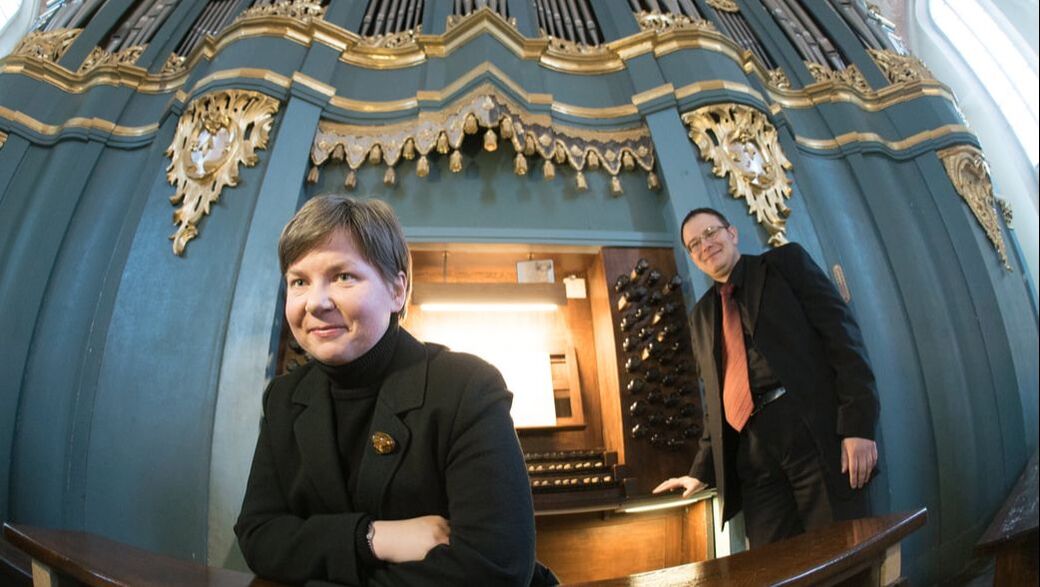 Photo by Edgaras Kurauskas Photo by Edgaras Kurauskas
Authors
Drs. Vidas Pinkevicius and Ausra Motuzaite-Pinkeviciene Organists of Vilnius University , creators of Secrets of Organ Playing. Our Hauptwerk Setup:

Categories
All
Archives
April 2024
|

 RSS Feed