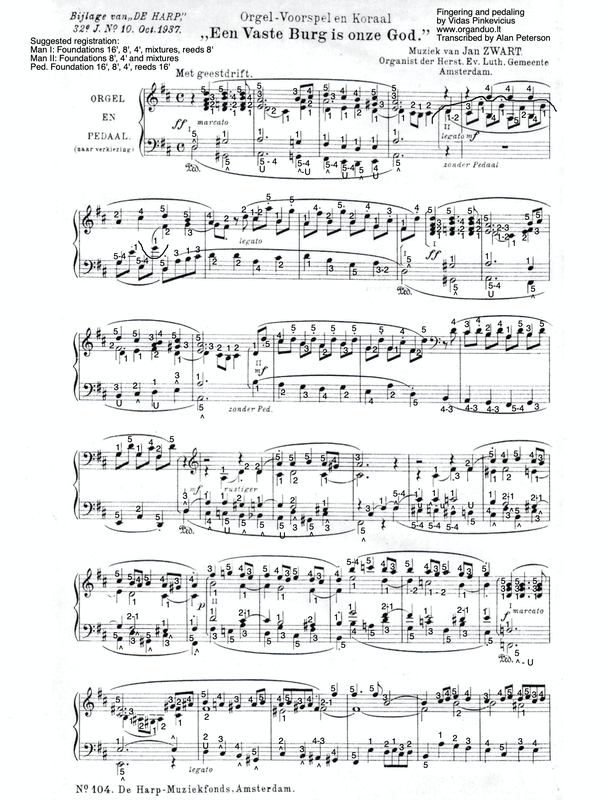
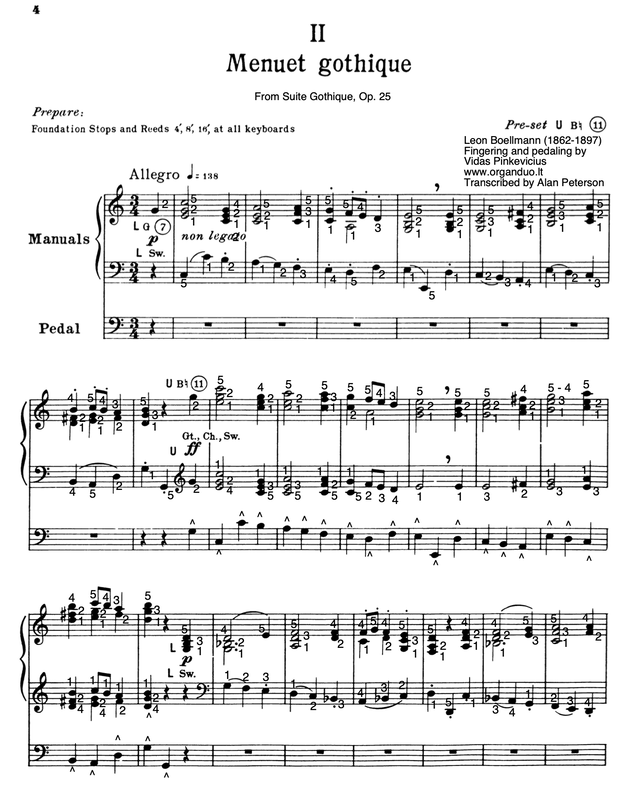
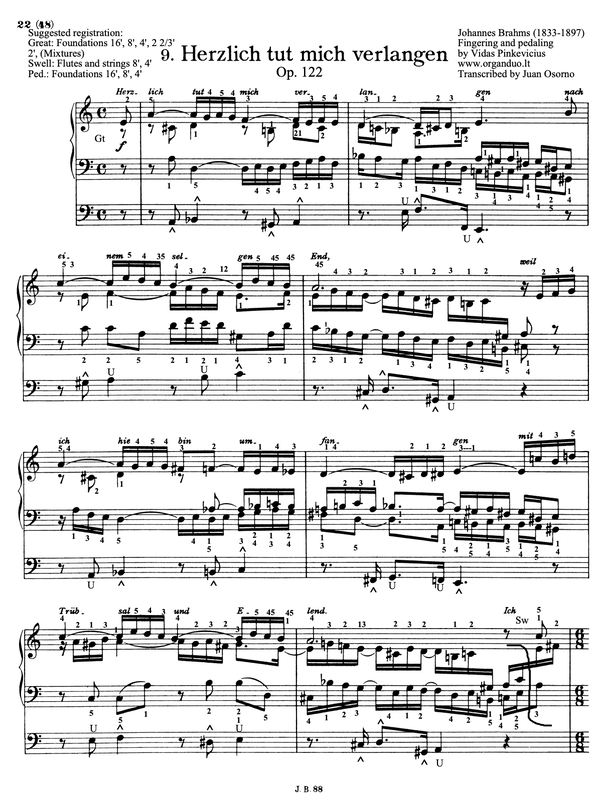
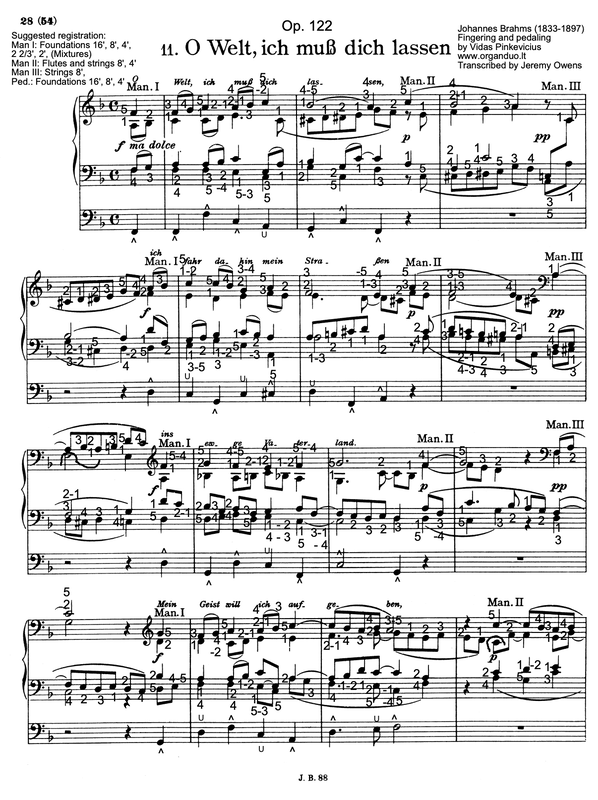
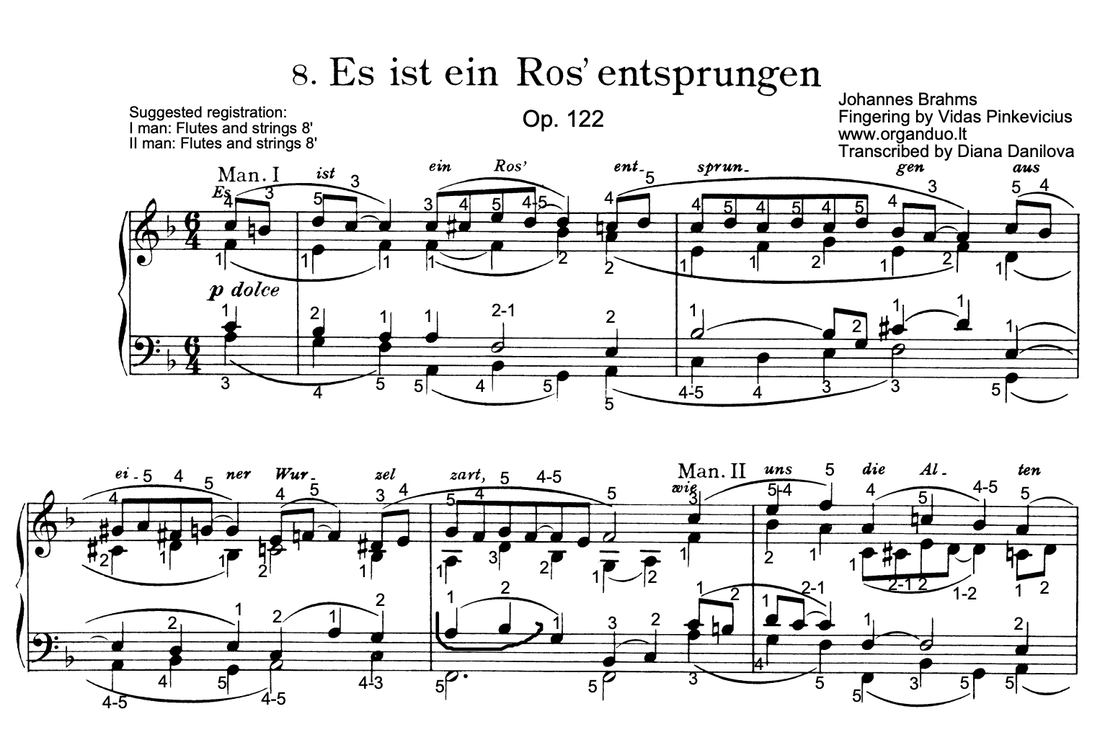
For many church organists, service playing involves not only performing hymns but also accompanying choir in anthems. One of the main difficulties in playing choral accompaniments on the organ is the legato touch. Although many different kinds of articulation are used in accompanying the choir on the organ, the legato is the most common. Without the proper legato the music might sound too choppy. In this article, I would like to give you some advice on how to achieve legato in playing anthems and choral accompaniments on the organ.

Write in Fingering

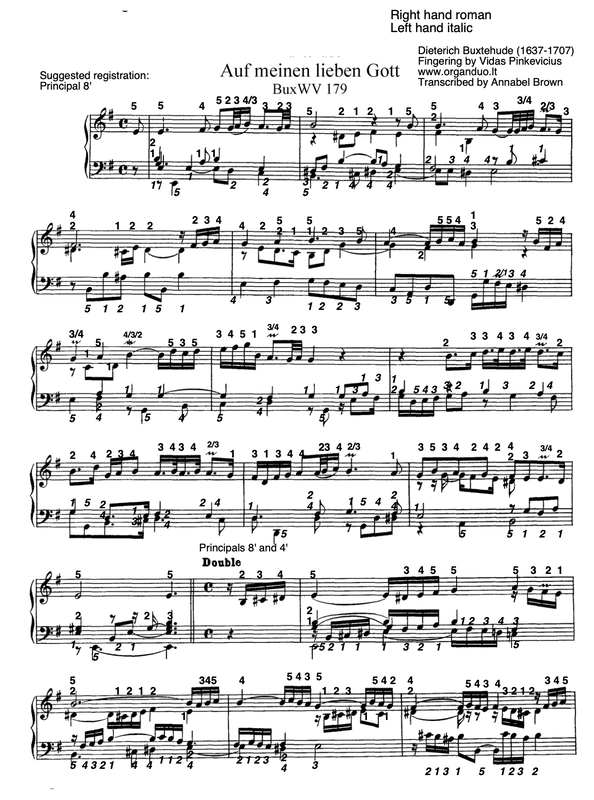
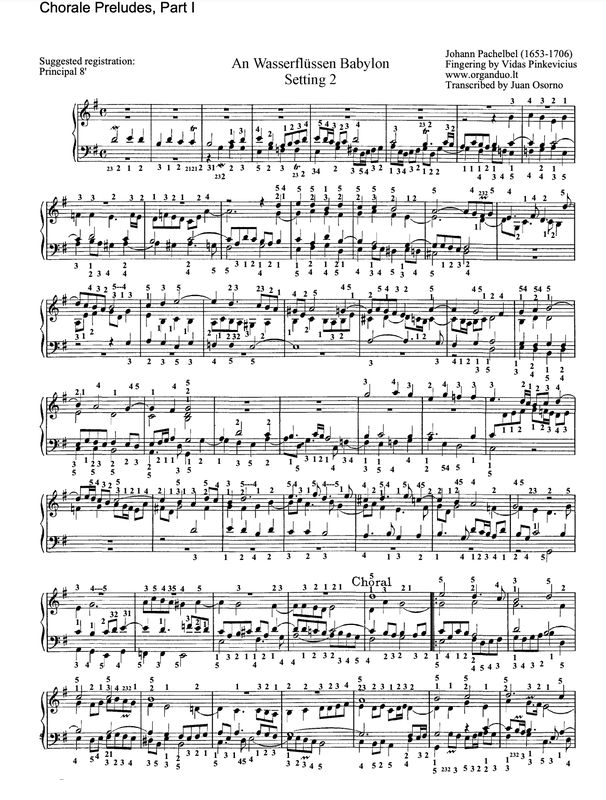
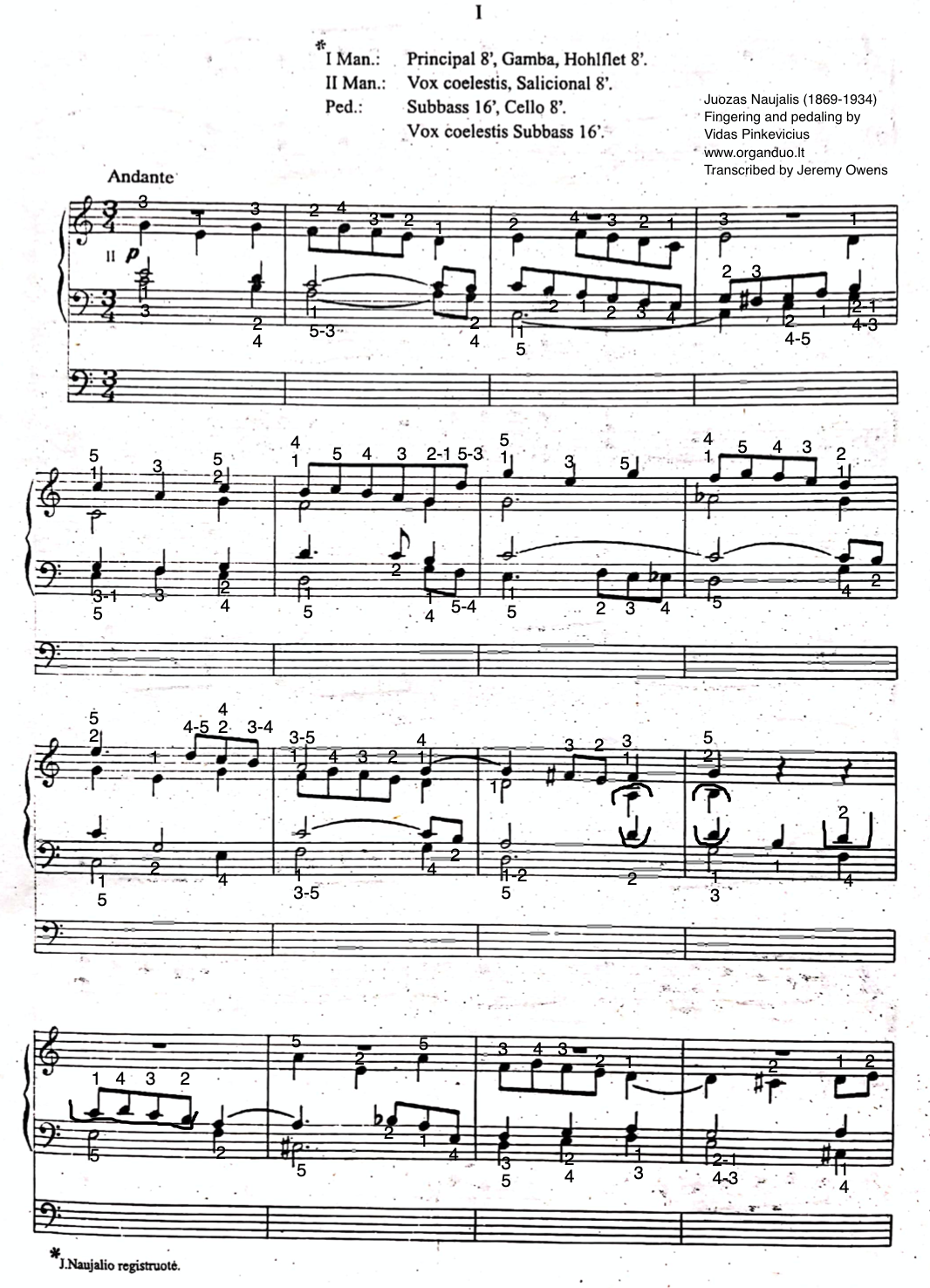
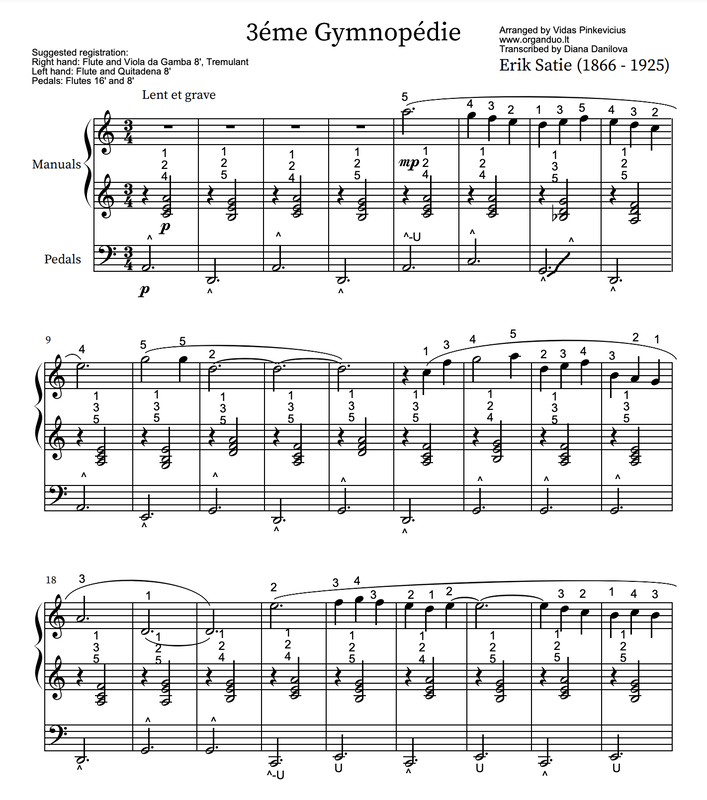
Very often people do not play with a good legato because they do not know the best fingering. Because it is harder to use the proper fingering if it is not written in the score, I suggest that you write in your fingering. It is especially important that places which are the most difficult in achieving legato would be fully fingered. Do not hesitate to change the fingering if you find a better solution. However, erase the old markings and write in the new ones as you practice for best results. The same applies for the pedal part, of course.

Finger Substitution

Finger substitution is generally accepted as the most common means to achieve a perfect legato on the organ. However, it should be used wisely. For example, most often there is no need to apply finger substitution in a one voice passage because the legato can be achieved by using position, scale and arpeggio fingering in such a case. However, for episodes which require playing more than one voice in one hand, you can use finger substitution technique. Basically how it works is like this. While holding the same key with one finger, you substitute it with another finger.  In chromatic music, this technique can work on chords where you substitute more than one finger at a time (double or even triple substitution).

Finger Glissando

If finger substitution cannot be achieved and all your fingers are busy, another option would be to use finger glissando. With this technique, you slide from one key to another using only one finger. In some cases, double glissando is also a possibility (sliding from two sharp keys to two natural keys). However, make sure that there is no other way to achieve the legato besides glissando. Quite often you can take the burden of one hand by playing a few notes with another hand. Whatever you choose, always write in your solution in the score.

Finger Crossing

Like finger glissando, finger crossing is not a very popular technique but sometimes it is necessary to use it. In finger crossing, you place the longer finger over the shorter one and vice versa. This technique is useful in playing wider intervals, like sixths, sevenths, and octaves legato. Usually finger crossing works best with fingers 3, 4, and 5.

If you take my advice, write in fingering and use finger substitution, glissando, or crossing in your choral accompaniments, you can achieve a perfect legato even with small hands. More often than not the legato playing depends not on the size of the hands but on the choice of the fingering.


The practical techniques of accompanying the choir with or without a conductor are discussed in Organ Technique: Modern and Early by George Ritchie and George Stauffer which I highly recommend.


By the way, do you want to learn to play the King of Instruments - the pipe organ? If so, download my FREE video guide: "How to Master Any Organ Composition"  in which I will show you my EXACT steps, techniques, and methods that I use to practice, learn and master any piece of organ music.
 
 
Performance of 16th-18th century hymns on the organ requires special kind of fingering. This type of fingering helps to achieve the desired articulated legato touch and feel the alternation of strong and weak beats. In order to play the hymns in style it is important for an organist to know what kind of fingering to use. In addition, then the organist will have a strong feeling of meter and pulse which helps to lead the congregational singing. In this article, I will show you how to choose the best fingering for 16th-18th century hymns.

Avoid Placing a Thumb on Sharp Keys

Because performance of early type of hymns has so much in common with the performance of early music on the organ, generally try to avoid placing the thumb on sharp keys. This has something to do with the early type of keyboard which was used in the Renaissance and Baroque organs. These instruments had keys which were both shorter and narrower than our modern day piano or organ keys. Placing a thumb would be very inconvenient on an early style instrument. Many authors who wrote about performance practice in the 16th-18th centuries had their individual approaches to fingering because of their national school and historical period but most of them agreed that thumbs should be avoided on sharp keys as much as possible.

However, sometimes the thumbs are necessary to use because of wider intervals and chords in the left hand part. It is not uncommon to see the position C-G-C in the left hand. The thumbs are OK on the natural keys but if the piece is written in the mode of F or g, very often there is a chord B flat-F-B flat in the left hand. So in this case the thumbs cannot be avoided. The same holds true for an octave B flat-B flat.

Avoid Finger Substitution

Another important point about early fingering in hymn playing is that you should avoid using finger substitution. Finger substitution is a technique, fully developed in the 19th century and helps achieving a perfect legato touch. This technique involves substituting one finger to another while holding one key. Since we need a different type of articulation in early music, finger substitution will create some difficulties of articulating the hymns properly. Very often pianists who come to the organ will have this problem. If we use finger substitution, we have to think about achieving the articulate legato. On the other hand if we use that special type of fingering, we will articulate the notes naturally.

Interval Fingering

In hymn playing, when you play two voices in one hand, you can use interval fingering which has much in common with the finger skipping technique. This rule generally means that every interval in the Baroque or Renaissance period had its precise fingering and succession of similar intervals should be played with the same fingerings. For example, the thirds usually were played using 1-3 or 2-4. So the passage of three consecutive parallel thirds C-E, D-F, and E-G would be performed using 2-4, 2-4, and 2-4. Use 1-4 or 2-5 for the fourths and fifths (sometimes 1-5 for fifths is more convenient on a modern keyboard). Wider intervals, like sixths, sevenths, and octave are played with 1-5. Likewise, for a passage of three consecutive parallel sixths C-A, D-B, and E-C, use 1-5, 1-5, and 1-5.

Write in Fingering

I recommend that you write in the exact fingering that you will be using in your hymn. Do this at least at the beginning stages of your organist career. In doing so, you will prevent from playing your hymns with accidental fingerings which might not help you to achieve the desired precision and articulation. In fact, treat your hymns like normal organ music and practice accordingly. For example, you may find that in some cases playing not the entire 4 part texture but practicing in voice combinations is more beneficial. Or if you have trouble with sight reading your hymn, stop and work on one phrase at a time.

By the way, do you want to learn to play the King of Instruments - the pipe organ? If so, download my FREE video guide: "How to Master Any Organ Composition"  in which I will show you my EXACT steps, techniques, and methods that I use to practice, learn and master any piece of organ music.
 
 
Playing early organ music requires much knowledge in registration, articulation, fingering, and other aspects of organ performance. Fingering, in particular, is an area where correct choices can facilitate the execution of articulation, phrasing, and ornamentation. The right way of fingering can even help to feel the pulse and the meter easier. If the organist plays a Baroque or Renaissance organ piece with the correct fingering, chances of performing it in style are much higher. Although there are many different national schools of early organ music, and each of them has its own tradition of fingering practices, it is possible to outline some general ideas about fingering. In this article, I would like to give you my advice on how to choose the best fingering in music composed before 1800 which will help you to achieve the correct articulation.

Paired Fingering. The most famous of all kinds of early fingerings, paired fingering is used primarily for one voice passages in one hand. It can help to emphasize the meter and the pulse if used correctly. Paired fingering is based on the idea that the notes on the stronger beats should be played with stronger fingers. Authors of treatises from different national schools had their own ideas about strong fingers. They even referred to them as good and bad fingers.

It is best to play with early fingering scale based passages written in quarter, eighth, and sixteenth notes. Try this exercise: play the ascending C major scale with the right hand using 3-4-3-4-3-4-3-4 fingering. Try to achieve some articulation between each note which should not be played legato. This type of articulation is called the ordinary touch or the articulate legato. Notice how notes C, E, G, and B start with the strong finger 3 which emphasizes the pulse very well. Try to achieve the slight pulsation while shortening the notes which you play with finger 4.

Try the same exercise in descending scale with 3-2-3-2-3-2-3-2. You can play with the left hand the same exercise using 3-2-3-2-3-2-3-2 (ascending) and 3-4-3-4-3-4-3-4 (descending). Do not cross the fingers but shift the position with the entire hand. In other words, move both fingers together as a unit.

Position Fingering. This type of fingering means that we choose the fingers which would allow playing the most number of notes without changing position. Like paired fingering, position fingering is also used for solo passages. Try this exercise:

Play a passage like C D E F G F E D E F G A B A G F G A B C D C B A in sixteenth notes with the right hand using a pattern of 12345432 12345432 12345432. Notice how it is possible to play 8 notes in one position. Putting the thumb under and switching to the new position is very efficient way to play such passages.

Interval Fingering
. While paired and position fingering are best suited for solo passages, interval fingering is used to play two notes in one hand. Thirds are best played with 2-4 or 1-3, fourths – with 2-5 or 1-4, fifths, sixths, sevenths, and octaves – with 1-5. The succession of the same kind of intervals is played with the same fingers. Therefore, such common passages of successive thirds, for example in music of Sweelinck, are best played with 2-4. The passages in sixths are played with 1-5.

Chord Fingering
. Because of narrower keys in the 16th and 17th century organs, the chords (and solo passages) in early music are often played without the thumb. For example, first inversion major chord E G C can be played with 2 3 5 in the right hand). The left hand chords are often wider, as in C G C and played with 1 2 5.

The general rule for the Renaissance and early Baroque music is to avoid using thumb (especially in sharp keys). However, there are many instances where the thumb cannot be avoided, such as in music written in G minor, or F major. Quite often composers use excursions into the B flat major area where B flat is the primary note of the key. Therefore, the thumb is definitely used in such cases, though it is not exactly comfortable for the hand.

Because of the chromatic nature of the music of J.S.Bach and complicated keys used in his works, playing with the thumb and using finger crossing is quite comfortable. However, try to avoid finger substitution and glissando which are best suited for the legato manner of playing used in organ music written about after 1800.

By the way, do you want to learn to play the King of Instruments - the pipe organ? If so, download my FREE video guide:
"How to Master Any Organ Composition" in which I will show you my EXACT steps, techniques, and methods that I use to practice, learn and master any piece of organ music.
 
 
This is Part 2 of the article which deals with the most efficient fingering for Romantic and modern organ music. Please read Part 1 here.

Arpeggio and Chord Fingerings. When you notice a place with an arpeggio in it, think in terms of a chord. In other words, the standard way to play arpeggios is by using the chord fingerings. For three note root position chords, such as C E G, use 1 3 5 in the right hand or 5 3 1 in the left hand. For first inversion chords, such as E G C, use 1 2 5 in the right hand or 5 3 1 in the left hand. Second inversion chords, such as G C E are best played with 1 3 5 in the right hand and 5 2 1 in the left hand. For chords, starting on the sharp or flat note (B flat D F) we have to use the same fingerings.

Play chords with four notes, such as C E G C, with 1 2 3 5 (right hand) or 5 4 2 1 (left hand). Play the first inversion E G C E with 1 2 4 5 (right hand) or 5 4 2 1 (left hand). The second inversion G C E G is best played with 1 2 4 5 (right hand) or 5 3 2 1 (left hand). The main rule for using 3 or 4 in the middle of an arpeggio or a chord is an interval of the third. If the third is major (as in C E), play with 3. If the third is minor (as in E G), play with 4.

Finger Substitution. This technique allows achieving a perfect legato when playing more than one voice in one hand. Finger substitution basically involves changing fingers on the same note. The most common instance for finger substitutions are passages in double thirds, sixths, and other intervals. Sometimes when playing more chromatic music we have to change fingers on three or four note chords as well. 

Finger Glissando. Finger glissando is a technique of sliding from one key to another with the same finger. We use it to achieve legato primarily when playing more than one voice in one hand. Passages of chromatic scales in double thirds and sixths are typical places for this technique.

Finger substitutions and glissando in single voice passages are somewhat less orthodox. More often we play these passages using finger crossing, scale fingering, position fingering, or chord fingering instead. Moreover, very often when a person uses finger substitution or glissando in a single voice passage, it is evident that he or she did not give much thought about the fingering in advance.

I suggest you write in fingerings in every piece that you play on the organ, at least in the beginning of your organist career. This will diminish chances of playing with accidental fingerings which will hinder your progress. Choosing fingering, of course, should be done before the actual practice of the piece. If there are several options available, try all of them and choose the one which is the most efficient and comfortable for your hand.

By the way, you can write in fingerings for a shorter fragment and start practicing it right away without waiting to finish fingering the entire piece which might take a while. With experience you will start to feel the familiar patterns and you will instinctively choose the most efficient fingering automatically. Then it will be necessary to pencil in the fingering only in the most difficult places.

If you are really serious about not only developing your keyboard and organ technique but also your sense for fingering, I highly recommend playing scales in octaves, thirds, sixths and tenths, and also in double thirds, and double sixths in all 24 major and minor keys regularly. Playing in double intervals is an invaluable exercise for finger substitution and glissando. In addition, practice chords, short and long arpeggios on the tonic, dominant, and diminished seventh chords. A great resource with fingering guide included is The Complete Book of Scales, Chords, Arpeggios and Cadences. It includes all the major, minor (natural, harmonic, melodic) & chromatic scales - plus additional instructions on music fundamentals.

By the way, do you want to learn to play the King of Instruments - the pipe organ? If so, download my FREE video guide: "How to Master Any Organ Composition" in which I will show you my EXACT steps, techniques, and methods that I use to practice, learn and master any piece of organ music.
 
 
Knowing how to choose the most efficient fingering is crucial to any organist. This skill is important because it makes a big difference both in practicing and performing. If you know how to play with good fingering, you will feel much more confident and your performance might sound effortless and efficient. In addition, the right fingering helps you to avoid mistakes and allows playing with precision and clarity. Today, I would like to discuss some ways how to choose the fingering for organ music composed after 1800 which will help you achieve such results.

Since the normal touch for Romantic and modern music is legato, every fingering technique is geared towards achieving the perfect legato. Differently from the piano where the legato can be achieved also by the means of the right pedal, the legato techniques that are used in organ playing are based on the fingering only. There are three most important ways to play legato on the organ - finger crossing, finger substitution, and finger glissando.

Finger Crossing. This technique is primarily used for single voice passages. It helps to achieve legato where you play just a single voice in one hand. The most common manifestation of finger crossings is thumb-under technique. Here you put the thumb under other fingers in order to change positions and move upwards or downwards. You can also use finger crossing by putting the longer finger over the shorter one or the shorter finger under the longer one.

Scale Fingerings. Probably the easiest way to play the single voice episodes in organ music is by choosing fingerings which are based on scales. This also involves chromatic scales. Here the most important rule is to avoid using the thumb on the sharp keys because it gives unnecessary strain to the hand. For example, in a passage in B flat major for the right hand, such as B flat C D E flat F D C D E flat F G A B flat it is best to use the B flat major scale fingering: 2 1 2 3 4 2 1 2 3 1 2 3 4. Notice that we start not with 1 but with 2 on the B flat. For the left hand the best fingering here would be 3 2 1 3 2 4 5 4 3 2 1 3 2.

However, in real music we often have to play with the thumb on the sharp keys (especially in music with many accidentals). A very useful exercise not only for finger dexterity and independence but also for fingering patterns is practicing scales in all major and minor keys. This can be done either on the piano or the organ. If you practice scales regularly, with time these fingerings will become second nature to you and many places in your organ compositions which earlier appeared problematic because of the fingering will be straightforward enough.

Position Fingerings. When you write in fingerings, think about the position. How to play the most number of notes without leaving your current position? Put a thumb under only when is necessary to change position. For example, consider the earlier passage in B flat major. Placing a thumb on C allows us to play 8 notes in one position using fingers 1-4 and only when we have to ascend higher we put a thumb again on F and start playing like in ascending F major scale.

For more fingering suggestions, read Part 2 of this article.

By the way, do you want to learn to play the King of Instruments - the pipe organ? If so, download my FREE video guide: "How to Master Any Organ Composition" in which I will show you my EXACT steps, techniques, and methods that I use to practice, learn and master any piece of organ music.