|
I’m so delighted to be able to teach you about avoiding mistakes when playing in an equal tempo today. Listen to the audio version here.
You see, recently one of my “Unda Maris” studio students played in our church and he had a trouble of keeping equal tempo and avoiding mistakes. I thought to help him with some of the tips which might be of value to you too because you also probably need to avoid mistakes and play at a constant tempo. So the problem is usually with the tempo that is too fast. A lot of people try to slow down when they practice and this is good. But this tempo still needs to be considerably slower. You see, when we play the organ we don’t necessarily feel the limits of our abilities and we pick the tempo that sounds well, the piece of music that we’re playing sounds well in this particular tempo but it doesn’t mean that this tempo is suitable for us at the moment. So when students played their piece and made mistakes usually it usually means they played too fast. So the normal tip would be to slow down and try to play at the 50 percent slower tempo. So that would be the first tip I could give you. Maybe slow down from let’s say 80 beats per minute to 40 beats per minute. That would be OK. What about if your concert tempo is at 60 beats per minute? Well, you could slow down to 30 beats per minute. If you still make mistakes after slowing down 50 percent, then you need to reduce the texture. What do I mean by that? Imagine if your piece of music has 4 voices and you’re playing it extremely slowly at 40 beats per minute and you still make those mistakes. This simply means you need to take this texture apart and play, let’s say just 3 voices at the moment. If that is too difficult for you, then play maybe 2 voices together. And if you still make mistakes, play it very slowly but only one voice. That’s why I always recommend to start your practice of a new unfamiliar piece with a single line only in most cases if you want to avoid mistakes completely. So soprano, alto, tenor, bass - all those lines could be played extremely slowly and without combining them first, just one voice. After you master this particular step, you are free to go to the next level and play 2 parts together. So that would be soprano-alto, soprano-tenor, soprano-bass, alto-tenor, alto-tenor and alto-bass, and tenor-bass combined. And the next thing would be to practice 3 voice combination - soprano-alto-tenor, soprano-alto-bass, soprano-tenor-bass and alto-tenor-bass. You see, how many steps we took in order to achieve this final combination - 4 parts combined, both hands and pedal, in other words. 14 steps before the final 15th step - 4 parts together. So don’t forget to do this. Of course, you don’t have to do this all the time if the piece is very easy, if the piece is of homophonic nature, if it moves in chords or if it’s a melody and accompaniment. Then you just need just 7 combinations: Right hand, left hand and pedals alone. Then right hand and left hand, right hand and pedals, left hands and pedals and the all parts together. If it’s not polyphonically complex music. So try these tips in your practice and let me know if it helps. It helped me and it helps this student that I’m trying to help in our “Unda Maris” studio. OK guys, please send us more of your questions. We love helping you grow. And remember, when you practice, miracles happen.
Comments
Vidas: Let’s start Episode 67 of #AskVidasAndAusra podcast. And today’s question was sent by Vince. He writes:
“Dear Vidas and Ausra: When I am playing hymns or a classical piece with 4 parts, sometimes a mistake happens where I can not tell which voice has the mistake. If performing, and not able to stop and figure out where the mistake is, the error may carry over to subsequent notes in that part because I don't know WHERE to make the correction. I'm not tone deaf, but at times the mistake totally eludes me, even so far as, the mistake is in the pedal but it sounds like it is in the soprano! Any advice on how to deal with this? Please don't say "just play perfectly!" :-) Perhaps ear training, but what method? Thank you very much. I enjoyed the interview with Kae Hannah Matsuda.” So, it’s wonderful question, right? I’m very glad he liked this interview with Kae, who helps us to transcribe those podcasts and make text versions available to you. Without her help, this would not be possible, so thank you so much, Kae. And Ausra, Vince is having a problem with detecting mistakes, right? Ausra: Yes. So, as he told himself, I think that ear training is the best solution to solve his problem. Because you have to learn to hear each voice that you’re playing, and it doesn’t matter how many voices you are playing at a time--you have to hear them all. And I would have a couple suggestions for him how to do it. First of all, he has to learn to sing each line of his hymn. If it’s four voices, he has to learn to sing them all, and to know them all by heart. Vidas: That’s very great advice, Ausra. All the main professors we’ve worked with recommend this technique, too. And obviously, this helps. Every time you discover a polyphonic piece with independent voice lines, you have to simply listen to inner voices especially; and there is no other way to do that at first, than to actually sing it. Ausra: Yes, and when I teach solfége we sing four-part exercises; and the main technique is, you know, that the student comes to the piano; and for example, I’m telling him or her, “Sing me tenor”--it means that he or she will sing the tenor line, and will play the other three parts together. Vidas: Aha, so tenor will be silent. Ausra: Yes, tenor will be silent--from the keyboard; but he or she will sing it. That’s an excellent technique, it develops your ear very well. Vidas: How do your students react to this at first? Is it frustrating for them? Ausra: Yes, it is frustrating for them. Not so much for choir conductors; but for other majors, yes. And everybody wants to sing the soprano line, but I never ask to sing the soprano line, because that’s the easiest part! And basses, not so bad; but alto and tenor are the hardest voices to sing. But they are very useful for your ear training. Vidas: But they don’t start with four-part textures, do they? Ausra: Yes, if it’s hard for you to do that, you have probably to just take a bicinium. I mean, two voices--a two-voice piece. Play one, and sing another one. Vidas: I would even think that Vince should start with a single part, a single voice. Just imagine it’s a counterpoint exercise, just like organ playing; so ear training is sort of also an art, and a skill you should develop equally well over time. And with organ, you could start with one single line. So why don’t you start with one single line when you sing those melodies? Ausra: Yes. Vidas: From your own piece. Or a hymn. You don’t need to actually get a special ear training book for that. Ausra: Well, a hymnal is an excellent source of things--you can do exercises from any of the hymns. Vidas: Yeah, absolutely. The voices are sort of independent, but not too independent. Ausra: You can take, for example, a four-part hymn, and just omit the middle voice, tenor or alto, and do soprano and bass. If it’s very hard for you, just play bass and try to sing soprano (melody), which is well-known to you; and then, you know, play soprano and sing bass. And then maybe,you know, later, when you feel comfortable with those two voices, you will add two more voices. But it will take time; these things take time, but it’s worth doing it. Vidas: I have just had an idea now, like lightning struck into my mind, that a similar course designed specifically for organists who play hymns to develop their ear training, would be excellent and very, very helpful, right? If we could devise such a training program, then over time, people could really develop a much better sense of pitch, discovering their mistakes, expanding their abilities to understand the pieces that they’re playing, right? Ausra: Yes. Because if you can sing correctly, I don’t think it will be a problem for you to hear if you are playing it correctly or not. Vidas: Mhmm. Right now, as we’re recording this, I only had prepared a melodic dictation course, basically for one melodic line. And that’s not enough, right? You have to actively sing, learn to sing those melodies--and in combination of melodies up to four parts, over time. Right? Ausra: Yes. Vidas: So guys, maybe we will try to figure something out and systematically develop such a training, so that you could simply jump in and get started with the materials; and over time, develop your sense of pitch--just like we would teach our students at school, National Čiurlionis Arts School in Vilnius, which is extremely well-equipped with theory, with music, harmony training...and things like that, for musicians. Please let us know if such a course would be helpful to you or not. Wonderful! Thanks, guys, this was Vidas. Ausra: And Ausra. Vidas: And remember, when you practice… Ausra: Miracles happen. People often get discouraged when they make mistakes. They feel that there is something wrong with their practice. While it may be truth sometimes, very often it is a natural part of how we learn.
For example, it can often happen that you play correctly the 1st time, the 2nd time and you make a mistake on the 3rd time. Is that what happened to you in your organ practice? That's OK. Failing and making mistakes is an integral part of our learning process. So please don't get frustrated when you make mistakes. In fact, if you don't make a mistake at the beginning stages of your organist training, then something is likely wrong with your organ practice. If you don't fail enough times, you will not know what success is. If you feel you are not making any mistake at all, it probably means you are not looking hard enough and not concentrating on details (such as notes, rhythms, fingering, pedaling, articulation, ornaments, hand and feet position etc.). It probably means your mistakes get unnoticed. If this is the case, record yourself and listen to your recording. Ask yourself, "would I pay money to get to this concert if someone played like that?". Practice until the answer is yes. As they say, Practice Makes Perfect. Let's add to it Wise Practice Makes Perfect. Make sure you take a really slow controlled tempo in which you can think of the next note before you play it. Practice in fragments of 4 measures as I always recommend (do 10 times each fragment) in separate voices and all combinations of 2 and 3 voices before putting everything together. If you struggled with making mistakes up until now, apply these tips and in just 7 days, you will feel the breakthrough. If not, then it may mean that the piece is too difficult for you at the moment and that you need to work on your organ technique. Force yourself not to look at your fingers and feet while you are playing. Look at the music. If you play from memory, just close your eyes. This is tough, I know. But trust me on this, it will get easier with time and the benefits of doing so are enormous. By the way, do you want to learn my special powerful techniques which help me to master any piece of organ music up to 10 times faster? If so, download my video Organ Practice Guide. I have written earlier about the need for a slow practice and the work in fragments, and attention to detail which are all technical things. Although attention to detail is crucial in practicing your organ music, it is not enough to be able to play without mistakes. You need to have a special kind of mentality. Here I am referring to the focused mind which can help you to reach that optimum performance state which in turn will empower you not only to play without the mistakes. Moreover, your performance will have the special power over listeners and you will have their attention fixed on your playing without interruption. In this article, I will explain this mental technique and how to achieve it.
The mentality or the mindset of a world class organist is similar to the state of mind of an athlete or a martial artist. Athletes refer to it as “Being in the Zone”. Martial artists say that “their body should be relaxed but the mind should be on fire”. In other words, they have to have an alert but clear mind. They have to throw all of their thoughts, insecurities, and mental blocks away and simply be in the moment. Various traditions have different techniques which can help you to achieve that state of mind. Some of the most popular are breathing, meditation, or prayer. In organ playing, I find that deep, regular, and slow conscious breathing from the lower abdomen actually helps me to improve my mental focus. When playing a piece of music, I often try to find the natural breathing rhythm. Usually it coincides with the cycle of measures. For example, I may inhale over two or more measures and exhale over the same number of measures and repeat this process over the course of the piece. The breathing should be done through the nose. You can do the same in your piece and you will start to notice some really interesting things over time. If you stay focused on your breathing then your mind gradually calms down, your body relaxes, and you will be able to control your movements much better. In turn, the risk of hitting the wrong note by accident is much lower. If you do play an incorrect note or two during your performance, let it go and force yourself to stay focused and not keep your thoughts on this mistake. Very often if we make a mistake, we think about it for a while when we are playing, we loose focus, and consequently make more mistakes. So no matter what went wrong you have to try to stay focused until the very end. It is interesting how we can make mistakes even in a slow tempo in an easy spot. This is how it may happen. As we are playing, we might be aware how well we play or how easy is this particular episode and again, we may loose our focus. The solution is to keep your focus until the very end. The legendary American organist Marilyn Mason used to say that the recital is not over until you are in the parking lot. Actually, it is so true because if for a moment we relax our focus, we can make a mistake and loose control over the piece. The master French organist Marcel Dupre suggested that we keep our attention fixed on the current measure that we are playing in order to avoid mistakes. This thought is similar to the idea stated earlier of being in the moment. I understand that for most people it will be hard to achieve this level of focus on the organ. However, if you consistently practice slowly, work in fragments, give a great attention to details, and keep your attention on your breathing, eliminating mistakes actually is not too difficult. Simply change your focus from how not to make mistakes to fulfilling the musical needs of the piece, be in the current measure, and your performance level will improve dramatically. By the way, do you want to learn to play the King of Instruments - the pipe organ? If so, download my FREE video guide: "How to Master Any Organ Composition" in which I will show you my EXACT steps, techniques, and methods that I use to practice, learn and master any piece of organ music. Many of my organ students ask me how they can play their organ pieces without mistakes. They ask for an advice about being able to achieve the level of fluency when they could sit down on the organ bench and play flawlessly for a long time any organ composition they want, slow or fast, easy, medium, or difficult. They know it is possible because they have heard top level organists play organ music with such an impeccable technique that it could be taken directly from a CD recording. However, they also know that very few people ever advance this far in organ playing. Performing on this level takes more than mastering a piece of music. It also requires a special attitude and mindset. In this article I would like to give some insight into the techniques which might help you eliminate mistakes in organ playing.
Somebody told me some years ago about the difference between the good performance and a superb performance. When you are listening to a good organist playing some nice organ music, everything seems to sound well. There might be some tiny insignificant errors but in general, you like this performance. However, if you happen to listen to a real world class performer, there is something more in such a playing. It is hard to express this feeling in words but you feel that absolute clarity and sense of precision and perfection in such a performance. If you ever had an opportunity to listen to such playing, you probably know what I mean. I am not talking about many wonderful CD recordings which we all love to listen to, because most of the time they are edited, mastered, and sometimes they may not necessarily reflect the real skill of the organist. I am talking about the live organ concerts, these unforgettable events when you simply marvel at the artistry of the performer. At any rate, the real difference between a good performance and a superb performance is attention to detail. A truly world class organist will know exactly why he or she made some particular decision about some episode in the organ piece. These people never leave anything to chance. At any given moment in a piece they know the exact reasoning about the fingering and pedaling choices, about the rhythmic and melodic accuracy, about the phrasing and articulation, about the registration, or about the formal and harmonic structure of the piece. They simply give such a meticulous attention to any detail that many of us take for granted. So if you seriously want to be able to play without mistakes, I recommend you give some thought about the above mentioned aspects of organ playing. Moreover, once you are sure about your choices in your practice, you should attempt to achieve those things through practice. In other words, it is not enough to know why you are playing this particular spot with this fingering and pedaling, articulation, ornamentation, or registration. You should reconcile all these things through dedicated and relentless practice. Always ask yourself questions like “Does it sound the way I want it?” or “Why am I playing this spot in this particular manner?” Answering to these questions and in turn practicing with attention to detail will enable to progress to such level of organ playing when the task of playing without mistakes will seem insignificant. Instead, you will want to express the composer’s intentions to the best of your ability. And you will have the means to do that. Remember, that professionalism is not necessarily a financial status of a person. You can also think of it as an attitude. You can play like a real professional with absolute precision and clarity a simple 2-part invention or a majestic 5 voice fugue. The complexity level does not matter. What matters is the attention to detail. By the way, do you want to learn to play the King of Instruments - the pipe organ? If so, download my FREE video guide: "How to Master Any Organ Composition" in which I will show you my EXACT steps, techniques, and methods that I use to practice, learn and master any piece of organ music Every organist admires people who can play flawlessly without any mistakes. Such a performance seems like taken directly from a CD recording. While listening to live concerts of top level organists we are wondering how they are able to play without mistakes not one piece but the entire recital. Most people can play with accuracy a slow piece but when it comes to playing in fast tempo, they might hit at least a few wrong notes. This is the opposite with world class artists. There is seemingly no limit of their finger and pedal technique. Achieving that level can take years of dedicated practice but there are certain elements which can help you to progress faster along the road to perfection.
In this article, I would like to give you some advice on how to eliminate mistakes in organ playing. This article is not about the situation when you make mistakes because you do not know the piece well enough and leave some difficult passages not fully mastered. Instead, I am writing about a situation when you think that you have already mastered the piece but during the actual performance accidentally hit the wrong notes here and there. Slow Practice One of the most important techniques which can help you to play without mistakes is a slow practice. If you struggle with accurately playing in a fast tempo, it is crucial to understand that slow practice is a key to success. Even though the piece is fast, you will only be able to reach this tempo through a slow practice. On the contrary, if you usually practice at a concert tempo, the time may come when you will not be able to be in control. In fact, constantly practicing in a fast tempo is actually quite dangerous. You may reach the point of making mistakes habitually and consistently at the same spot. So practice slowly in order to have a full control of your piece. When you are ready, you will reach the fast tempo naturally. If you know the piece really well, mistakes usually occur when you are not aware of every detail, every note or every passage. The music just flies by and you may accidentally hit the wrong notes. This can be cured with slow practice because through it you will get accustomed to notice every important note and every single detail. Work in Fragments If you want to be able to eliminate mistakes in your organ playing, another recommendation would be to subdivide the piece into smaller episodes and work in fragments. If you practice in shorter fragments (4 measures or so at a time), then every mistake you make will be easy to fix. For example, if you make a mistake, stop at that point, go back a few measures and play the same fragment correctly at least free times in a row. Note that if you play correctly twice but make a mistake on the third try, you will have to start counting from the beginning. However, if for some reason you loose patience and continue playing the piece until the end even after making the mistake, chances are that next time you will do the same mistake in the same spot. Remember that if you are constantly practicing eliminating mistakes and forming good practicing habits, then you are progressing the right way. On the other hand, if you don’t fix your mistakes and play with them every time, actually, you are practicing your mistakes, which just move you farther away from your goal. So have patience, practice slowly, work in fragments, correct your mistakes and you will see some real advancement in your organ playing. By the way, do you want to learn to play the King of Instruments - the pipe organ? If so, download my FREE video guide: "How to Master Any Organ Composition" in which I will show you my EXACT steps, techniques, and methods that I use to practice, learn and master any piece of organ music. |
 DON'T MISS A THING! FREE UPDATES BY EMAIL.
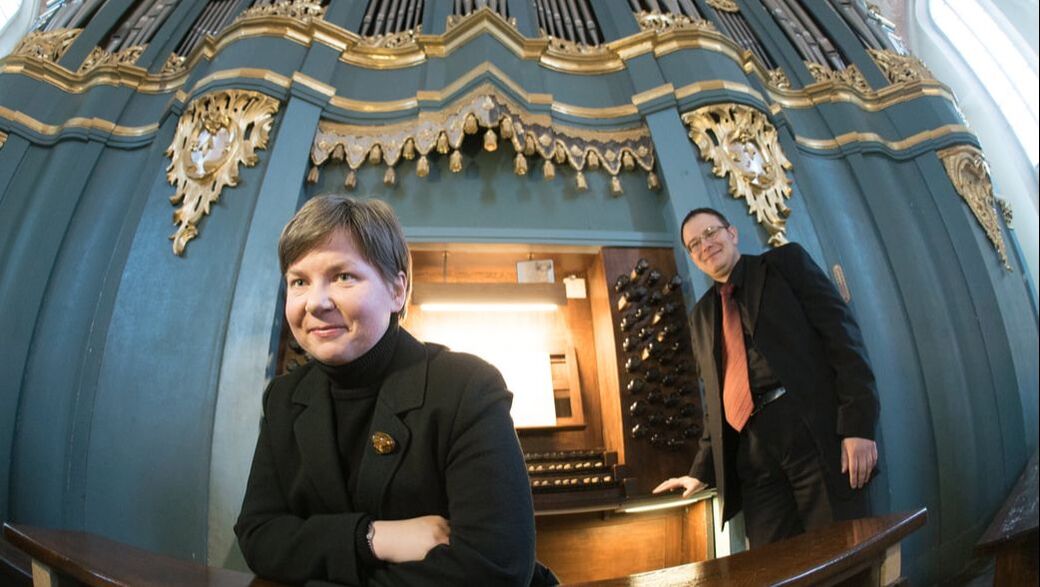 Photo by Edgaras Kurauskas Photo by Edgaras Kurauskas
Authors
Drs. Vidas Pinkevicius and Ausra Motuzaite-Pinkeviciene Organists of Vilnius University , creators of Secrets of Organ Playing. Our Hauptwerk Setup:

Categories
All
Archives
April 2024
|

 RSS Feed