|
Vidas: Hello and welcome to Secrets of Organ Playing Podcast!
Ausra: This is a show dedicated to helping you become a better organist. V: We’re your hosts Vidas Pinkevicius... A: ...and Ausra Motuzaite-Pinkeviciene. V: We have over 25 years of experience of playing the organ A: ...and we’ve been teaching thousands of organists online from 89 countries since 2011. V: So now let’s jump in and get started with the podcast for today. A: We hope you’ll enjoy it! Vidas: Hi guys! This is Vidas. Ausra: And Ausra. V: Let’s start episode 653 of Secrets of Organ Playing Podcast. This question was sent by Jeremy. He’s our member of Total Organist Community, and helps us with fingering and pedaling scores. And he writes, Today I did a variety of different things on the organ. The past couple of weeks I have been working through the New Oxford Organ Method just to see what it did (I really am enjoying it). It acts kind of like an organ teacher for those who have basic piano skills. It walks you through how to break the piece down into technical and musical bits. So I recorded the last piece in the "ordinary touch" section of the book today--Rising Passacaglia by Frederick Stocken, and practiced the next piece in the book (which is evading my memory at the moment). I began week three of the Pedal Virtuoso course and was inspired by Vidas to start the first Trio of J.S. Bach (learned four measures of the notes). Then I started working on Walther’s Komm Der Heilige Geist and made sure Buxtehude's Lobt Gott ihr Christen Allzugleich was still in my fingers. Practiced BWV 536 (which is Prelude and Fugue in A Major) for Sunday's service and worked on Hindemith second sonata, first movement. Here's the Stocken: https://youtu.be/eJYeQ-BJh_k V: It’s very nice that Jeremy was practicing from my Pedal Virtuoso Course. I wonder if he was inspired by my Trio Sonata recording? A: Yes, that’s what I thought as I read. V: Yeah, it’s good to know that other people watch these videos too. But today I want to talk about his work through the New Oxford Organ Method and specifically about the touch in the Rising Passacaglia, the ordinary touch. Should we remind, Ausra, to our listeners what the ordinary touch means? A: Yes, I think that would be very helpful. V: Go ahead. A: Why me? V: Because I’ve been talking too much. A: (laughs) But I got my second shot of AstraZeneca yesterday, so I need to be careful not to overstrain myself. V: Not to use your, not to move your left arm. A: Sure. Well but okay, the ordinary touch was known as Baroque articulation style. Basically, all the music written in the Baroque style had to be played with articulate legato, or every note has to be detached. V: Mm hm. A: Unless it’s indicated otherwise. V: Yeah, it’s sort of detached but not too much, not too choppy. A: Sure, and that’s usually a mistake made by many beginners, that when you tell them detach each note, they start sort of to play staccato almost. V: And I asked Jeremy in this conversation, “Does it say why Rising Passacaglia is listed in the ordinary touch section?” And he answered probably that the reasoning is that the ordinary touch helps provide clarity and can be used in music of later times, especially in music inspired by Baroque models. Would you agree, Ausra? A: Well yes, but not 100%. It depends on the complete piece, I would say. V: You mean specific piece? A: Yes, specific piece. V: Probably it’s interesting to look at what organists of other countries do with modern pieces. And sometimes they do play with ordinary touch. I’ve heard Sietze de Vries from the Netherlands improvise in modern styles, or even play a piece by Mendelssohn, right - this is legato sort of style - but he would articulate. And a few other of his Dutch colleagues would do that. And I was always wondering why. A: Yes, and I don’t think that’s approach that I really like. I’m not talking about contemporary music, about modern music. Usually with modern music, if not the guidance is included how to play it, I guess you could do whatever you want with it, because it’s so eclectic and... V: Don’t you mean composer? A: Yes, yes, yes. V: Composer can do whatever they want. A: Well no. I mean if composer haven’t included specific performance instruction for his or her piece, then I think you could do whatever you want with it. But if we are talking about Romantic period, like Mendelssohn, Liszt, Reger, and all these wonderful composers, I’m even not talking about French composers but in general about the Romantic period could find many many pieces that have titles like Passacaglia for example - I’m talking about Max Reger… V: Mm hm. A: It really doesn’t mean that you need to do it and to play it with ordinary touch. I think that’s a big mistake. V: If it’s very very chromatic you mean. A: Yes. V: If it’s very late Romantic style. A: Yes. But even in Mendelssohn and Liszt, I think you should play legato unless there are other performance suggestions. V: What if composer imitates old style? Then you could probably use ordinary touch, right? A: Are you talking about composers that lived in 19th century? V: No...well, in a sense sometimes yes. Grieg for example, would write neo-classical style too. A: But then he would indicate specific articulation marks. V: Would he? A: Yeah! V: And that will be probably arrangements for organ, not original. A: That’s right. V: Mm hm. A: But otherwise really I wouldn’t suggest to use the ordinary touch in Mendelssohn. Of course, like your god Sietze de Vries does that, but I mean it’s up to him. Of course I respect his opinion and his way of playing, but I wouldn’t do that myself. And if I were to teach organ, I wouldn’t suggest my students to do that. V: But it helps to understand his reasoning, you know? He is probably doing this out of some deeper understanding, not just incidental. A: But still, you know, we need to talk then on what type of instrument he had performed that piece. V: Exactly. I was going to… A: Well, and if we are talking about historical performance practice it’s better, it’s really better not like a general rule for 100%, but if you perform Romantic music on instruments built in Romantic period. I think you would agree on that. V: Of course. And these instruments differ from country to country. A: Sure. For example, recently I tried so many of them, all kinds of sample sets made by Piotr Grabowski. It mainly featured organs built in Poland. And many of them, most of them I would say were built in the Romantic period. V: Yes. A: Or Post-Romantic period, but still holds that great Romantic tradition. And basically, if I would start to articulate on instruments like that, it would really sound like a big mistake. V: And this is probably because those instruments, most of them, are not tracker action. Right? A: Yes, of course. V: And what happens in the Netherlands, look, even in the middle of the 19th century they still had those Baroque stop handles, and everything drawn by hand. So it was fully tracker, slider chest organs. And I would suspect that Sietze de Vries uses that touch for later music because he plays that type of instrument. And if he had an opportunity to play a different type of instrument, let’s say a pneumatic instrument, Sauer organ from late 19th century or beginning of 20th century, he would probably adjust his touch as well. A: I think so because he is a great musician, and he knows what to do and how to do. But I just think it would be bad if some inexperienced organist listened to his recordings and started to imitate his playing on different type of instrument. Then it wouldn’t sound really good. V: Yeah, there is so much to these things to consider. So much depth and it requires so much knowledge. And little bit of knowledge is actually dangerous, right? Because you only see the surface and not entire thing, entire context. A: That’s right. So I think the deep knowledge is always good. V: So. A: But of course, if you are, or if we are talking about early Romantics, then I think more articulation is appropriate. And in general, you need to look at the structure of the piece. You need to listen what works and what not. Because of course if you will play everything just complete legato, then of course it will be a real mess too. Even on great Romantic instruments. Because you still need to look at the phrases, at the structure of entire composition. V: And repeated notes? A: Of course. That gives so much pain while playing Franck, for example. V: Yeah, and playing Franck’s music is not the same as Mendelssohn’s music. A: Sure. V: That’s the big difference. All right guys, we hope this was useful to you. Please send us more of your questions. We love helping you grow. And remember, when you practice, A: Miracles happen. V: This podcast is supported by Total Organist - the most comprehensive organ training program online. A: It has hundreds of courses, coaching and practice materials for every area of organ playing, thousands of instructional videos and PDF's. You will NOT find more value anywhere else online... V: Total Organist helps you to master any piece, perfect your technique, develop your sight-reading skills, and improvise or compose your own music and much much more… A: Sign up and begin your training today at organduo.lt and click on Total Organist. And of course, you will get the 1st month free too. You can cancel anytime. V: If you like our organ music, you can also support us on Buy Me a Coffee platform and get early access: A: Find out more at https://buymeacoffee.com/organduo
Comments
Vidas: Hello and welcome to Secrets of Organ Playing Podcast!
Ausra: This is a show dedicated to helping you become a better organist. V: We’re your hosts Vidas Pinkevicius... A: ...and Ausra Motuzaite-Pinkeviciene. V: We have over 25 years of experience of playing the organ A: ...and we’ve been teaching thousands of organists online from 89 countries since 2011. V: So now let’s jump in and get started with the podcast for today. A: We hope you’ll enjoy it! V: Hi guys! This is Vidas. A: And Ausra. V: Let’s start episode 606 of Secrets of Organ Playing Podcast. This question was sent by Laurie, and she writes: “Hi Vidas, Be sure you are sitting down to read this. ? I have no objection to the study of articulate legato touch for early music, but my question is, why MUST we use it? I understand it was the practice in the time of Bach and early music, but wasn't that true because the tracker instruments lent themselves to that sort of touch? And the flat pedalboards could be navigated easier with all toes, rather than using heels. But if we have a modern instrument that does not have "tracker touch" and has a concave radiating pedalboard, why not lend new interpretations to these masterworks? It could give new life and new understandings to old music. I'm sure you have heard Cameron Carpenter play. I'm not always a fan, but I learn something new about the construction of the music when I listen to his interpretations. For example, here he is playing the Bach B Minor Prelude and Fugue on a modern organ, making full use of colorful registrations and expression pedals. https://www.youtube.com/watch?v=jixCGS_AAG8 Isn't this improvisation in its own way? What do you say?” V: And by the way, Laurie is on the team of people who are transcribing these podcast conversations, so she’s also, then, a member of the Total Organist community as well! So, Ausra, what comes to your mind when you’ve listened to this? A: Well, of course you are free to choose. You live in a democratic country, and you can interpret music as freely as you want, but if you are thinking that this is something new, to play Bach legato and on a modern instrument, this is not a new way, because that ordinary touch about which Vidas and I are talking and advocating so much, actually it was sort of recreated and rediscovered, and only, I would say, 40 years ago, maybe, if I’m correct. And it all came with people like Harald Vogel, who advocated to play the Baroque music on the Baroque instrument and early music on the early instrument. And how I see things is that after you try to play it in the ordinary touch and using only toes for the pedalboard, you will never go back to playing otherwise. And the advantage of what we are advocating is this: If by chance in life you will get access to a historic instrument, you will be able to play it, and if you will only use only modern techniques and play Bach legato and use your heels while playing Bach, you will never be able to play on the historical instrument, because you will sit down at the organ bench, and you will see that it’s simply impossible. Okay, let’s hear what Vidas thinks about it! V: I have a few things to say. I think if Bach lived today and played those modern instruments, he might have written a completely different kind of music, right? And not necessarily in his own Baroque style. He might not have been an organist at all in this day and age. Right? It’s very idiomatic to his period that he became what he became, actually, and not even talking about Bach, but any other master from the past. So, when we encounter masterpieces from those days and we try to recreate how they might have sounded today, we always make some compromises, because when we are on a modern instrument, we don’t have those sounds available, or even the intervals available. The tuning system is different, and then we’re hearing a little bit different harmonies—not as pure, for example, not as colorful. But then the advantage to the modern era is that composers can modulate to any key they want and each key sounds exactly the same. It’s from the color perspective, but it kind of ties to this performance practice, and in forming performing practice, we’re not advocating that you should necessarily play everything with toes only, but you should know how it’s done, and then you are free to choose, and not only know, but I think you could try and practice and spend some time, and when you master one, two, three, or five pieces this way, try to do an experiment; try to learn something else from this period but in a legato fashion, with heels, for example. Try your own pedaling and fingering with finger glissandi and everything, and then go back to this historically informed technique in the way you play it, and see if it sounds more convincing. You see? The style of music lends itself to this kind of articulations, and if you use modern pedaling, you have to think about articulations. But if you use early pedalling and fingering, then it works automatically. You can recreate it automatically. You don’t even think about it. A: Well, and as I mentioned before, don’t think that what Carpenter does, that this is a new thing, because Marcel Dupré actually toured America many years ago during his lifetime, and he plays all Bach, complete works by Bach, and I believe he even played from memory, and of course, he used the legato techniques and toe and heel techniques on the pedalboard, so it’s nothing new, what you are talking about. Well, okay. V: And so, just try different approaches and then choose the one that sort of works for you in your situation. We just don’t want you to relearn the same piece twice. If you ever have the chance to play a tracker instrument, which was inspired by Baroque techniques, or an actual Baroque organ if you go to some church which has… some organs in the United States have historically based organs… and you might have a chance to play them, and what would you do then? Would you play legato, or would you try to relearn it the second time? We advocate that you don’t have to relearn it. You can do the same thing the right way right away, and then it would sound convincing on any instrument. The last thing, Ausra, if we consider this. If you play with articulation on a modern instrument, does it sound bad? A: Well, no, it doesn’t sound bad. V: Does it sound bad if you play with toes-only technique on a modern pedalboard? A: No, I have never noticed that. V: But the other way around, if you play on a historical instrument and you play legato, does it sound less convincing? A: Sure! Definitely. V: You see? It’s kind of self explanatory. This technique doesn’t go both ways. You can play with articulation and with toes only on any instrument, not only with a Baroque instrument. But when you go to the Baroque instrument, legato technique doesn’t work so much. I mean, there are some instances and exceptions, but in general the rule is articulate legato like string players would articulate with their bows, or with their tongues for wind instument players. Flutists, for example. A: Yes, I think that’s a very good insight you are talking about. V: Alright, guys! We hope this was useful to you! Please send us more of your questions; we love helping you grow. And remember, when you practice, A: Miracles happen. V: This podcast is supported by Total Organist - the most comprehensive organ training program online. A: It has hundreds of courses, coaching and practice materials for every area of organ playing, thousands of instructional videos and PDF's. You will NOT find more value anywhere else online... V: Total Organist helps you to master any piece, perfect your technique, develop your sight-reading skills, and improvise or compose your own music and much much more… A: Sign up and begin your training today at organduo.lt and click on Total Organist. And of course, you will get the 1st month free too. You can cancel anytime. V: If you like our organ music, you can also support us on Patreon and get free CD’s. A: Find out more at patreon.com/secretsoforganplaying
Vidas: Hi guys, this is Vidas!
Ausra: And Ausra! V: Let’s start episode 517 of Secrets of Organ Playing Podcast. This question was sent by Lee, and Lee commented on the YouTube video of mine where I talk about articulate legato touch in early organ music. I demonstrate how it sounds vs. normal legato. Normal legato is when notes are connected, and articulate legato are where there is some detachment between the notes. Right? So he asks: “"How would "articulate legato" be notated in a score vs. normal legato? Thanks."
A: Well, this question makes me smile a little bit, because articulate legato is supposed to be played for… it’s intended for Baroque music, for early music. So, if you are playing, let’s say, a piece by J. S. Bach, or Dieter Buxtehude, or other early masters, you simply know that everything that is written, and it’s written in a normal score without any articulation marks should be played in articulate legato.
V: Right. But… A: But…. You only play legato whose parts are specifically written in. V: Ah, I see… A: Plus, you need to find a good edition. It means, if you will pick up, for example, an edition made by Marcel Dupré, you can simply just throw it away, because it’s all marked in legato and other articulation marks, but these are not original. These are added later by Marcel Dupré. V: Yeah, and Marcel Dupré legato fingering and pedaling are dated. They are basically not used in historically informed early performance practice style. We don’t, of course, have CD recordings from the Baroque times. A: From the 17th and 18th century! V: Yeah. But remember, Ausra, we do have, for example, several pieces recorded on a mechanical clock from the 18th century—Handel’s Concerto, for example—with multiple virtuosic embellishment. A: Yes. That’s right. Plus, you know, the greatest evidence that we have are surviving instruments. Simply, if you would play legato on the Baroque instrument, it wouldn’t work. V: And we just have to look at other instruments which share the same articulation. Strings, winds… A: Yes, and you know, we have also many treatises from that time survived about playing various instruments, not necessarily the organ, but let me just mention, probably, the few famous ones such as C. P. E. Bach’s “The True Art of Playing Klavier,” then the big book of Joachim Quantz on playing a flute, then Leopold Mozart on playing violin, and basically, if you would read all these books, you would find the sections talking about articulation, and you will see that baroque music was all about articulation. V: And similar to keyboard, string music, like violin music, also had a similar articulation done with bowing. A: Yes, and the bow itself was shorter than it is in a modern violin or other stringed instrument, so obviously, you had to articulate much more. V: Exactly. And you know, when you change the direction of the bow, there is a slight break between those two notes, and that’s what creates this ideal articulation! A: Yes, but for many beginners, when they start to articulate baroque music, they simply start to play it too detached. It sounds just like staccato, and it makes me laugh, because it really sounds like a comedy. V: Artificial! A: Artificial. It’s not like it needs to sound. V: The principle is that you sort of play with one finger but as legato as possible. A: So basically, to master this ordinary touch, it takes time. It takes time, and it takes effort, and it takes to listen carefully to what you are doing. You cannot do it in one night, or in one year, I would say, too, unless you are really sufficient in your practice. V: What about the wind instrument, tonguing? Is it also similar, too? A: Yes, it’s very similar. V: ...to what we do? A: Practically, they had to tongue each single note in most of the cases. V: Unless it’s written “legato.” A: Yes, that’s right. V: or staccato. Then it would be shorter. A: And wind instruments and organ have so much in common, because they both have pipes. So, I guess this also suggests to us that the correct way to play Baroque music is to articulate it. V: So guys, if you want to find out more about articulation of early music, check out those three treatises. We will link them in our description of our conversation—the one with the treatise by C. P. E. Bach about playing keyboard instruments, basically Klavier, as he says, and the next is by Joachim Quantz about playing the flute, and the last one is by Leopold Mozart (Wolfgang Amadeus Mozart’s father) on playing violin. A: Yes. V: And those three treatises, will give you a great, great introduction, not only to this idea of ordinary touch, or as we call it today, articulate legato, but also to all kinds of performance practice issues including fingering, ornamentation, for example, diminutions—all those details that make your Baroque piece sound like it might have been performed back in the day. A: Yes, and the biggest counter argument that I heard about why we need to do it nowadays, they most simply are the modern instrument and so on and so forth, but even if you play articulate legato on a modern instrument, it still sounds better in this kind of music, at least for my ear. V: Obviously, yes! It’s more difficult to articulate on a modern instrument, because the keys are wider and longer, and the feeling of the keyboard is different. Right? But if you apply this ordinary touch right away, you don’t have to relearn it if you ever have a chance to practice on an historical instrument, or a copy of the historical instrument. A: True, and that’s what I think it is that separates just an ordinary musician from an excellent musician, is that you learn in time. Because, for example, the older generation, for example our professors, Quentin Faulkner and George Ritchie, they had to relearn it, because as young people, they were taught to play legato, and to do only some articulation in Baroque music. But later on, all this big discovery basically based on German organists such as Harold Vogel or Ludger Lohmann became famous throughout the organist world, and some of the older generation didn’t want to accept it. I have met some of them personally, and they would be complaining, “Oh, there are these youth that nowadays play all Bach non-legato, and they call it ordinary touch, and they say that this is the way that Bach played...” V: And this youth was over 50 years old! A: Yes, but that guy who told me that, I think at that time he was more than 80 years old already. He was a pupil of a famous German organist, Karl Straube. V: Yes. A: And Straube was the same in Germany at the time as Marcel Dupré in France, so really a leading figure. And of course, he taught this guy that I knew to play legato, and he trusted him because he was such a renowned organist who worked widely in his days. But life is changing, and new discoveries are made. So our professors, Ritchie and Faulkner simply relearned everything. V: Yeah, and as long as you keep learning, you postpone the aging process, which is really good news. A: And anyway, when you hear one performance and another one and you compare them, then you know right away which is the right one, because your intuition tells you that. And after trying that ordinary touch, you will never go back to playing Bach legato. V: Thank you guys, this was Vidas, A: And Ausra. V: Please send us more of your questions; we love helping you grow. And remember, when you practice, A: Miracles happen! 
Vidas: Hi guys, this is Vidas.
Ausra: And Ausra. V: Let’s start episode 344, of Secrets of Organ Playing Podcast. This question was sent by Glenn. And he writes: Hi Vidas and Ausra! I love your podcast, especially that I can read the transcript when I am in a place where I can't listen. I have a question about articulation. When you have a sustained note, like in the first partial measure of BWV 603 right hand, and an adjacent voice that sounds the same note, how do you articulate it? Do you just hold the sustained note—then it seems like the adjacent voice just goes away! Or do you break the sustained note, to sort of make room for the converging voice? Then it seems you don't hear the sustained note like you should. Similar problem in the fourth measure. Am I missing something? Thank you. -Glenn V: This is really common, I think, situation when two voices are very close together and then they form a unison at some point. And what you do, Ausra? A: True. Actually it’s a very complex issue. It should be a simple one but I don’t think I found a right answer to it. And sometimes it depends on situation. Sometimes I just leave that note for a short while, while another voice hits the same key again, and then I keep holding it, and sometimes not. V: Marcel Dupré once wrote, that in this situation, it’s better to repeat, right, to lift up the sustained note, and to make a rest with exact break of a unit value. I mean the shortest most common rhythmical value in the piece. Let’s say it’s eight note, right? A: I think it’s a very good advice. But sometimes when the texture is very thick… V: Mmm-mmm. A: I don’t follow it, because it takes too much pain to do it. V: And also sometimes, you don’t necessarily have the same situation or equal situation. Because sometimes this second voice is important and sometimes really not important. A: But the thing is that interests me the most was why, especially, it’s very often the case in Bach’s music, why he does that. V: Mmm-hmm. A: Why he composes like that. And I understood it thoroughly when I started to teach harmony. V: Understood. A: Yes. Because he is very particular about voice leading. And usually in places like this, if he would do something else then the voice leading would sort of suffer. V: Mmm-hmm. So if you are really particular about that, and want to be very precise, then probably lifting up and making a break in the sustained note is a good idea. Especially if you are playing in a[n] acoustical environment when the echo is great. A: Yes. V: Right? A: Yes. V: But then you need to be very meticulous about that. Are you very meticulous, Ausra? Are you perfectionist? A: Well, I would say yes. V: More than me? A: Especially now when I am teaching harmony for so many years. V: Mmm-hmm. A: Voice leading is very important for me. V: Mmm-hmm. A: That they always analyze how each voice goes and why it goes like that, and it’s important for me what I have to sustain and what I have to release and then to do it. V: Mmm-mmm. And in practice, this is one of the things that separates amateurs from professionals too. This professional attitude—attention to details. A: And I think when learning, especially Bach’s music, because it’s so complex, it’s very wise to start with the very slow tempo and you need to listen to what is happening. V: Mmm-hmm. A: Because if you will learn it in a wrong way, with the wrong voice leading, then you will have a real hard time to fixing it. Sometimes it’s much easier to learn a new piece than to fix something that you have learned incorrectly. V: Mmm-hmm. A: And sometimes it’s quite easy to miss things with thick polyphonic texture. V: Exactly. You know, when I’m playing modern pieces sometimes, I get carried away and forget to look at the middle voices and lift them at that precise time. Maybe not because of sloppiness but maybe lack of time. Remember last time I played this recital with organ works by Teisutis Makačinas, and there was a reason I didn’t play extremely precisely. You know what? Because composer didn’t write extremely precisely. Because every time something repeats, he writes something differently. And he likes that, so I thought to myself, maybe I should also play some, in a different way every time. A: Don’t remind me about it. When I remember that second part of that second sonata, I just feel really bad. V: You were my assistant. A: True. And everything just sounds the same, and the same, and the same. And then you have to add stops or to turn page, and if you just miss a few measures by accident, then you cannot find this spot you are on because everything looks and sounds the same. Or almost the same. V: What would you rather do, teach harmony or assist a piece like that? A: Well I better teach harmony. V: It’s so, I presume that, compensation, financial reward for you, has to be bigger, right, when you assist in registering this piece, than teaching harmony. A: Well, I never thought about it. But maybe you really have to pay me for all that work that I did for you. V: Okay. Let’s make a deal. I will pay you when they pay me, okay? A: (Laughs). Deal. V: Because it was actually surprise—I was going to play it for free, just because composer asked me and he was our former harmony professor and polyphonic professor at Academy of Music in Vilnius. But, when he came to the rehearsal, he said that Lithuanian Composers Union is going to pay me for this performance. So, is it fair to say, Ausra, that I should give you half of what I receive? A: Well, no I don’t think half would be a fair. I think you need to give me maybe like… V: More. A: Ten percent. V: Ten percent? A: Yes. V: Oh, you are being modest. Let me give you sixty percent. A: Okay. We will see. I think you will forget about it. V: No, no, no. Let me give you sixty percent, but then you will buy me coffee. A: Okay. I make for you coffee every morning, so… V: And take me to the movies as well. A: You asking too much. V: (Laughs). Thank you guys for listening. We hope this was entertaining to you, and remember that you have to actually think in details, right? It’s very good. Unless you are really, really short of time and then you choose what is better to play with less perfection but complete musical texture and rhythmical drive, or with great precision but stuck every ten measures or so. A: Well, don’t take me wrong—if you want playing with precision, it doesn’t mean that you play slowly… V: Mmm-hmm. A: And sloppy, and boringly. It’s not why I’m studying that voice leading in each piece that I am playing. Because now you put like fast and exciting and precise, slow and boring is not the right way I think to say things. You can do everything precisely but in a fast tempo too. V: I’m saying from my perspective, because I had to choose. A: But I’m not talking about your last recital. I’m talking more in general. V: In general. I was talking about me. I always talk about me. I’m very egoistic. A: Well I don’t think, or maybe if you would play, have played that recital very precisely, maybe it would be easier for me then to assist you. I don’t know. V: But it would last maybe half as long. (Laughs) A: Because honestly, at that recital, I thought maybe I just simply don’t have a pitch, and can’t hear and can’t see anything. V: Could not follow the score. A: Yes, in that particular one spot. Few pages in a row, yes. I felt lost and I’m almost certain that you didn’t play as it was written. V: Was it almost as good as written? A: I don’t know. Maybe it was even better. Who knows. You never know with contemporary music. V: Uh-huh. And composer asked me to improvise at the end, too. A: And I think that was the nicest part of your recital. V: Mmm. A: I’m always surprised how slow you can be at doing the domestic things that I’m asking you to do, let’s say to help me in the kitchen, or do something else, like cleaning, and how incredible you can be on your organ. V: We all have our own challenges and handicaps, I think. A: I know, because when I see you on the organ bench and hear your playing, oh, I’m thinking, this man can be be really fast, in doing things. V: But see, you are much better at both things—in the kitchen and playing organ, than me. A: Well, no. I couldn’t improvise like you. V: Maybe, maybe, you don’t know, Because you didn’t play that recital, you see, I did. So maybe next year, composer asks you to play, and then you say ‘okay, professor, I will improvise’. A: Thank you, thank you. No I have already my recitals planned for the next year, so... V: Mmm-hmm. You will go to Paris, right? Notre Dame? A: This will be in 2020, so… V: Oh. A: Not be next year. V: 2020, exactly. A: Alright. Thank you guys again. And please keep sending us your questions. We love helping you grow. And remember, when you practice... A: Miracles happen! 
Vidas: Hi guys, this is Vidas.
Ausra: And Ausra. V: Let’s start episode 307, of Secrets of Organ Playing Podcast. This question was sent by Tamara. And she writes: Hello Vidas– I have been following your Secrets of Organ Playing emails—very helpful, thank you! Do you recommend total legato for hymn playing in any situation? I did learn and follow the 4 ways to render a hymn in the Ritchie book (Chapter 7). It seems that the best, most efficient hymn playing is balance of legato and articulation, distributed among the SATB parts. Thank you. Tamara V: Mmm. That’s a very specific question, Ausra. A: Yes, it is. V: And the way I remember Dr. Ritchie teaches is, and Quentin Faulkner too—is if the hymn is created after 1800’s, then you play it legato. And if it’s an earlier hymn then your articulate. Very simple, or not? A: Yes. Sounds about true, but you always need to look at the specific keys and the specific hymn too. Because there are sometimes later, composed hymns that you also need to articulate. V: Right. It could be like Neo–classical style. A: That’s right. And there are also specific hymns that might be created, at least the melody might be created earlier, for example, based on Gregorian chant, that you want to play legato for example because it sounds better that way. V: Really? A: Really. V: Mmmm. So Gregorian chant sounds better with less articulation, you think. A: Yes. V: Oh. Interesting. A: I think so. At least for my ear. V: If I create, for example, a hymn tune today, but it’s in baroque style, or ancient style, this too should be played probably with articulation, or not? Because it’s 21st Century. A: It depends on the style. V: If the style is earlier than,,, How would you play my music, Ausra? Would you play my music at all? A: Which one? V: (Laughs). A: I don’t think so, but,,, V: Nobody wants to play my music. Not even Ausra. Okay, guys. Let’s stop for a second to cry, and then after we done crying, we’ll continue. Okay! I’m done crying. Now, Tamara says that the “most efficient hymn playing is balance of legato and articulation, distributed among [the] SATB parts”. What do you think she means by that, Ausra? A: I think that what she says? V: Balance of legato and articulation? A: Maybe by that she means that you play, I don’t know, soprano legato and you articulate other voices, or maybe that you take breaks, articulate between phrases. I’m not sure. V: Or maybe, it’s articulate legato. You know,,, A: Oh. Could be. V: Mix between legato and non-legato. A: But in general, I always look actually, when I take a hymn, I look not at when it was written. I look at the musical structure. I look on the particular organ that they had to play that hymn. I look in the space if it’s reverberant, or if it’s dry. I’m thinking if I will be singing it solo or congregation will sing it too. Because in general, the more reverberant room is, the more articulate you have. Even if a hymn is written legato, you will have to do some articulation between phrases. Because if people are singing, the need to take a breath. Music needs to breathe. V: The monster never breathes. Who said that? Stravinsky, I think, about organ. A: Well so maybe... V: Stravinsky didn’t know that articulate legato playing style at that time. A: Could be. I think it was part forgotten during his lifetime. So... V: Mmm-hmm. So let’s make organ breathe, right, guys? Let’s make it actually sing. Without breathing there is no singing, right? You have to sing yourself. Imagine you are singing with the congregation. That’s the easiest thing. You don’t have to sing soprano part, you can sing middle voices, or the bass. That’s up to you. But if you sing, you naturally have to breathe. A: That’s right. And of course, it also depends on the tempo that you are playing the hymn to. The slower you play, the more breaks you have to take. V: Does it, come easily, this type of articulation or not, Ausra, for people, or for you? Let’s say for you personally. Do you remember your first attempts at hymn playing? How did you feel? A: Well, when I just started to play hymns at church, I actually didn’t think so much about either to play them legato or non–legato. V: Mmm-hmm. A: I had other concerns at that time. V: Such as? A: How do not miss the place in the mass where the hymn should sound; how don’t miss pedal keys, and don’t mess them up. And all that liturgical struggle. V: Will the people complain to the priest after your playing? A: No. Well... V: (Laughs). A: There was one lady who thought that especially you play too fast. V: Mmm-mmm. A: Because... V: You mean myself? Vidas? A: Yes. And I’m playing a little bit better because I’m playing a little bit slower. But still not slow enough for them, because he wanted to drag the hymns, and to slow them down as much as possible. That way mass would never end. V: This was one of my last church service playings in that church. A: Yes. That’s right. V: (Laughs). Yes. I guess in every congregation you have people like that—complaining and going to the priest or pastor, and telling them how things should be around there. Because they know better. A: True. V: So you say you didn’t think about articulation at the beginning? A: Yes. At that time, yes, I didn’t think about it because I had much more things to think about. V: For me, I don’t remember, maybe in America I started to think about articulating hymns, more, than in Europe. Is the same for you? A: Yes. True. V: Everything changed when we went to America, somehow. We started thinking differently. Maybe teaching style was different, right, and more clear, and more specific, and things were explained to us in a way that, at that age and stage of our development, we could understand. Of course we already had masters degree from Lithuania, so we weren’t beginners there, but it was good to do a second masters degree, and doctoral degree after that too. Don’t you think? A: Yes. V: Okay, guys. Try to experiment with many playing styles when you encounter hymn playing. Because every century requires its own rendering of legato or articulation. Don’t you think, Ausra? A: Yes. That’s right. V: Mmm-hmm. So, thank you guys for listening, for sending these thoughtful questions. We think that when you apply our, sometimes advice, sometimes feedback, sometimes just experiences to your playing, for some people it’s really helpful. Not for everyone, right? Because some people have their own opinions and that’s okay. Because we also have our own opinions about things. And Ausra’s opinions sometimes are different from my opinion, right, Ausra? A: Yes. V: Would you, Ausra, like that my opinion would be the same, like yours? A: I can’t imagine that! V: (Laughs). What about me? Do you think I would love that? A: I don’t think so. V: We like to argue. Then we wouldn’t have anything to argue about. A: Yes. We love to fight. V: Yes. At least in drawings. A: That’s right. V: Okay. Please send us more of your questions. We love helping you grow. And remember, when you practice... A: Miracles happen!
Vidas: Hi guys, this is Vidas.
Ausra: And Ausra. V: Let’s start episode 283 of Secrets of Organ Playing Podcast. This question was sent by William. He wrote: Hello again! Question. I am working on some choral preludes from the Orgelbuchlen. When there is a melody separated from left hand and pedal, do you articulate all of the parts? Thank you. William V: Let’s imagine if I understand this question correctly. What’s your idea, Ausra about this situation? A: Well of course you have to articulate all parts because that’s what baroque music does. You need to play them articulated. V: When then is a melody separated from left hand and pedal. Ah, he means… A: He means like for example chorale like Wenn wir in höchsten Nöten sein. V: With ornamented cantus firmus. A: Yes, when you have ornamented cantus firmus most often in the right hand. Sometimes you could have it in the left hand in the tenor in more advanced chorales and yes, you need to articulate all parts. V: And I see why he has this question, right? Because if the top voice is so important and melodically ornate and beautiful maybe he thinks that this is the voice he needs to articulate and other parts are not that important like accompaniment. What I’m thinking is more of playing with four different instruments. How about cantus firmus playing with oboe, then maybe alto with violin, tenor with viola, and then the bass with bassoon or cello or even doubled with double bass. So all those different instruments should do some articulation Ausra, right? A: Yes, that’s right. V: Because they are doing dialog and duets with each other and commenting on each others musical ideas. A: And to give you more ideas how baroque music should sound, how it should be articulated, I think you need to listen to some recordings of Bach cantatas and his instrumental music. There are so many nice recordings on YouTube that could give you a clearer idea of how things worked in baroque times. And then you will see that each voice is important. V: When violin plays for example a passage, unless it indicated legato, they would make an articulation with bowing. Down, up, down, up. And this short instance when the bow is changed is an articulation. A: That’s right. You know especially when you have ornamented chorales like William mentioned in his question. It’s only a question of how much you need to articulate and it depends on what kind of instrument you are playing, what kind of acoustics it is in, and you need also to vary articulation between your hands and your feet. V: Umm-hmm. A: Because if it’s cantus firmus or solo voice it’s very ornamented you probably will articulate it a little bit less because you have many diminished notes with small note values and of course you will play that voice a little bit more legato but not legato still, quasi-legato. V: People downstairs will think it is legato but upstairs you will make articulation. A: That’s right. And then probably the bass line and your left hand you will have to articulate a little bit more. V: Umm-hmm. Because they are moving in longer note values. A: Sure, and especially bass line because obviously you will be using 16’ stop in the pedal. V: And the bass usually moves in eighth notes that way. Imagine cello playing different bowing, right, left, right, left. That’s also articulation for each and every eighth note. And then for example if you are imitating a wind instrument like oboe, it’s done with tonguing too. Takka, takka, takka, takka. With trumpets, I don’t know. Or with oboe or something similar. Baroque articulation was called “ordinary touch” and it was so common that people or composers didn’t even notate it on the score. A: Sure, because it was the common tradition and everybody knew it. V: Umm-hmm. What they did notate is when articulation was different like legato or staccato. A: Yes, those few places where you have to play legato they will be indicated in the score. V: But checking the score is original, not edited in modern times. A: Well I think that in modern times many editors use legato in baroque music. I think this was common in the period of late 19th century and early 20th century. So those are the most dangerous editions to look at. V: Umm-hmm. Excellent question that William has sent, right Ausra? A: Yes. I would never even think about it myself that these kind of questions could arise but it’s fascinating, it’s truly fascinating. V: You know what is self understandable for us, like second nature. For a lot of people who haven’t played for 25 or 30 years like we are doing. It’s really a mystery sometimes, a secret. So secrets of organ playing, that’s what we are revealing. A: Yes and actually this kind of question makes you to look at the various issues in a different angle, in a different light and a different perspective, and it’s fascinating. V: You know this organ technique book by George Ritchie and George Stauffer that we so often recommend and use in our teaching, George Ritchie writes about early music articulation and has some exercises there. He writes that if you want to achieve articulate legato with five fingers, first try to play the same passage with one finger, second or third finger and do it as legato as possible. It should not sound too detached. Instead aim for a singing manner, cantabile manner, as legato as possible with one finger and then try to repeat the same thing with five fingers. Normal fingering. That’s articulate legato. A: That’s a good exercise that you are telling. Everybody needs to try it. From my experience with my students and probably with myself a long time ago, I could see that when you are starting to learn baroque articulation first of all you are playing everything too legato because it’s hard for you to articulate each note. And after that it comes the second step where you are playing everything separately but your articulation is too short, everything sounds almost staccato and soft of almost un-musical and very unnatural. And after this one you sort of start beginning to regulate everything. And then it becomes as it should be, neither too short nor too long. V: So the first step is to play too legato, the second step is too detached, and the third step is sort of in the middle. A: And it’s sort of very hard to overcome each step. You cannot jump right away to the last one. V: What’s the next level after you have mastered this? A: Well, I don’t know. V: Now, today you are not even thinking about that when you are sight-reading even, right? A: Yes. V: What do you think about instead? A: Well I think in general more about the meaning of the piece, about structure, about all those things. V: About how the piece is put together. A: Yes. V: Harmonies. A: Yes, and if it’s choral based work you think more about text painting, about all those baroque rhetoric figures. V: Right. A: About instruments that piece was originally composed on. V: Interesting. So each level of advancement has its own advantages and disadvantages and short-comings and also benefits. Remember we also have to go to a beginners mind in order to understand how other people feel and sometimes we forget how we started, right? I remember that articulation was a mystery to me for I don’t know how many years. At least probably five years. At least probably until we met Pamela in Michigan. A: Yes, for me it was really a mystery until I tried a pedal clavichord. I think that the pedal clavichord finally taught me to articulate. V: And that was in Sweden in 2000. A: Yes. Sometimes you can cheat on the organ actually, and cover things up about playing the organ but you cannot do it when you play a clavichord. You will not hide anything. V: And knowing that the clavichord was regular practice instrument for organists back in the day then it reveals you all those secrets. So Ausra, final advice for everybody listening wouldn’t it be wise to travel a little bit more and try out as many historical instruments as possible. A: Yes, if you have possibility of travel. If you don’t, then try to listen more to historical recordings, made on historical instruments. It will give you a pretty clear idea. V: Wonderful. Thank you guys for sending those thoughtful questions that we sometimes don’t think people encounter those problems. Apparently they do and we’re so glad to help you out. And keep sending them more and we will try to help you advance in the future. This was Vidas. A: And Ausra. V: And remember, when you practice… A: Miracles happen. Vidas: Hi guys, this is Vidas.
Ausra: And Ausra. V: Let’s start episode 147 of #AskVidasAndAusra podcast. Today’s question was sent by William. He writes: “Thank for all the help you have helped so many organists. My question is about articulation of Bach. When I went to school I was taught to play everything legato. I am now reworking the first organ works I studied e.g. 8 Little Preludes and Fugues by Bach. Are all notes legato. I have found I can make them much more exciting. But what about Orgelbuchlein? Are the themes played strictly legato or articulated. I play in Cathedral with 6 seconds of reverb. Same with choral preludes of Buxthehude. Are they ever played legato? E.g. Our Father In Heaven (Vater unser im Himmelreich). Third movement in d minor. Melody is beautiful. But is it played legato?” V: So this is very important question for organists, right? A: Yes, a very important question, and to make the long story short, it was a period, quite a long period when all Bach music was played legato, but then there was a movement I believe, one of the starters was Ludger Lohmann who defended his dissertation about Bach articulation. And basically we need to thank people like Ludger Lohmann and Harald Vogel who recreated the original performance practice of Baroque music, and all the music by J.S. Bach, Dieterich Buxtehude must be played in articulate style. So basically almost non-legato must be used in Bach or Buxtehude or these contemporaries music. Because that’s what historical instruments tell us. V: That’s right, Ausra. And sometimes there is some confusion even in historical sources. Like this title page of Bach’s two-part inventions and three-part sinfonias. He writes that they should be played in cantabile style. So in the middle of 20th century when people were issuing modern editions of these beautiful little gems, they thought they should be performed legato, cantabile style, singing style. But taking into account how other instruments were articulated at the same time in the baroque period, like violin or wind instruments, they all articulated with small spaces within in each note, unless composers indicated otherwise with slurs. So, doesn’t it, Ausra, seem to you that articulation in keyboard instruments is similar to those melodic instruments? A: Sure. It must be the same. V: Mmm, hmm. A: Because that’s the style it requires. And I also remember when I was a student at the academy of music, I had to go to Siauliai, the city in northwestern part of Lithuania, where they have each year sort of big sacred music festival. And that year I had to go and to be assistant to one professor who came from Germany, with another man, professor Conrad Voppel and he was complaining to me now that all German now days are full of young organists and his meaning that those young organists at that time were almost like 40, 50 years old. You know Ludger Lohmann mong them, I believe. And he was telling me, they play Bach, and articulate his music, and they call it Bach style, and he was just outraged. V: Mmm, hmm. A: Well, and I understand him because he was actually a student of legendary organist Karl Straube. V: Oh, yeah. A: Yes, and at that time, Straube in Germany and Dupre in France, were really the most famous organists I believe in the world at that time. And Straube told him to play Bach legato. And there were only some particular place where you articulate like maybe at the end of phrase or at the end of a period, that’s it. But it was a romantic tradition to play Bach like this. But, you know, if you don’t believe us, that Bach needs to be played articulated, come to Europe or then go to America to places that have historical Baroque instruments and try to play legato on those instruments and you will see that it’s basically impossible. V: Impossible, what, to play legato? A: To play legato, yes. V: Why? A: That’s the nature of those instruments. V: What makes it so difficult to play legato, let’s say with pedals? A: Pedals are almost impossible to play legato. That’s true because the keys are much, much, much shorter compared to romantic or modern instruments. And you probably would break your leg if you tried to play legato. It’s just physically impossible. V: Personally I’ve played a number of these historical organs, where your foot doesn’t fit on the pedal bar. Your heel cannot play the pedals at all. A: Sure, yes. V: You have to play with toes, A: Yes. V: Right? A: Yes. V: A number of them. A: Yes, and how would you play legato on the pedal bar unless you play Bach and play legato only with your toes, that’s impossible. V: Unless you slide them in glissando fashion, but it’s also not the case historically. Remember, that many organists back in the day practiced on clavichords. And with clavichords, you have to have a decent touch and it only sounds well when you play with toes. A: Yes V: Not with heels. Although, I heard some modern organists try to master a sonata by Julius Reubke, romantic piece, famous master work in legato fashion on the clavichord. It’s just for fun, of course. So it’s possible but in a concert situation doesn’t sound well. A: So, yes, I think that appropriate music must be played in appropriate style. So in Baroque music, use almost no legato, and in romantic music, we play almost everything legato. V: Except, there are exceptions. A: Right, there are exceptions. V: Like repeated notes, like other instances where the composer has indicated ending of the slurs, ending of the phrases you have to breathe, and the breathing and the articulation then is very precise and you have to shorten it by a certain rhythmic value. A: Yes, and for example in Baroque music, you can play legato some of, for example, so called famous style motif, where you play legato two notes, V: Mmm, hmm. A: And play sort of prolonged first note: té-dem, té-dem, té-dem. V: But you know Ausra, it all is relative, depending on the acoustics, right? Sometimes, like William says, he has six seconds of reverberation. A: So the larger acoustic you have, the more articulation you need. V: Even if you want to achieve legato, then you have to perceive that your listeners should hear legato, not you, right? Like downstairs in the pews, it should sound those few notes legato, then you probably still need to articulate upstairs in the balcony. A: Sure, yes. And another thing I wanted to tell you about Baroque music when you have to play at least some legato. When you are playing chromatic pieces, sometimes you have to play legato. And the so called Toccata per Elevazione, Italian style. V: Dissonances and suspensions, right? A: Yes, so in those places you also have to play some legato. V: Or in Baroque compositions which remind you of those styles, sometimes episodes with dissonances, dissonant chords and suspensions, they need to be played legato then. A: Yes. V: And remember, when you practice… A: Miracles happen!
Vidas: Let’s start Episode 66 of #AskVidasAndAusra podcast. And this question was sent by William. And he writes, “My question is I started working on the first sonata of Mendelssohn. How is it to be articulated. Detached or legato? The fast passages are very difficult to keep smooth at tempo. Also who has ideas on how to register this opening movement. I am working from score from 1920's. I think there has to be some thought on playing these great works of Mendelssohn!"
Hmm, interesting question! Have you played a few pieces by Mendelssohn, Ausra? Ausra: Yes, I definitely have. Vidas: Me too. So, I think we can talk about articulation first, and then about registration: general ideas about articulation, about registering Mendelssohn’s pieces; because remember, he wrote that preface. Ausra: Yes. Vidas: Great. So, articulation: Do you think that in the mid-19th century, when Mendelssohn created these pieces, articulate legato was already out of fashion, or…? Ausra: I think it was getting definitely out of fashion, and I think that legato was the main way to articulate music--to play music. Vidas: So, yeah, of course, in different places, you would discover some remnants of Baroque articulation, for sure, even in those places; because in even village organs, instruments would have mechanical action and Baroque specification--they would still be tuned in meantone sometimes, right? Ausra: Yes. Vidas: Meantone temperament. Remember, we recently heard Professor Pieter van Dijk from the Netherlands, play a piece by Romantic Dutch composer Jan Alber van Eycken--who was actually a student of Mendelssohn-- Ausra: Yes. Vidas: --And sometimes he articulated this piece with articulate legato. Ausra: Yes, that’s true, but still, you know, the main way to play it is legato. You use that “articulate legato” or you know, non legato only to emphasize the structure of a piece, when the score advises it. Vidas: So...all the notes should be slurred, except in certain places, right? Ausra: Yes, like repeated notes, of course you have to shorten them. Vidas: And staccato notes? Ausra: Yes. And ends of phrases, and the beginning of a new phrase, you have to take a break, to show the structure. Vidas: Or unison voices, when one voice overlaps with another and makes a unison interval, like C in one voice and C in another voice; you have to shorten the previous note also, so that it would be possible to hear that two voices sounding and not one. Ausra: Yes. Vidas: And there is an exact amount of rest you have to make, right? In these cases? Ausra: Yes. Usually you have to shorten it by half of its value. Vidas: So if the note is an 8th note value, so you make it a 16th note, and 16th note rests. Ausra: Yes. And it’s fairly hard, especially if you have, for example, more than one voice in one hand; and you have to keep one voice smoothly legato, and another voice detached; so that’s a challenge. You have to make sure you play with the right finger; and, of course, you have to use a lot of finger substitution. That’s the way to do it. It takes time. It’s a really hard thing to do. Vidas: And then, if you have, for example, triple meter, when the notes don’t divide exactly in half--so then it’s kind of tricky, right? You have to calculate what’s the unit value--what’s the most common, fastest rhythmical value in this piece, right? Maybe 16th note, maybe 8th note if it’s a slower piece. So then, it means that you should make a rest between repeated notes, between staccato notes, with the exact rest that unit value has. In this case, 16th note, or 8th note. So that would be very precise articulation. And your playing would be much, much clearer, this way. Ausra: Yes. Vidas: So Ausra, now let’s talk about registration. Mendelssohn himself wrote the preface for the six sonatas, and he wrote registration suggestions, right? First of all, do you remember, those pieces should be played with 16’ in the pedal, or not? Ausra: Yes, they have to have 16’... Vidas: Always, except when composers notate differently, right? Ausra: Yes, so always use 16’, except when, you know, it’s written in the score not to do it. Vidas: Then, Mendelssohn gradually explains the dynamic signs: pianissimo, piano, mezzoforte, forte, and fortissimo, I believe. Ausra: So basically five levels. Vidas: Five levels, yes. You can add a couple more, like mezzopiano, if you want; but the general feeling would be the same. So, what is pianissimo? In Mendelssohn’s terms, it would be very very simple, right? Just the softest stop on the organ. Ausra: Yes. Probably 8’ flute. Vidas: Or a string. Ausra: Or a string, yes. Strings became, I think, more and more common in those days. Vidas: Then piano would be a couple of those soft stops, combined. Ausra: Yes. Vidas: Then he goes to mezzoforte, right? So...But we could talk about mezzopiano. Mezzopiano probably would mean, maybe, combined few soft stops but not only at the 8’ level but… Ausra: At the 4’ level. Vidas: At the 4’ level, too. What else? In mezzoforte, can you engage already some of the louder stops? Maybe principals... Ausra: I think yes, you could try; it depends on your organ, but yes, you could definitely try. Vidas: Forte for Mendelssohn means full organ without some of the loudest stops. Basically, this means without reeds? Ausra: I would say so, yes. Vidas: Without strong reeds. Ausra: Because you already have to use mixtures, I guess, for forte; but not reeds. Vidas: And fortissimo means simply, full organ with reeds. Ausra: Yes. Vidas: And with couplers, if you want to. So that’s the basic idea, how to register Mendelssohn; but not only Mendelssohn, right? Ausra: Yes, you can do, I think, the same in Liszt pieces. Schumann probably. Vidas: To some extent, Brahms. Ausra: Yes. Vidas: Maybe even Reger, right? Ausra: Yes. Vidas: Maybe even Reger. Although, Reger requires a special pedal, Walze they call it, like Rollschweller. It’s like a crescendo pedal, basically. Ausra: Yes. Vidas: You gradually add stops by moving this pedal. That’s a later idea than mechanical action organs that Mendelssohn and Liszt played, right? We talk about, basically, Ladegast organs which were built in the mid-19th century; and maybe, to some extent, the earliest Walker organs, too. Ausra: Yes. Vidas: Excellent. So guys, please try to adapt those ideas into your situation. Maybe your organ that you have available, it will be different, you have to make compromises; but the general idea will be the same. Thanks guys, we hope this was useful to you. And please send us more of your questions; we love helping you grow as an organist. And...this was Vidas. Ausra: And Ausra. Vidas: And remember, when you practice… Ausra: Miracles happen.
Vidas: And we’re starting Episode 59 of #AskVidasAndAusra podcast. Today’s question was sent by Minori, and he has a challenge with articulation and phrasing in the pedal part. He writes, “while playing the organ, I just can manage to coordinate my hands and feet but it is not easy for me to care about articulation and phrasing in the pedal part.”
That’s a very common problem with beginners, right? Ausra: Yes, definitely. Vidas: Not beginners in general playing the instrument, but beginners at the organ. Because organ articulation is very different from other types of instruments, I would say; that when people first try to articulate on the piano, they manage to play everything legato, I would say, rather easy. But then, when they transfer to the organ, somehow they forget that you can do all kinds of articulation with the organ. Ausra: Yes. Vidas: What’s your experience with this, Ausra? Ausra: Yes, the same, actually. Organ is quite a tricky instrument to play well, to articulate well. Because the principles of its mechanics are so different from the piano, because it’s a wind instrument, you must not forget it. And also you have such a different way articulating notes when you are playing early music and when you are playing later music. And also when you play piano, you just have to think about how you press the key down, but not so much how you release it; but in organ, playing organ and articulating organ, it’s very important, both the beginning of the sound, and the end of it. So you have to be very careful about it. Vidas: Good idea, Ausra. Beginners tend to forget the ending of the chord a lot, and sometimes even the beginning. They tend to depress three or four notes not necessarily together, at the same time. Precisely. But I would say there’s another issue with Minori here, I can read between the lines, because he is having difficulty with coordinating hands and feet, and then articulation and phrasing becomes a challenge, right? It’s sort of like he first thinks about the notes, and about articulation afterwards only. Ausra: Well, when you are learning a new piece, you have to start with the right articulation right away. Maybe the process will be a little bit slower at the beginning, but it will give you a much better result at the end. So just work slowly, think about articulation right away, work in combinations. Play just a single pedal line first; then do right hand and pedals, then left hand and pedals; and only when you are comfortable by playing all these combinations, only then put everything together. Vidas: Hey Ausra, what was your first piece that you played on the organ? Ausra: Well, that was G minor Prelude and Fugue from the Eight Little Preludes and Fugues. Vidas: So you had like, twelve years of experience of playing piano, before that? And now, you’re starting to play the organ, right, and your teacher assigned you this g minor Prelude and Fugue from the Eight Little-cycle...And did you try to coordinate your hands and feet, or you thought about articulations right away? Ausra: Well, I had so many challenges at that time: everything was so new, with all the articulation business, and pedaling business, but I don’t think I learned in a good manner right away. Nobody talked with me what I had to do first and what I had to do later. So I just tried to play all together and do everything at the same time--and it wasn’t easy, and I think I wasn’t successful. The biggest challenge for me in this piece was to go in the pedal from a low G to C, to connect those two beginning notes of the prelude. It seemed like an impossible thing! Vidas: And for me, my first piece--it was a little bit earlier than yours--I started playing a couple of years earlier in my school in Klaipėda, and it was “Jesu, meine Freude” by Bach from the Orgelbüchlein. And my teacher, gave me to choose any chorale prelude from this collection that I wanted. I wasn’t a very good sightreader, and I didn’t have recordings then, there was no YouTube to listen to. So I just flipped the pages through and maybe chose the most understandable one that I could comprehend at the time. And as yourself, I tried to play everything at once, and everything legato! So when September came, I think I had a couple of weeks of practice at home; and then in my first lesson, I came to my teacher, and she was so angry with me! She said it’s better not to practice this prelude at all, than to practice it incorrectly, with legato touch. Now I had to redo it, and relearn it the right way. Ausra: Well, how could you know about articulations at that time? Vidas: Yeah, she wasn’t very specific about how to make spaces between each and every note (and I wasn't as motivated to learn and think back then as later). Plus, of course, as yourself, I also didn’t know that the best way to manage four-part texture is actually to practice each line separately, and then two-part combinations only after I can do each line separately, you know, without mistakes. Ausra: Yes, that’s the best way to do it. Vidas: And three-part combinations comes only after two-part combinations. And so on. So, Ausra, do you think that Minori should despair, or is it an easy problem for him to overcome? Ausra: I think he will overcome it in time. It might be hard at the beginning, but I think he will make progress in time. Just don’t give up. Vidas: When you learn new music today, Ausra--Baroque music, let’s say, which has all kinds of articulation, and even Romantic music, which also has legato nuances and you have to coordinate legatos in various voices which are not necessarily together at the same time--remember in modern music, in legato, we have to shorten certain notes exactly, and make them exactly half as short. Ausra: Yes, repeated notes. That’s the most challenging thing. Vidas: Or staccato. Ausra: Yes, in Romantic music, when you have a few voices, and let’s say two voices in one hand or even three voices in one hand, but you have to play like two voices legato and one voice has repeated notes that you have to shorten by half, so that’s a challenge. Vidas: So today, when you practice new music or when you sight-read new music--is it difficult for you to articulate? Ausra: Well, not anymore, but now I know what to do. Vidas: When did you first discover that it’s not a challenge anymore--that you have different challenges now? Ausra: Well, it was maybe thirteen years ago. Vidas: Also in America? Ausra: Yeah. Vidas: So how many years by that time you were playing? In Lithuania, you played maybe six years? Ausra: Yeah. Vidas: In Michigan, you played two years with Pamela Ruiter-Feenstra? Ausra: Two, yes. Vidas: But then, in Lithuania we had one more year. Ausra: So, about ten years. Vidas: About ten years, guys. After ten years it becomes easy. Ausra: Yeah. Vidas: So, Minori and others who are listening to this, please be patient. Please be patient at least for ten years. Ausra: Yes! Vidas: If you can do this, then everything becomes easier after that. Ausra: Well, but of course, you have to practice hard during those ten years. Vidas: Exactly. And enjoy the process, because each day you will notice some improvement. And that is the most important thing: to be better today than yesterday. Not to compare yourself with the masters; but compare yourself to yourself, of yesterday. Okay guys, this was Vidas. Ausra: And Ausra. Vidas: Please send us more of your questions; we love helping you grow. And you can do this by subscribing to our blog at www.organduo.lt and replying to any of our messages. And remember, when you practice… Ausra: Miracles happen. By Vidas Pinkevicius (get free updates of new posts here)
I've heard people play mechanically like automatons on the organ. They have good technique and can play quite fast but their playing lacks humanity. It's fun to listen to such playing... for about 20 seconds. After that - it's too predictable. What's the secret here? Of course to stress the strong beats. Make them longer. And not necessarily every strong beat in the measure, perhaps only the most critical ones in the sentence or in the musical idea. Then you will sound like a human being and people will be touched by your playing. |
 DON'T MISS A THING! FREE UPDATES BY EMAIL.
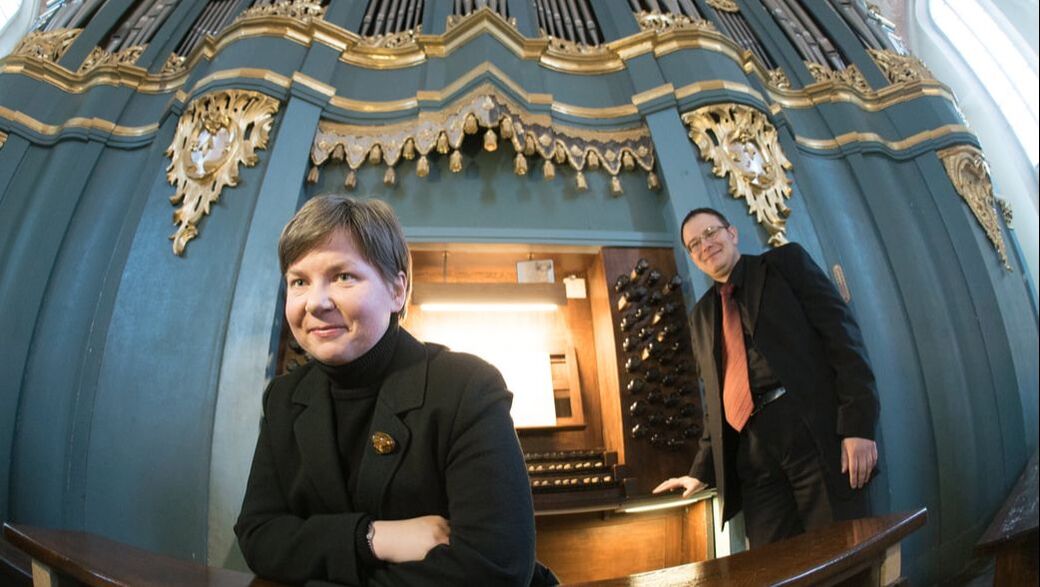 Photo by Edgaras Kurauskas Photo by Edgaras Kurauskas
Authors
Drs. Vidas Pinkevicius and Ausra Motuzaite-Pinkeviciene Organists of Vilnius University , creators of Secrets of Organ Playing. Our Hauptwerk Setup:

Categories
All
Archives
April 2024
|

 RSS Feed